
Ruby on Rails for a Dubai startup: where it still makes sense, and where it does not
Where Ruby on Rails still makes sense for a Dubai startup, UAE hiring realities, and when a founder should choose something else.
Read the articleWeb Services · Ecommerce
Shopify development in Dubai for sellers who want a hosted store without managing servers, set up with the payment gateways, delivery workflow and Arabic storefront a UAE audience actually needs, not left on generic defaults.
Shopify development in Dubai gets recommended by default more often than it should. Shopify is a genuinely good fit for a lot of UAE sellers, but the decision that actually matters happens before any theme is chosen: whether a hosted platform with an app driven feature set suits how this particular business sells, or whether a self hosted store, or something else entirely, is the honest answer. This page is about Shopify specifically, once that decision has been made, and the parts of a UAE build that a generic Shopify guide never covers: which payment routes actually work for a UAE registered company, how cash on delivery reconciles against what a courier collects, how delivery cost varies once an order leaves Dubai, and what a right to left Arabic storefront actually requires inside Shopify’s theme structure.
Shopify development sits under our wider website development work. For a platform agnostic look at building an online store, including tax invoices and platform comparison, see ecommerce solutions; for growing an existing store’s visibility, see ecommerce SEO.
The real decision
Shopify development in Dubai starts by being honest about fit, since the wrong platform choice is expensive to reverse once a catalogue and a year of orders are sitting inside it.
| Shopify tends to win when | A self hosted store tends to win when |
|---|---|
| You want to launch without managing a server, security patches or uptime yourself | You already run WordPress for content and want the store built into the same site |
| Your catalogue and checkout logic fit within what apps and Shopify’s own settings cover | Your pricing, bundling or checkout rules are unusual enough that an app cannot cleanly express them |
| You want a large, mature app catalogue for common features like reviews or subscriptions | You want full code level control over checkout, without app subscriptions stacking up |
| You are comfortable with Shopify’s own release cycle setting what changes and when | You want to control exactly when the platform itself changes underneath you |
Neither answer is better in the abstract. A boutique brand selling forty products with a handful of variants is usually well served by Shopify from day one. A business with rental bookings, trade pricing tiers or a large catalogue synced from an ERP system often needs more than Shopify’s app ecosystem comfortably provides. The honest test is not which platform sounds more capable, but which one your actual catalogue, team and integrations will still fit comfortably in two years from now, once the product range and the order volume have both grown.
Themes
Shopify development in Dubai usually starts with this choice, and it is a spending decision as much as a design one. An existing theme, configured within its own settings and sections, gets a store live faster and keeps ongoing changes inside what a shop owner can do without a developer. A custom Liquid theme, built specifically for the brand, earns its cost when the existing theme catalogue genuinely cannot deliver the layout, the bilingual behaviour or the product presentation the brand needs, not simply because a fully custom build sounds more serious.
The middle ground, an existing theme heavily customised with custom sections and blocks, covers most Dubai sellers well. It keeps Shopify’s own update path intact while still giving a brand a storefront that does not look like an unedited template.
Apps
An app that solves one problem well is one of Shopify’s real strengths. A checkout weighed down by a dozen small subscriptions is one of its real risks.
Most apps that add genuine functionality, reviews, subscriptions, advanced shipping rules, loyalty, carry their own ongoing subscription on top of your Shopify plan, billed separately and easy to lose track of.
An app that injects its own code into the storefront adds weight the same way any third party script does, which is why Shopify development in Dubai treats app choice as a performance decision, not only a features one.
Where an app only approximates what a business needs, and the gap causes real friction at checkout, a small custom build inside the theme or a Shopify Function can outperform three overlapping apps stacked together.
Before recommending an app, we check what it actually does that Shopify’s own settings do not already cover, and we review the store’s existing app list for overlap before adding another one, since Shopify development in Dubai regularly inherits stores carrying two or three apps doing variations of the same job.
Payments
Shopify’s own documentation lists the United Arab Emirates among the countries where Shopify Payments is available, which means a UAE registered business can, in principle, accept card payments through Shopify’s built in gateway without a separate merchant account from a third party provider. Whether that is the right route for a given store still depends on settlement currency, the card schemes and wallets your customers actually use, and how the account verification process fits your company’s documents.
Where a business chooses a third party gateway instead, whether for a specific wallet, a lower cost structure, or an existing merchant relationship, Shopify supports that too, and Shopify development in Dubai regularly wires in a gateway chosen for exactly those reasons rather than defaulting to Shopify’s own. One practical detail worth knowing in advance: Shopify applies its own additional transaction fee on orders processed through a gateway other than Shopify Payments, on top of that gateway’s own fee, so the true cost of a third party gateway is two fees stacked, not one.
Cash on delivery
Cash on delivery still accounts for a meaningful share of online orders across the UAE, and a Shopify store handles it as a manual payment method rather than through a card gateway: the order is confirmed without a card being charged, and payment is collected by the courier when the parcel arrives. The part that catches sellers out is not setting it up, which is straightforward, but reconciling it afterwards, since Shopify has no automatic way of knowing whether a courier actually collected the cash it was supposed to for a given order.
Shopify development in Dubai for a store offering cash on delivery should build that reconciliation step in from the start: a way to mark an order as collected once the courier confirms it, and a clear view of orders sitting unconfirmed for longer than expected, since those are the orders most likely to need a follow up call or a failed delivery resolved.
Delivery
A Dubai based store’s delivery cost is rarely one flat number, and Shopify’s own shipping settings need real input to reflect that.
Usually the fastest tier with the lowest delivery cost, and often where same day or next day delivery is realistic to promise, if your courier actually supports it.
Sharjah and Ajman sit close enough that transit time barely changes, but a courier’s price band often still differs from the Dubai rate.
Ras Al Khaimah, Fujairah, Umm Al Quwain and Al Ain add real distance, and a flat national rate here often either loses money on far deliveries or overcharges near ones.
Selling into the wider Gulf or further needs its own rate table and, usually, a different courier relationship entirely, covered separately below under Shopify Markets.
Shopify’s shipping settings can hold zone based rates, but somebody has to define the zones and the bands correctly for a UAE business first. Shopify development in Dubai should build these from your actual courier agreement, not a generic country wide default that treats a delivery to Dubai the same as one to Fujairah. Getting this wrong rarely shows up as a single obvious failure; it shows up slowly, as thinner margins on distant orders that nobody has actually reviewed against the real courier invoice.
Arabic
Shopify’s own theme documentation describes locale files, JSON files that hold the translated text strings a theme uses, as the mechanism for adding another language to a storefront. That covers translated words. It does not, on its own, cover a genuinely right to left storefront: mirrored navigation, a checkout that flows correctly for an Arabic reader, product cards and filters that behave properly in a right to left grid, and Arabic typography chosen for legibility rather than left as a Latin fallback font.
This is the gap that produces the Shopify stores that look Arabic but read as a translated English site to a Dubai shopper. Shopify development in Dubai for a genuinely bilingual store treats the Arabic version as a template requirement from the start of the theme build, the same discipline covered in depth on our Arabic website development page, applied specifically inside Shopify’s section and locale structure rather than assumed to happen automatically.
Migrating
A migration is won or lost on what happens to the data and the URLs, not on how quickly the new theme looks finished.
Products, variants, images, customer records and order history are exported from the current platform and mapped field by field onto Shopify’s structure, since the two rarely match one to one.
The migration runs on a Shopify store not yet connected to your domain, so the catalogue, pricing and Arabic content can be checked in full before anything goes live.
Every existing product, category and content URL is mapped to its new Shopify address with a permanent redirect, so search rankings, bookmarks and shared links keep working.
Payment gateways, delivery zones, tax settings and analytics are reconfigured and tested with real test orders before the switch, not discovered missing on the first live sale.
The domain is pointed at the new Shopify store, the old platform is kept accessible but not public for a period, and orders, redirects and search visibility are watched closely in the first weeks.
Ownership
This question deserves a straight answer before a project starts, not after a business has three years of orders sitting inside the platform.
| Yours, and exportable | Built on Shopify’s platform |
|---|---|
| Your domain name and DNS | The storefront theme’s Liquid code and structure |
| Your product catalogue, exportable to a spreadsheet | App configuration and any app specific data |
| Your customer list and order history, exportable | Checkout customisation, which is limited to what Shopify’s checkout allows |
| Your product photography and written content | Custom Shopify Functions or backend logic built on Shopify’s APIs |
Leaving Shopify later means your business data comes with you, but the storefront itself has to be rebuilt on whatever you move to. That trade off is worth understanding at the start of Shopify development in Dubai, not discovering three years into running the store.
Selling further
Shopify’s Markets feature lets a single store present different currencies, and where configured, different languages, to different regions from one underlying product catalogue.
Prices can be set or adjusted per market rather than relying on a single automatic currency conversion, which matters once a UAE brand starts shipping into other Gulf countries.
Stock, orders and reporting stay in one place even as the storefront presents differently by region, which is the main practical advantage over running entirely separate stores.
Markets is a genuine feature worth using for a UAE brand with real demand beyond the Emirates. It is not, on its own, a substitute for the Arabic storefront work above; a market configured for Arabic still needs the same right to left template work described earlier.
Performance
Shopify hosts the platform, which removes a whole category of speed problems. It does not remove every one of them.
Server infrastructure, checkout security and uptime sit with Shopify, which is one of the platform’s genuine strengths for a UAE seller without an in house engineering team.
Theme weight, image sizing, and how many apps inject their own scripts into the storefront remain entirely within the store owner’s control, and are usually where a slow Shopify store is actually losing time.
The same principles covered on our website speed optimisation page, Core Web Vitals measured from real visits rather than a single test, apply directly to a Shopify storefront, image heavy product pages in particular.
Checkout
Shopify’s hosted checkout is one of the platform’s strongest selling points and also one of its firmest boundaries. It is fast, it is tested at a scale no small development team could match, and PCI compliance for card data sits with Shopify rather than becoming the store owner’s responsibility. The trade off is customisation: on most Shopify plans, checkout page layout, field order and branding can be adjusted within Shopify’s own settings and, on higher plans, with checkout extensions, but the underlying checkout flow itself is not open to a full rebuild the way a self hosted store’s checkout is.
For most Dubai sellers this trade off works in their favour, since a tested, secure checkout matters more than a fully bespoke one. Shopify development in Dubai flags the exception early: a business whose checkout genuinely needs a step, a field or a rule that Shopify’s checkout cannot express is better served knowing that before the project starts, not after the storefront is built.
Catalogue
A Shopify catalogue that grows without structure becomes hard to browse and harder to filter, which shows up first in a rising bounce rate on category pages and only later gets noticed as a data problem. Variants, size, colour, material, handle genuine product options well, but they are not the right tool for every distinction; overloading variants to express things like collection or season tends to produce a bloated, confusing product editor rather than a useful filter for shoppers.
Metafields are the better tool for structured detail a product needs beyond its core variants: care instructions, material composition, compatibility, or the kind of specification table a considered purchase in the UAE market often needs before a shopper commits. Setting metafields up properly at the start of Shopify development in Dubai, rather than retrofitting them once a catalogue has grown to hundreds of products, saves far more time than it costs on day one.
Tracking
A store without reliable tracking cannot tell a good product page from a bad one, and Shopify’s own reporting only covers part of that picture.
Purchase, add to cart and checkout events connected properly, so campaign performance can be judged by actual revenue rather than clicks alone.
Meta, Google and any other advertising pixels configured to fire on the right events, without duplicating or under counting purchases, a common fault on stores with several apps each adding their own tracking.
Tracking configured to respect a visitor’s consent choice rather than firing regardless, which matters for both compliance and for trusting the numbers the store reports.
This work overlaps closely with our web analytics service, and Shopify development in Dubai for a new store should treat analytics setup as part of launch, not a task added weeks after the store is already taking orders.
Growing sales
Not every Shopify store is a straightforward single purchase catalogue. A growing number of Dubai sellers want a subscription option for repeat purchase products, or a separate wholesale or trade channel alongside their retail store, and Shopify’s app ecosystem covers both reasonably well for common cases. Subscription apps handle recurring billing and customer self management; wholesale can run through a dedicated business channel or through customer tagging and tiered pricing within the main store, depending on how separated the two audiences need to be.
Where these models get complicated is at the edges: a subscription with irregular delivery intervals, or wholesale pricing tied to a customer’s specific negotiated terms rather than a fixed tier, which is where a generic app most often runs out of road. Shopify development in Dubai should be honest about where an app comfortably covers this and where it starts to strain, since forcing an unusual pricing model into an app built for a simpler case is a common source of ongoing support headaches. Being told that plainly before a project starts, rather than discovering it after launch, is usually worth more to a growing UAE seller than an optimistic answer would have been. We would rather turn down a poor fit for Shopify at the brief stage than hand over a store that fights the business model it was supposed to support.
Handover
A Shopify store handed over without proper training tends to stay exactly as it was on launch day, because nobody on the team is confident enough to touch it.
A recorded, practical walkthrough of adding products, running a discount, processing an order and issuing a refund, kept as a reference your team can return to.
Training on the specific sections and blocks built into your theme, so homepage and campaign changes do not need a developer for routine updates.
A clear list of every app, gateway and integration connected to the store, with admin access handed over rather than left in a developer’s own account.
A period after go live for questions and small fixes as your team gets used to running the store day to day.
Mobile
Most visits to a Dubai online store now arrive on a phone, and Shopify’s default themes are built mobile responsive from the start, which removes one worry a self built store often has to solve from scratch. Responsive is not the same as genuinely well suited to mobile shopping, though. A product gallery that needs precise taps to swipe, a filter panel designed for a wide screen and squeezed into a narrow one, or checkout fields sized for a mouse rather than a thumb, all still show up on a technically responsive Shopify theme.
Shopify development in Dubai should test the actual buying path, browse, filter, add to cart, checkout, on a real phone before launch, not only check that the layout resizes correctly. The two are different tests, and only one of them tells you whether a real customer can comfortably complete a purchase on the device most of them are actually using.
Search
Shopify handles the technical foundations reasonably well by default, which shifts the real work onto structure and content, not plumbing.
Shopify’s default product and collection URL patterns are workable but somewhat rigid compared with a fully custom build. Getting handles right from the start avoids messy redirects later.
A collection page with genuine introductory content and clear filtering tends to rank and convert far better than a bare product grid with a heading pasted above it.
Filter and sort parameters can generate large numbers of near duplicate URLs on a bigger catalogue, which needs deliberate handling rather than being left to accumulate.
This page covers what Shopify development in Dubai should get right structurally from the outset. Ongoing keyword and content work for an online store, including how category and product pages should be prioritised, is covered on our ecommerce SEO page.
Returns
Return handling is easy to leave as an afterthought during a Shopify build, and it is usually the first thing a customer tests when something goes wrong with an order. A policy that exists only as a page nobody reads is not the same as a working process: Shopify’s own order management can track a return or exchange, but the courier collection, the refund timing, and how a cash on delivery order gets refunded when no card payment was ever taken all need a defined answer before the first return actually happens.
Shopify development in Dubai should treat the return path with the same care as the purchase path, since a smooth return is one of the stronger trust signals an online store can offer, and a clumsy one is remembered far longer than a smooth checkout is.
Common mistakes
| What we find | What it actually costs the business |
|---|---|
| Three overlapping apps doing variations of the same job | Recurring subscriptions stacking up, and a slower storefront than the store needs |
| Arabic pages translated but left in a left to right layout | An Arabic visitor reads a site that looks unfinished, undermining trust at the worst moment |
| Cash on delivery offered with no reconciliation process | Nobody can say with confidence which COD orders were actually paid |
| One flat delivery rate across every emirate | Either losing money on distant deliveries or overcharging nearby ones |
| A gateway chosen for its brand name rather than its fee stack | An avoidable extra transaction fee on every single order |
Content
Shopify development in Dubai can build a technically excellent store around product content that is not ready, and the gap shows up immediately once real customers arrive. Product photography shot inconsistently between batches, descriptions copied from a supplier’s own catalogue in another market, or an Arabic version treated as a lower priority than the English one, all undercut a store that otherwise works well. This is not a criticism of any one business; it is simply where product content most often falls behind the build schedule, because photography and copywriting usually sit with a different team or supplier than the website project itself.
Building the store’s information architecture, categories, filters, metafields, around content that does not exist yet is possible, but it means guessing at structure that content should really be driving. Where content is not ready, Shopify development in Dubai works better sequenced around it: structure agreed early, content produced in parallel, and the store populated once both are ready rather than launched with placeholder text that quietly becomes permanent.
Security
Running an online store carries real fraud and data risk, and it is worth being clear about where that responsibility actually sits on Shopify.
Card data security, PCI compliance for the checkout itself, and the underlying platform’s infrastructure security sit with Shopify as the hosted provider, which removes a genuinely difficult responsibility from a small team.
Order level fraud review, staff account access and permissions, app vetting before installation, and how customer data is used outside Shopify’s own systems remain decisions the business has to make and manage itself.
Shopify offers built in fraud analysis flags on orders, which is a useful signal rather than a decision, particularly relevant for a store also accepting cash on delivery, where a flagged order is worth a second look before it ships. We are not a security certification body, and any specific compliance requirement your business has beyond what Shopify itself provides should be confirmed with your own advisor. This is a practical description of where responsibility sits on the platform, not a legal opinion, and any regulatory question specific to your industry deserves its own qualified advice.
Beyond launch
The build is the easier half of Shopify development in Dubai to plan for, because it has a defined end point. What happens after launch is where a store either keeps improving or slowly drifts: new products added without the same care as the original catalogue, seasonal campaigns bolting on yet another app, and the Arabic version quietly falling a page or two behind the English one as new content gets added. None of this happens through neglect; it happens because nobody owns keeping the two in step once the original project team moves on.
A short standing arrangement, even a modest one, covering periodic app and performance review, catalogue structure checks, and confirming Arabic content is keeping pace, tends to be the difference between a store that still looks deliberate a year after launch and one that has visibly drifted. It does not need to be a large undertaking to be effective; a short quarterly check against the points below usually catches drift long before a customer ever notices it. This does not need to be extensive to be worthwhile; it needs to be scheduled, rather than left to whenever someone happens to notice a problem.
Getting started
Product count, variants, and whether the range is stable or changes often, so we can judge how much of the build should be app based versus custom.
Your current or planned payment gateway, whether cash on delivery matters, your delivery zones, and whether Arabic is required from launch or added later.
If your existing store lives on another platform, tell us that too. Migration planning starts on day one of Shopify development in Dubai, not as an afterthought once the new store is already built.
Selected work

E-commerce · Retail · Dubai
A Dubai floral boutique on WooCommerce, built around a fast checkout for a gift driven market.
thegorgeousflower.com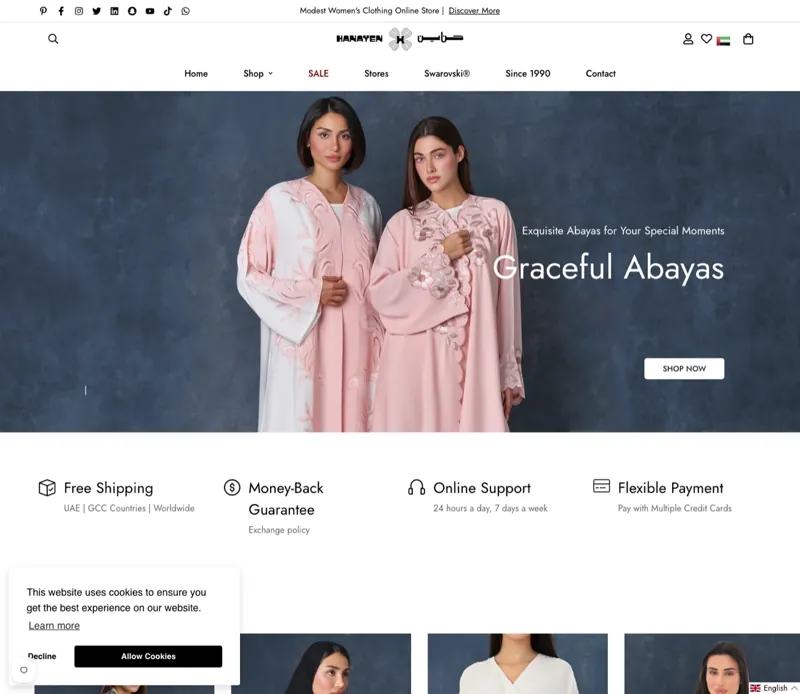
E-commerce · Fashion · Dubai
A Dubai luxury abaya house trading since 1990, carrying its craftsmanship into a quick mobile checkout.
hanayen.com
E-commerce · Fashion · UAE
A sustainable clothing label whose customers shop on a phone and expect the store to feel considered.
egosustainable.comFrom the blog

Where Ruby on Rails still makes sense for a Dubai startup, UAE hiring realities, and when a founder should choose something else.
Read the article
Choosing a CMS for a UAE business by who edits it, what it integrates with and who maintains it, not by which platform sounds most impressive.
Read the article
Laravel against WordPress for a Dubai business: where a content site ends, an application begins, and what happens when WordPress is pushed past that line.
Read the articleStraight answers
Neither wins every time. Shopify suits a seller who wants a hosted platform with little server management and a large app catalogue for common features. WooCommerce suits a business that already runs on WordPress, wants full control over checkout and data, or has product logic an app cannot cover cleanly. We recommend based on your catalogue, your team and your integrations, not a default answer.
Yes. Cash on delivery is set up as a manual payment method rather than through a card gateway, and Shopify development in Dubai for a store offering it also covers how those orders reconcile against what a courier actually collects, since that gap is where COD problems usually start.
Yes, though it needs deliberate template work rather than a toggle. Shopify's theme structure holds translated text in locale files, but right to left layout, mirrored navigation and Arabic typography are template level decisions we build in, not something Shopify switches on automatically.
Yes, products, customers, order history and content can be migrated where the platforms support it, and every existing product and category URL is redirected to its new Shopify address so search rankings and saved links are not lost.
Your products, customer data, order history and domain are yours and exportable. The storefront theme and app configuration are built on Shopify's platform, so moving away later means rebuilding the storefront elsewhere, even though your underlying business data comes with you.
You receive a fixed written quote scoped to your brief within 45 minutes during business hours, with no obligation. The main factors are catalogue size, custom theme work against an existing theme, the number of apps and integrations, and whether Arabic is included from launch.
Sources
Fixed price, in writing
Got it. Your quote is being written now.
In business hours you will have it within 45 minutes. Check your inbox for the confirmation.