
Contrast and readable text
Colour contrast that meets AA thresholds, resizable text that does not break the layout, and body copy set at a size that does not need zooming to read comfortably.
Web Design by Industry
A government or semi government website in Dubai has to work for every resident, including someone using a screen reader or an older device, and hold up to a stricter accessibility and content standard than a typical business site. We build with that standard as the starting point, not an afterthought.
A government or public sector website in Dubai carries a different kind of pressure to a business site. Visitors range from a fluent English speaker on the latest phone to an elderly resident using a screen reader on an older browser, and both need to reach the same service page without friction. Government website design in Dubai has to treat accessibility, clarity and bilingual content as requirements from the first wireframe, not improvements added after launch.
This page sits under our wider web design by industry work. For the build itself see website development, and for structured content and navigation see UI and UX design.
A public sector project in Dubai rarely means a single ministry commissioning a single site. It more often means an authority, a regulator, a government owned corporation or a semi government entity with its own board and its own idea of what counts as government grade quality. Government website design in Dubai has to flex for that range: an authority working to a federal accessibility policy sits under a different set of obligations to a semi government company that behaves commercially but still carries the public’s expectation of accurate, current information.
The person approving a government website brief in Dubai is rarely the person who will publish to it day to day. On an authority or a larger semi government body it is usually a director of communications or a head of digital services, working alongside an IT or information security lead who has to sign off hosting, data handling and access control before anything reaches a review committee. On a smaller semi government entity, the decision often sits with a general manager who answers personally to a board for how the organisation presents itself in public.
Whoever holds the brief is measured on service uptake and public trust rather than on how a homepage looks in a pitch. In a first meeting they will typically ask whether the site can meet the accessibility standard their organisation has already committed to, whether it can support formal procurement and vendor onboarding rather than a simple invoice, and whether content can be spread across several departments without one team’s mistake appearing under the whole organisation’s name. A brief that answers those three questions early moves through internal review far faster than one that leaves them for later.
Accessibility
The UAE Design System’s own accessibility guideline for federal government websites instructs entities to meet WCAG 2.1 at the AA level, and public sector sites in Dubai are increasingly held to the same bar.
Colour contrast that meets AA thresholds, resizable text that does not break the layout, and body copy set at a size that does not need zooming to read comfortably.
Every interactive element reachable and usable without a mouse, with labels and heading structure that make sense when read aloud rather than only when seen.
Pages that stay usable on a slower connection or an older phone, since a public service site cannot assume everyone has the newest hardware.
Beyond the checklist
The design system’s guideline goes further than a single pass or fail test, and the points below shape how we build rather than how we audit at the end.
Labels and structure that work with the voice over tools residents already carry on their own devices, rather than assuming everyone will install something new to use a government page.
Video published on a government site needs captions a viewer can turn on or off and read in their chosen language, not captions burned permanently into the footage.
The UAE’s National Digital Accessibility Policy names the elderly and people of determination directly, so testing at larger zoom levels and with keyboard only navigation is part of every build, not an optional extra. See our accessibility guide for how we approach this across the site.
Bilingual content
Government website design in Dubai for a bilingual audience means neither language is treated as the master copy with the other bolted on. Arabic content needs its own right to left layout, its own navigation labels written naturally rather than translated word for word, and its own review by someone fluent in Arabic before publishing.
This matters more on a government site than almost anywhere else, since a resident applying for a permit or a service needs to trust that the Arabic page says exactly what the English page says, with no gap in meaning between the two.
On most private sites, Arabic can reasonably be treated as a second language for a mostly English speaking audience. On a public sector site in Dubai, that assumption does not hold. A meaningful share of residents will approach a government service in Arabic first, and a citizen or resident dealing with an official matter expects the Arabic page to carry the same weight, and the same legal precision, as the English one, not a lighter summary written to keep translation costs down.
In practice this means budgeting real time for Arabic review of anything that describes a rule, a fee or a deadline, rather than running the English copy through a translation tool and calling the job done. Where a service page changes on the English side, the Arabic version needs updating in the same release, not weeks later, since a resident comparing both language versions of a genuinely public document will notice a gap quickly and trust the organisation less because of it.
Services and forms
A public sector website in Dubai is judged on whether a resident can find the right service and complete it, not on how the homepage looks. Government website design works best when each service, whether a permit, a licence renewal or an enquiry, has its own page explaining who it is for, what is needed, and what happens after submission.
Forms need the same care. Clear steps, plain error messages, and validation that catches a mistake before submission rather than after, reduce the number of residents who give up partway through or call a helpline that a clearer form could have avoided.
Beyond the service list
A handful of page types come up on almost every public sector brief we take on, whichever department or authority is asking.
A structured, searchable place for reports, circulars, statistics and downloadable datasets, rather than a folder of PDFs added to a news page as an afterthought.
A dedicated section listing open opportunities and closing dates, usually linking through to the organisation’s actual procurement platform rather than duplicating it.
Who does what, and which team owns a given service, laid out so a resident or a journalist can find the right contact without calling a general switchboard.
Dated announcements a resident or business can trust to be current, with an archive that keeps older notices findable rather than deleted outright.
A short page stating the accessibility standard the site is built to and how to report a problem, itself part of what the UAE Design System expects of a well built government page.
Where an authority gathers feedback on a policy or a development before it is finalised, a page explaining the consultation, the deadline and how a response is used, kept separate from a general contact form.
The visitor’s journey
Almost every visit to a public sector site in Dubai starts with one of a small number of jobs: find out whether a service applies to them, work out what to bring or submit, complete a transaction or form, or check the status of something already submitted. Government website design in Dubai works best when the site is built around that short list, rather than around the organisation’s own department structure, which a resident has no reason to understand.
The point most public sector sites lose a visitor is between reading about a service and actually starting it. A page that explains a permit in detail but buries the apply action several clicks down, or hands the visitor to a generic contact form instead of the actual service, reads as a dead end to someone who has already decided to act and just needs the page to get out of the way.
A resident who cannot complete a service online will call, visit in person, or give up. None of those outcomes cost the organisation less than getting the form right the first time.
Open data
The UAE runs an established open government data programme, and Dubai’s own Data Dubai portal publishes datasets and statistics from dozens of Dubai government entities, each refreshed on a schedule the owning entity controls rather than a single fixed cycle. A public sector website in Dubai increasingly needs to decide where it sits relative to that wider ecosystem: whether it publishes its own datasets directly, whether it points to the entity’s own listing on the citywide portal, or both.
Either way, an open data or publications section needs the same basic discipline as any other content on the site: a clear owner for each dataset or report, a visible date showing when it was last updated, and a consistent file format so a resident, researcher or journalist downloading a report this year gets the same structure as one downloaded last year. This is not legal advice on what a given entity is obliged to publish, since that depends on the entity’s own mandate and any sector specific rules, and should be confirmed internally or with the relevant authority.
Multiple departments
Larger public sector organisations often have several teams publishing to the same site, which can drift into inconsistent tone and structure without a shared system. Government website design in Dubai for a multi department organisation has to solve for that drift from day one.
Reusable page sections and templates so a new service page follows the same pattern as an existing one, whichever department writes it.
Department editors publish to their own section, with a smaller review group able to check anything before it goes live under the organisation’s name.
Our content management system page covers how we choose and configure the platform this kind of role based workflow runs on.
Working with existing systems
Very few public sector websites work in isolation, and naming the systems that usually sit behind one helps a brief move faster.
Where a service needs a verified identity rather than a simple enquiry, the site links out to the identity provider the organisation already uses rather than building its own login system from scratch.
Permit fees, licence renewals or other charges usually route through a payment gateway the finance team already has in place, connected to rather than rebuilt inside the website.
Where a service request needs a reference number and a status a resident can check later, the website’s job is usually to submit cleanly into an existing case management system, not to become one.
Many residents expect a status update by SMS or WhatsApp rather than email alone, so notification triggers are planned alongside the form itself, not added afterwards.
A government or semi government website project in Dubai is rarely bought the way a private business buys one. Dubai’s own government tendering framework, published on the Dubai government procurement page, describes a system where bid invitations from around forty major Dubai government entities are published through official platforms such as eSupply and iSupplier, and suppliers must register on the relevant platform before they can bid at all. Government website design in Dubai for an entity operating under that framework usually means the project starts with a formal tender or request for proposal, not a quote sent by email.
For a semi government entity or a smaller authority, the route can be lighter: a direct appointment against an internal procurement policy, a closed request for proposal sent to a shortlist of vendors, or a framework agreement already in place with a panel of suppliers. What stays constant across both routes is that the buying process itself, vendor registration, trade licence and insurance documents, references, and sometimes a security questionnaire, needs to be scoped and timed into the project plan alongside the design and build work, since it frequently takes longer than the build itself. Accessibility compliance increasingly appears as a stated requirement inside these procurement documents, which is one more reason it needs to be part of the proposal, not a promise made afterwards.
Two buying routes
Neither route is better than the other, but each shapes the project timeline differently.
| Formal tender or open procurement | Direct or framework appointment |
|---|---|
| Published through eSupply, iSupplier or a similar platform | Agreed directly against an internal procurement policy |
| Supplier registration and documents required before bidding | Documents exchanged as part of the appointment itself |
| A formal award and scope sign off before work starts | A written proposal and purchase order can move faster |
| Common for larger authorities and government departments | Common for smaller semi government entities and companies |
Security and hosting
A public sector site is expected to hold up to more scrutiny than a typical brochure site, even where it carries no sensitive personal data itself. Security and hosting are treated as core to government website design in Dubai from the outset, not as a late addition once the visual design is already approved.
Many public sector entities have a preference, or a formal requirement, for hosting inside the UAE, which needs confirming early since it shapes the hosting provider and architecture from the outset.
Larger public sector projects often require an independent security review before go live, which needs scheduling into the project timeline rather than treated as a final week formality.
Role based access so a department can publish to its own section without being able to alter another team’s content or the organisation’s core settings.
We do not claim a security certification we do not hold. Where an entity’s procurement process requires a specific standard or an independent audit, that is scoped and sourced as part of the proposal, not assumed.
Trust and tone
A government website’s writing carries more weight than most, since residents assume it is accurate and current in a way they might not assume of a business site.
| Do | Avoid |
|---|---|
| Plain language, short sentences, active voice | Legal or internal jargon copied straight from a policy document |
| A visible date showing when a page was last checked | Outdated fees, deadlines or contact details left unchecked |
| One clear next step per page | Several competing calls to action on the same page |
Content should be reviewed on a set schedule by the department that owns it, since a wrong deadline on a government page carries more consequence than the same mistake on a shop website. Getting this tone right is as much a part of government website design in Dubai as the accessibility and layout work that comes before it.
Ongoing ownership
A public sector site is never really finished at launch. Fee schedules, opening hours, appointment availability, circulars and public notices all change on their own timetable, and each one needs a genuine owner inside the organisation who is expected to update it, not a shared inbox nobody checks. Government website design in Dubai holds up best when that ownership is written into the brief from the start, department by department, rather than assumed to sort itself out after launch.
Where several departments publish independently, a lightweight approval step for anything time sensitive, a fee change or a public notice, catches the kind of error that a resident notices immediately and an internal team might miss for weeks.
Search behaviour
A resident researching a service and a resident ready to act on it type very different things into a search bar.
| Research stage search | Ready to act search |
|---|---|
| What documents do I need for a permit or licence | Service name, apply online Dubai |
| Which authority handles a type of request | Authority name, service status check |
| Authority name, fees or charges | Authority name, contact number or nearest office |
The first column needs content that explains a service in plain language and points to the right authority. The second column needs the actual transaction page to load quickly and rank on its own, not buried under a general services listing. Our SEO services work plans a site’s structure around both.
Government website design in Dubai moves fastest when each department hands over its own part of the brief in writing, rather than one communications officer trying to reconstruct all of it secondhand. In practice, three things go missing most often. The first is a genuinely current service list with the right owner named against each one, since organisational charts drift out of date faster than anyone expects. The second is plain language versions of policy text, since most source material arrives written for compliance rather than for a resident trying to understand what to do next. The third is a clear answer on what the Arabic version of the site is allowed to say differently, if anything, since departments rarely agree this in advance and it becomes a bottleneck once translation is underway.
Photography and imagery are a smaller but recurring gap too. A generic stock image of a handshake or a skyline does less for a public sector site than a genuine photograph of the service counter, building or team a resident will actually encounter, and gathering that early avoids a late scramble before launch.
Getting started
A clear brief on the points below lets government website design in Dubai move quickly once content ownership across departments is settled.
Every service or content section the site needs to cover, with the department or team that owns each one.
Any internal brand or accessibility guidelines already in place, so we build within them rather than creating a conflicting standard.
Whether Arabic content already exists to translate and review, or needs writing from scratch alongside the English version.
Which services need a form, and whether any of them need to connect to an internal system we should scope separately.
Phasing the build
Launching every service and every integration at once usually slows a public sector project down rather than speeding it up.
Core service pages, the department directory, an accessibility statement, a working enquiry or application form, and Arabic content for the highest traffic services.
Deeper integration with an internal case management or payment system, a full open data library, and Arabic content extended across every remaining page.
Any integration that depends on a system still being procured or replaced is better scoped once that system is confirmed, rather than built against a moving target.
What we still see
Most of these are fixable without a full rebuild, but they are worth naming plainly.
A number nobody has checked in months, discovered by a resident who then loses trust in every other figure on the site.
Passing a one time audit and then shipping new pages that are never checked against the same standard again.
An English original with an Arabic homepage and little else, which reads as the second language being an afterthought.
A resident who submits something and receives no acknowledgement assumes it failed, and calls or visits in person instead.
A service explained only through a downloadable PDF that is slow on a poor connection and hard for a screen reader to navigate cleanly.
Each team’s section looking like a different website, which undermines the trust a single, consistent public sector site is meant to build.
The public sector organisations we work with rarely judge a website by traffic alone. What tends to matter is whether a resident can complete a service online without calling or visiting in person, whether the accessibility statement reflects reality rather than an aspiration, and whether Arabic content keeps pace with English rather than trailing behind it. None of these are numbers we can promise in advance, since they depend on the service itself and the organisation’s own follow up process as much as the website, but they are the right things to track once a site is live, and we set up analytics against service completion and form submission rather than page views alone.
A useful supporting measure, often overlooked, is the volume of calls and in person visits for something the website already explains. A drop in that volume after a service page or a form goes live is a genuine sign the site is doing its job, and it is worth agreeing with the relevant department before launch how that baseline will actually be tracked, since it rarely happens automatically without someone deciding to record it. Where a call centre or a front desk already logs the reason for each enquiry, comparing that log before and after a page or form ships is usually more revealing than any analytics dashboard on its own, since it shows whether the website actually changed a resident’s behaviour rather than simply attracting more visits.
A launch date is a poor way to judge a public sector website, since the real test is what the site looks like a year later. On the organisations we see manage this well, ownership sits with named individuals rather than a generic department, a communications officer for news and circulars, a permits team for service page accuracy, an IT lead for anything touching an integration or a login. Each of those owners knows roughly how often their section needs a look, weekly for notices, monthly for fee and service pages, and immediately for anything a resident could act on incorrectly if it were wrong.
What tends to fail is the handover moment, where the agency that built the site moves on and no internal process replaces the discipline that existed during the project. We plan editorial roles and a review cadence into the brief itself, and train the actual people who will publish, not only the person who signed off the contract, so the site does not quietly drift once the project is formally closed.
Government branding rules
Public sector organisations in the UAE frequently operate under a corporate identity manual, whether their own or one set by a parent authority, and a website is one more surface that manual applies to.
Government and semi government logos usually carry strict placement and clear space rules, since the mark is meant to be instantly recognisable and consistently presented across every touchpoint.
Where a corporate identity manual specifies colours and typefaces, the website’s design system is built to match it rather than introduce a parallel brand of its own.
Where an entity sits under a larger authority or holding structure, a resident moving between related sites benefits from a family resemblance rather than each one looking like an unrelated organisation.
Very few government website design in Dubai projects start from a blank domain. Most begin with an existing site, sometimes years old, carrying URLs that residents, other government entities and search engines already link to, and sometimes documents or forms embedded in ways that are difficult to extract cleanly. Treating that history carefully matters more on a public sector site than almost anywhere else, since a resident who bookmarked a permit page two years ago should not land on a broken link after a redesign.
A careful migration means mapping the old site’s structure before touching the new one, deciding which URLs need a permanent redirect rather than simply disappearing, and auditing existing PDFs and downloads for content that should become a proper page rather than being carried over as another static file. None of this is glamorous work, but a public sector migration that ignores it tends to generate a wave of broken link complaints in the weeks after launch, at exactly the moment the new site is trying to build trust. Getting this stage right is an unglamorous but genuine part of government website design in Dubai, and skipping it rarely saves the time it appears to.
Mobile use
A large share of visits to a public sector site in Dubai now happen on a phone, often between other tasks rather than at a desk with time to spare. Mobile behaviour like this shapes government website design in Dubai as much as the desktop layout most internal reviewers actually look at.
Long dropdown lists, tiny tap targets and multi column layouts that only make sense on a desktop all cause a resident to abandon a form on a phone, so mobile is the primary layout we design for, not an afterthought.
A resident checking a service status while out and about is often on mobile data rather than home wifi, so page weight and loading speed are tested under those conditions, not only on a fast office connection.
Where a service needs a document uploaded, the form should accept a photo taken on the spot, with clear guidance on file size and format, rather than assuming every resident has a scanner at home.
Not every part of a public sector interaction belongs on a public website, and government website design in Dubai has to be deliberate about where the site’s job ends and a secure internal channel begins. A public enquiry or service request form should collect only what is needed to identify the request and start a conversation, an Emirates ID number for verification where a service genuinely requires it, rather than a broader set of sensitive personal or financial details that belong in a properly secured system with its own access controls.
Where a service does need to collect something sensitive, that step is usually better handled after a resident has been verified through a proper identity or payment channel, not on the first public facing form. Agreeing this boundary in writing before a build starts avoids a common late stage disagreement, where a department wants to collect more on the public form than the website’s security posture can reasonably support.
It is easy to assume a government website does not need to compete for search visibility the way a business does, since residents are expected to already know where to look. In practice, most residents still start with a search engine rather than typing a government domain from memory, and a service page that does not rank for the plain language version of what a resident is searching for sends that traffic to a third party summary, a news article, or worse, an unofficial site repeating outdated information. Clear page titles, one purpose per page, and content written in the words a resident actually uses rather than the department’s internal terminology all help a genuine government page win that search result instead of losing it to something less accurate.
Related industries
See our pages for education website design, healthcare website design, and security company website design, or where a resident facing service needs its own app rather than only a website, our mobile app development page.
Selected work
Work across sectors, with the closest to this industry shown first. Every one is a live site, not a mockup.
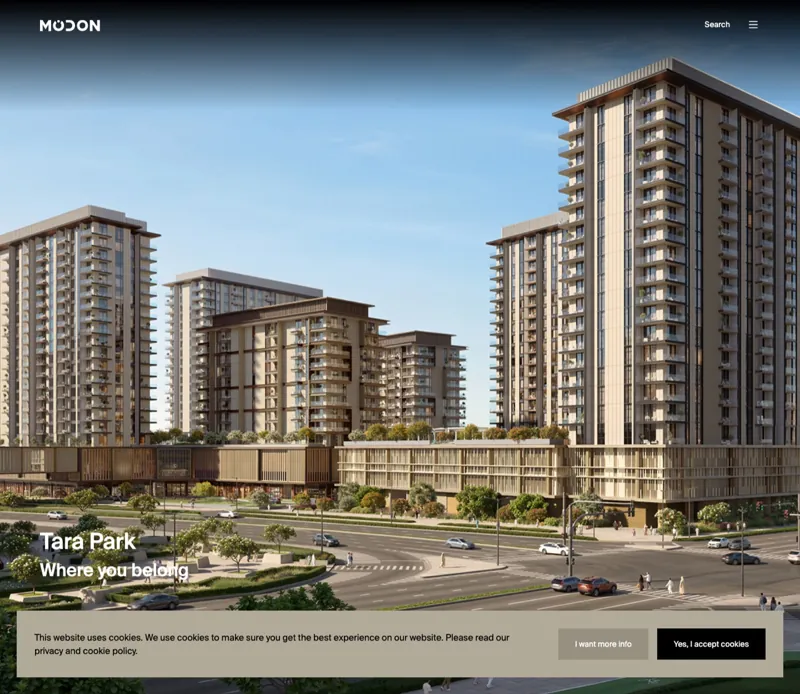
Website · Property development · Abu Dhabi
An ADX listed holding company building master planned communities, with a site that holds investors and residents at once.
modon.com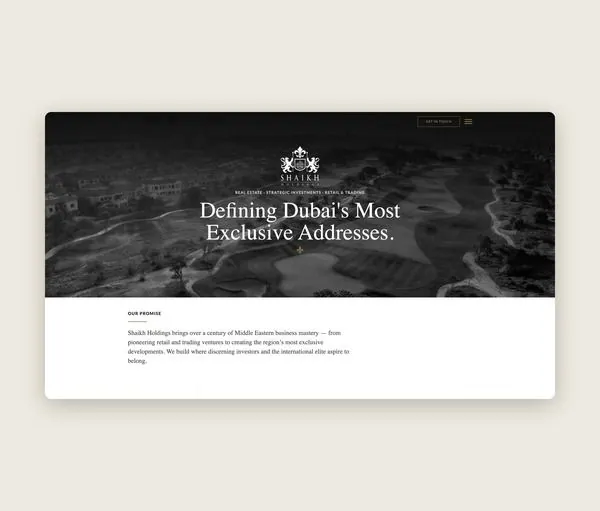
Website · Corporate · Dubai
A Dubai investment house with a century of business behind it. The site speaks to institutional investors, not shoppers.
shaikhholdings.com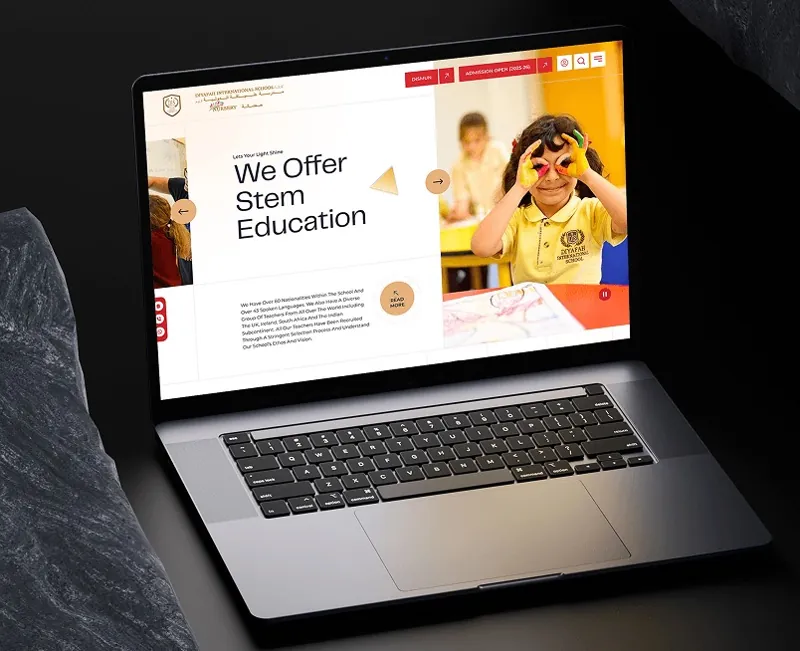
Website · Education · Dubai
One of Dubai's most diverse schools, 2,400+ students and 40+ nationalities, connected across campuses.
aldiyafah.comStraight answers
We work with semi government bodies, authorities and organisations that need a public facing website built to a government grade standard, alongside private businesses. Formal federal government procurement usually runs through its own vendor process, which we are open about before any conversation goes further.
WCAG 2.1 at the AA level, the same benchmark the UAE's own design system references for federal government websites. That covers things like colour contrast, keyboard navigation, readable focus states and proper labelling for screen readers.
Yes, structured forms with clear steps and validation work well for permit applications, enquiries or service requests. Where a form has to connect to an internal system, we scope that integration separately once we understand what the system can accept.
For most public sector sites in Dubai, Arabic and English are treated as equal, not as a primary language with a translated afterthought. We build the site so either language can be the entry point, with content genuinely written or reviewed in Arabic, not machine translated.
Through user roles and an editorial workflow so different teams can publish to their own section without needing a developer, while a smaller group reviews anything going out under the organisation's name.
Sources
Fixed price, in writing
Got it. Your quote is being written now.
In business hours you will have it within 45 minutes. Check your inbox for the confirmation.