
A portfolio, the base of Dubai construction website design
Sector, scope, value band where you can disclose it, and completion date, not just a photo gallery with no context attached.
Web Design by Industry
Construction website design in Dubai for contractors, developers and fit out companies: a project portfolio that proves capability, a tender document library, and a site built to be checked by a procurement team.
A contractor or developer bidding for work in Dubai is judged before a proposal is even opened. A procurement team checks the website first, looking for evidence of relevant project experience, current certifications and a company that looks capable of delivering at the scale being tendered. Construction website design in Dubai has to hold up to that kind of scrutiny, not just look presentable to a casual visitor.
This sits alongside our broader web design and website development work. The detail here is specific to contractors, developers and fit out companies rather than a general services template.
What the site has to do
A procurement reviewer looks for specific evidence, so construction website design in Dubai should be built around what they actually check.
Sector, scope, value band where you can disclose it, and completion date, not just a photo gallery with no context attached.
A structured, sometimes restricted area for drawings, specifications and bid packs that a procurement team can access without emailing back and forth.
Health and safety accreditations, quality certifications and any relevant licences, stated accurately and ready to be checked.
Project portfolio
A gallery of finished buildings with no detail tells a procurement reviewer very little. Construction website design in Dubai works better when each project states the sector, the scope of work you actually delivered, roughly when it completed, and, where you can disclose it, the scale or value band. That detail is what lets a reviewer match your experience to their project rather than guessing from photographs alone.
Where confidentiality prevents naming a client, describing the project honestly without identifying details still carries far more weight than omitting it altogether, and it keeps the portfolio credible rather than leaving a visible gap a reviewer will notice.
Regulatory angle, not legal advice
Construction sites in Dubai are not exempt from advertising rules once branding, signage or promotional material appears on a hoarding, fence or site board. The Dubai Development Authority’s own advertising permit page lists construction fence advertising among the formats it licenses within its jurisdiction, requiring a scaled drawing, a mock up on the actual site and, for larger signs, structural calculations and a risk assessment. Sites outside DDA’s TECOM areas typically fall under Dubai Municipality instead, so the right authority depends on where the site sits.
This is not legal advice. Confirm which authority covers your site, Dubai Municipality or DDA, before erecting branded hoarding or fence advertising, and keep any digital renders published on the website consistent with what was actually approved for display on site.
What stops a reviewer
Two problems come up repeatedly when we audit contractor and developer sites.
Nothing signals a struggling company faster than a “latest projects” page with nothing recent on it. Keeping the portfolio current is one of the simplest ways to look active in a market that moves quickly, and it is a detail construction website design in Dubai should schedule as a routine update, not a one off task.
A single generic contact form buries a tender enquiry among general sales messages. A separate route for procurement contacts, with fields for project type and timeline, gets the right enquiry to the right person faster, which matters more on a construction website in Dubai than almost any other page decision.
How we build it
The portfolio and document library are scoped early, since they usually hold the most content and the most sensitive material.
We review your existing project records, certifications and any bid documents that need a structured or restricted home on the site.
We agree what is public, what needs a login, and how tender documents are organised so invited contacts can find them quickly.
Templates are approved before development, then built into a content management system your team can update as projects complete.
Restricted areas, forms and document downloads are tested end to end, tracking is connected, and domain, hosting and CMS logins for the finished construction website are handed to you in your own name once the Dubai build is complete.
Who reads it
A construction website design in Dubai rarely has one visitor. It usually has three, on the same day, looking for different things.
Working through a shortlist, checking a project portfolio against the scope of the job being tendered, then looking for a licence, a classification and a way to request bid documents. A bad construction website design in Dubai loses this visitor the moment the portfolio has no sector or scale detail attached.
An owner or developer with a smaller job, wanting proof the company has handled a project like theirs, a rough sense of how the company works, and a straightforward way to describe their own project without wading through a tender form built for corporate procurement.
A tradesperson or engineer checking whether the company is hiring, what roles are open, and whether they can apply from a phone without creating an account first. This visitor rarely reads the homepage, so a construction website in Dubai needs a careers page that stands on its own.
Classification and prequalification
Contracting companies in Dubai are not free to describe themselves however they like. Registration and classification runs through Dubai Municipality’s Contractors and Consultants Register, and according to Dubai Municipality’s own consultants, contractors and suppliers data page, both consulting engineering offices and contracting companies must first be licensed by the Department of Economic Development, then authorised for their registered activity under conditions and standards set by Dubai Municipality’s Registration and Licensing Committee, and the page lists Pre-qualification Inquiries as one of the procedures a contractor works through as part of building permit procedures. Approved firms are searchable through a public portal and the Dubai BPS mobile application, which is exactly where a procurement team goes to cross check a claim made on a company website.
A construction website design in Dubai should state its registered activity and classification accurately, since it is checked against a public record rather than taken on trust. This is not legal advice. Confirm current classification, category and any prequalification documents needed for a specific tender directly with Dubai Municipality or the client running the tender before publishing a claim on the site.
Portfolio depth
A contractor who only ever shows villa fit outs will not be shortlisted for a mid rise structural job, and the reverse is just as true.
| Sector | What a reviewer expects to see |
|---|---|
| Residential and villa | Interior fit out standard, finishing quality, handover condition photography context |
| Commercial and retail fit out | Turnaround against a fit out permit deadline, shell and core coordination |
| Infrastructure and civil | Value band, phasing, and coordination with utility and road authorities |
| Industrial and warehousing | Structural spans, loading capacity context, and fire and life safety compliance |
| Fit out and refurbishment | Occupied building working constraints and how disruption was managed |
Grouping the portfolio by sector, rather than a single unfiltered gallery, lets a reviewer filter straight to comparable work. A construction website design in Dubai that separates residential, commercial, infrastructure and industrial work, each with its own scale indicator, answers the reviewer’s first question before they have to ask it in an email.
A portfolio without a sector filter is a gallery. A portfolio with one is evidence.
Tender document library
A tender document library is not a folder of PDFs dropped into a page. Drawings, bills of quantities, technical specifications and addenda each change during a live tender, so the library needs version control that shows which file is current, a record of who downloaded what, and an expiry date once the tender closes. Without that structure, a procurement team ends up emailing an updated drawing separately, which defeats the purpose of publishing the library at all.
Some documents belong behind a request form rather than a public login, particularly where a non disclosure agreement needs signing before a bidder can see project specific detail. A construction website design in Dubai can gate that content behind a short form that captures the bidder’s company and contact, so the team knows exactly who has requested access before sending a password.
Data and integrations
A construction website design in Dubai is only as credible as the last time anyone updated it, so it helps to know exactly which pieces of content need a keeper.
Sector, scope, completion date and scale for every project, kept as the portfolio is built rather than reconstructed from memory a year later. Someone on the team, usually a project or bid manager, needs to own updating this after each handover.
Drawings, specifications and bid packs, changing on the tender’s own timetable rather than the website’s. The library needs a named owner who knows when a document is superseded, since an out of date drawing on a public page is worse than none.
Trade licence, Dubai Municipality classification, insurance and any safety accreditation, renewed on their own cycle and easy to forget once a website is live. A renewal reminder outside the website is usually more reliable than expecting someone to remember to update a page.
Integrations that commonly come up on a construction website design in Dubai include an e signature tool for non disclosure agreements ahead of tender document access, a shared inbox or CRM that separates procurement enquiries from general sales messages, and a document storage system the tender library draws from rather than duplicating files onto the website itself. None of these are assumed, we agree what a specific project actually needs rather than bundling every integration by default. Where the website’s own hosting and where project files are stored matters to a procurement team as well, and our guide to website hosting and UAE data residency covers what that decision involves.
Search behaviour
A research search and a ready to tender search look different, and a construction website design in Dubai should answer both without forcing one visitor through the other’s journey.
| What someone is typing | What they actually want |
|---|---|
| General contracting company terms plus a sector or building type | Evidence of relevant sector experience, usually the portfolio page for that sector |
| A named tender or project reference | The tender document library or a way to request access to it |
| A specific trade or classification term | Confirmation the company holds that classification, not a general homepage |
| Jobs plus a trade name | The careers page, not the corporate homepage |
The structural answer is the same for every one of these: a page that matches the term rather than a homepage trying to cover all of them at once. A sector specific portfolio filter, a classification statement, and a standalone careers page each capture a different search, and each is worth its own URL rather than a single paragraph buried on the homepage.
What we need from you
A construction website design in Dubai moves as fast as the content behind it, and the same two things hold up almost every build.
Project records are the most common delay, since the detail needed for a strong portfolio, sector, scope, scale and completion date, often lives across several people’s memory rather than one document. Certifications and licence copies are the second, since they need to be current rather than the version that was true when the company was set up. We ask for both early, before design work starts on the portfolio template, so the build is not waiting on content once everything else is ready.
A sensible first launch usually covers the core pages: home, the sector filtered portfolio, classification and certifications, and a standard enquiry form. A tender document library, a restricted client area, and a full careers portal with applicant tracking are reasonable phase two additions once the core site is live and the operational process behind them, who reviews an access request, who screens an application, is actually agreed internally.
Careers at volume
Construction hiring runs at a different volume to most other industries, often many applicants for a small number of trade roles, so the careers section needs structure a general contact form does not provide.
Electrical, mechanical, civil, finishing and site management roles each filtered separately, so an applicant lands on relevant openings rather than a single long list mixing skilled trades with head office roles.
Short fields, a CV upload, and an option to apply without creating an account, since most trade applicants are applying from a phone on a break, not sitting at a desk filling in a long profile.
A confirmation that the application arrived, and where the process allows it, roughly what happens next, since silence after a submission is the single biggest source of applicant frustration on a careers page.
Where a role has a site location, stating it plainly against the vacancy, rather than a generic Dubai or UAE label, saves both sides time, since a tradesperson based in one part of the city may not want a role on the opposite side. Applications should route to whoever screens candidates first, tagged with the trade and role, so a high volume of applications does not bury the roles that need filling fastest.
Client references
A procurement team asking for references wants a contact they can actually call, project details they can verify, and confirmation the client agreed to be listed, not a quote pulled from an email. A construction website design in Dubai can hold a private references area, released to a serious enquiry rather than published openly, listing the project, the client’s role, and a contact who has agreed in advance to take a call about the work.
Keeping this list current matters more than keeping it long. A reference contact who no longer works at the company, or a project so old the detail has gone stale, does more harm than a shorter, accurate list. We only add a reference once you confirm the client has agreed to it, and we never write a quote or testimonial on a client’s behalf.
Landmark projects
A landmark tower, a master planned community, or a large infrastructure job usually outgrows a single page on the main site. A dedicated microsite, still on the same domain, gives a major project its own homepage, a construction progress timeline, renders where approved for release, and a press or media kit, without cluttering the main construction website design in Dubai that has to stay focused on winning the next tender.
Once the project completes, that microsite either folds back into the main portfolio as a detailed case study or stays live as a long term reference point, depending on whether the client wants it to keep generating enquiries for similar work. Either way, planning for that afterlife before the microsite launches avoids a dead page sitting unmaintained a year later.
Vendor and subcontractor access
Separately from a client facing tender library, many contractors also need to onboard subcontractors and material suppliers online rather than through a spreadsheet passed around by email. A vendor registration form on a construction website design in Dubai typically asks for trade, licence and classification detail, insurance status, and a way to attach a company profile, then routes to whoever manages the approved vendor list.
This is a smaller, more structured version of the tender document library, built for an ongoing relationship rather than a single bid, and it is worth keeping separate from the public enquiry form so vendor applications do not get mixed in with client enquiries or job applications.
Safety content
A facilities buyer or main contractor evaluating a subcontractor increasingly asks about safety record before price, so the site needs somewhere honest to put that content.
A plain description of how the company approaches site safety, written in general terms rather than as a legal document, since the full policy usually lives in a controlled document set, not a public webpage.
Only accreditations the company can produce a current certificate for, since a procurement reviewer increasingly asks to see the document rather than taking a badge on the website at face value.
A short, honest description of internal reporting practice is worth more to a serious buyer than a vague safety slogan, and it avoids implying a specific safety record figure the company has not measured or cannot verify.
The journey in practice
Watching how a reviewer actually moves through a construction website design in Dubai shows exactly where a thin site loses them, and it is rarely on the homepage.
Looking for immediate confirmation the company works in their sector, not a generic welcome message. If the sector is not visible in seconds, they leave for the next result rather than searching the site.
This is where an ungrouped, undated gallery loses them. Without a sector filter and a completion date, they cannot tell whether a project is recent or a decade old, and they will not click through every entry to find out.
A vague “fully licensed” line does not survive this check. A reviewer who cannot find a stated classification either emails to ask, which slows the process, or moves to the next contractor on the list.
A single general enquiry form, shared with every other visitor type, is the last point a serious reviewer drops off. A dedicated procurement route, visible from the pages they have just read, is what keeps them on the site long enough to make contact.
Insurance and bonding
A larger tender often asks whether a contractor can provide a performance bond or hold specific insurance cover before work starts, and a construction website design in Dubai can address this without publishing figures that belong in a formal bid document. A short, general statement that the company can provide insurance certificates and bonding arrangements on request, rather than a specific cover value, keeps the page honest while still answering the question a reviewer is likely to have.
We do not publish specific insurance values, bond amounts or underwriter names on a public page, since these change between projects and are usually confirmed directly during a tender, not read off a website. Where a client wants this detail shown, it belongs in the restricted tender document area covered earlier, not the public portfolio.
Arabic matters differently on a construction website in Dubai depending on who is reading it. A government adjacent tender, a master developer relationship, or a main contractor coordinating with Arabic speaking authorities usually expects the classification statement, portfolio summary and procurement contact page in both languages, built with proper right to left layout rather than a machine translated afterthought. A tender document library itself is normally left in whichever language the tender was issued in, since translating a bill of quantities introduces a risk of mismatched terminology between the bid and the drawings.
Where a construction company works mainly with private residential or commercial clients who correspond in English, a fully bilingual site is less critical, and the budget is often better spent on a sharper English language portfolio instead. We agree with each client which pages genuinely need a bilingual version rather than translating the entire site by default, since a construction glossary translated inconsistently across pages causes more confusion than publishing in English alone.
Bilingual Arabic and English pages matter most on a construction website in Dubai where the client, rather than the contractor’s own team, drives the decision, particularly government adjacent work, master developer relationships, and larger private clients who correspond in Arabic. A tender document library rarely needs translation, since bid packs are usually issued in the language the tender itself was run in, but the portfolio, classification statement and enquiry form are worth building bilingually with proper right to left layout where the audience calls for it.
Beyond an outdated portfolio and a buried procurement contact, covered earlier, the other mistake we see repeatedly is a classification or licence claim that does not match the public record, which a procurement reviewer checks in minutes and remembers if it does not add up. A construction website design in Dubai should never state a classification, certification or years operating figure the company cannot immediately back up if asked.
Success for a construction website design in Dubai is measured the way the owner would recognise it: whether procurement enquiries are landing through the correct route rather than a generic form, whether the portfolio is being kept current, and whether tender document access requests are coming from people the team actually expects to hear from. We do not invent target figures for enquiry volume or conversion rate, since a useful benchmark for this depends entirely on how many tenders the company runs in a given period.
Other patterns worth fixing
Beyond a stale portfolio and a buried procurement contact, these come up often enough to name.
Generic construction stock imagery signals a company hiding something, or simply one that has not invested in documenting its own work. Real site photography, even a small library, does more for credibility than a polished stock library ever will.
A reviewer increasingly opens a link from an email on a phone, not a desktop. A project detail page with a scale table that does not resize, or a document library that will not download on mobile, loses that reviewer at the worst possible moment.
A project with no completion date, a certification with no issue date, and a careers page with no indication a vacancy is still open all leave a visitor guessing whether the content is current. Dating content plainly costs nothing and removes the doubt entirely.
Measuring it
The clearest signal is whether procurement enquiries are arriving through the dedicated route rather than mixed into a general contact form, since that alone confirms the site is being read by the right visitor and not just found by accident. A steady trickle of tender document access requests from names and companies the team recognises as genuine prospects, rather than the same handful of automated form spam entries, is a second honest signal.
A rising or falling portfolio page view count on its own says very little without knowing who is looking, so we treat it as a supporting signal rather than the headline metric. We do not invent a target number of enquiries, a conversion rate, or a benchmark response time, since what counts as a good result depends entirely on how many tenders a specific company runs and how large they are, and a number borrowed from another industry would be meaningless here.
A generic web design template swaps the sector name into the same layout used for every other business, and a procurement reviewer notices that within seconds. Construction website design in Dubai has to be built around the specific evidence a reviewer checks, a classified licence, a sector filtered portfolio, a tender document library and a genuine safety record, rather than a stock set of service icons and a contact form borrowed from an unrelated industry.
That is also why this page keeps returning to the same idea from different angles: a construction website design in Dubai only earns a procurement team’s trust when every page answers a specific question that team actually has, in the order they ask it, rather than presenting a single impressive homepage and hoping the rest holds up under scrutiny.
It is also why we treat this as a build, not a single deliverable handed over on launch day. A construction company’s portfolio grows every time a project completes, its classification and certifications renew on their own schedule, and a tender library empties and refills with each bid cycle. A construction website design in Dubai that is planned to be updated, rather than left as a one off project, is the version that still holds up to a procurement reviewer’s scrutiny a year after it goes live, not just on the day it launched.
Agreeing who owns that upkeep before launch, usually a bid or marketing coordinator rather than whoever built the site, is a small conversation that prevents a large problem later. A well built construction website in Dubai that nobody maintains drifts back into the same stale state it was built to fix within a single project cycle, so we agree an update owner as part of the handover, not as an afterthought once the site is already live.
Contractors and developers often share buyers with other technical, tender driven sectors. Compare our work on manufacturing websites, real estate websites, facility management websites and technical services websites, or browse every sector on the web design by industry hub. For a restricted document area, see how we approach content management systems, and for how a project handover should work once a site goes live, see our website handover and ownership checklist. For the UI and UX decisions behind a portfolio, enquiry form and tender library, our UI UX design page covers the planning stage, and SEO services covers ranking for sector and classification searches once the site is live. Where a careers or client reference area handles personal data, our note on consent and the UAE PDPL is a useful starting point, though it is not legal advice.
Selected work
Work across sectors, with the closest to this industry shown first. Every one is a live site, not a mockup.
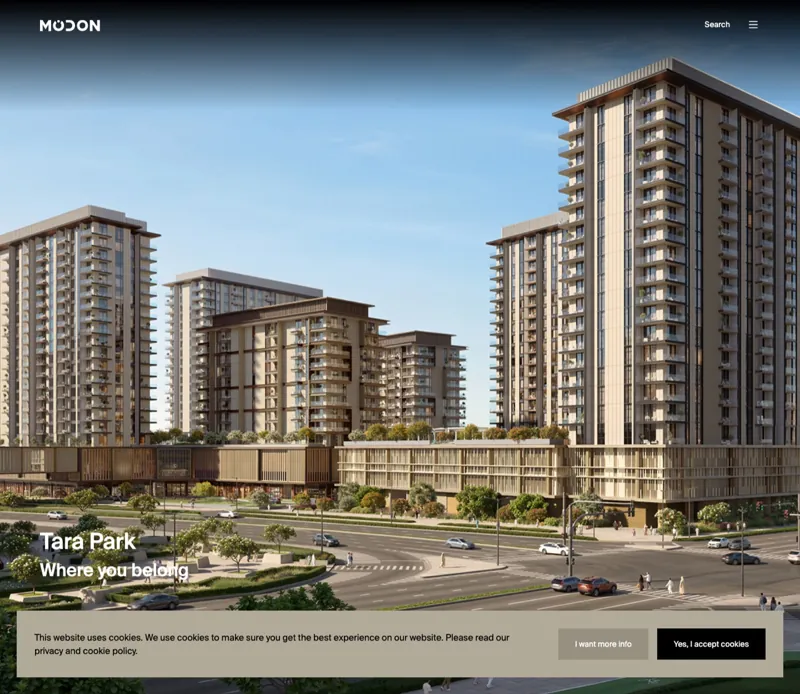
Website · Property development · Abu Dhabi
An ADX listed holding company building master planned communities, with a site that holds investors and residents at once.
modon.com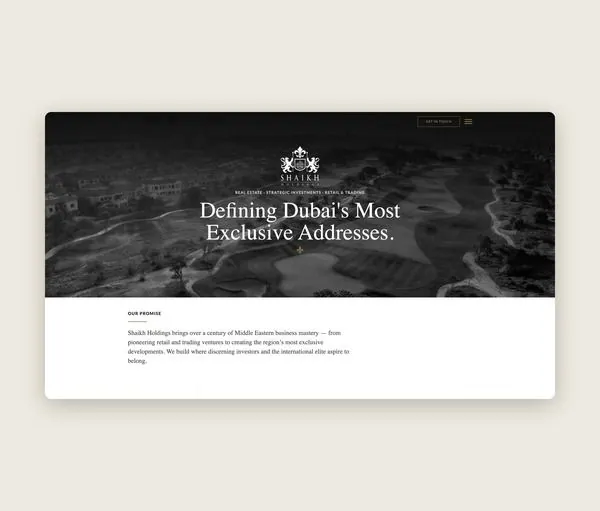
Website · Corporate · Dubai
A Dubai investment house with a century of business behind it. The site speaks to institutional investors, not shoppers.
shaikhholdings.com
Website · Furniture · Middle East
A design led furniture brand that launched with no digital home, now shown as carefully as its pieces.
stulo.comStraight answers
Yes, we can build a restricted area for tender documents, drawings or bid packs that only invited contacts can access, separate from the public parts of the site.
Where a project cannot be named, we describe the scope, sector and scale without identifying the client, and only publish named case studies once you confirm you have permission to share them.
Displaying branding, signage or promotional material on a construction site or hoarding in Dubai generally needs an advertising permit. This is not legal advice, so confirm requirements with the relevant authority for your site, which is Dubai Municipality or the Dubai Development Authority depending on location.
Yes, provided you can produce the certificate on request. We do not add certification or accreditation claims we cannot verify against a document you supply.
Every project gets a fixed written quote, scoped to your brief, sent within 45 minutes during business hours with no obligation. Portfolio size, a tender library and any password protected areas are the main cost drivers.
Sources
Fixed price, in writing
Got it. Your quote is being written now.
In business hours you will have it within 45 minutes. Check your inbox for the confirmation.