
Store locator, a Dubai retail website essential
Every branch with an address, map, phone number and accurate opening hours, including how hours change during public holidays.
Web Design by Industry
Retail website design in Dubai for shops and boutiques: stock that matches what is actually on the shelf, store locations a shopper can find, and a path from browsing to buying that works on a phone.
A shop in Dubai selling from a physical location and a shop selling only online need different websites, and most retail businesses are somewhere in between: a boutique with two branches, a homeware store with a busy Instagram page, a shop that wants to take orders online without becoming a full ecommerce operation. Retail website design in Dubai starts by working out which of those you actually are, rather than defaulting to a generic online store template.
This sits within our wider web design and ecommerce solutions work. What follows covers the parts specific to a retail shop rather than an online only brand, a wholesale supplier, or a two sided marketplace, which we cover separately on our marketplace website development page.
What the site has to do
Retail website design in Dubai needs to work whether a customer is deciding to visit the shop or deciding to buy on the spot.
Every branch with an address, map, phone number and accurate opening hours, including how hours change during public holidays.
Size, colour and variant options that reflect what is actually available, so a shopper is not told an item is in stock and then finds out otherwise at checkout.
Most retail browsing in Dubai happens on a phone, so the cart, delivery details and payment step need to be quick to complete on a small screen, not just usable.
The buyer
The person approving the brief is rarely the person who will update the site day to day, and the two often want different things from the same project.
For an independent shop or a small chain, this is usually the owner, measured on total revenue across every channel rather than online sales alone. Their first question is almost always whether the website will reduce or add to their own workload, since they are often the person who will end up updating it.
In a larger retail business, a dedicated manager is measured on online conversion rate, average order value and how closely online stock matches the shop floor. Their first meeting question is almost always whether the site can connect to the point of sale or inventory system already in use, since a second manual stock process is the outcome they are trying hardest to avoid.
Both roles ask about the same underlying risk in different words: will the website say something is true, such as a product being in stock or a store being open, that turns out not to be. Retail website design in Dubai has to be built to answer that question honestly rather than optimistically, and a proposal that does not address it plainly in the first meeting is usually the wrong proposal.
The visitor’s journey
Most retail visits follow one of two paths, and a website that only builds for one of them loses the other.
A shopper who already knows the product searches or filters directly for it. If the search box does not understand a brand name, colour or a common misspelling, they assume you do not stock it and leave, even when you do.
Before adding to a bag, many shoppers want to know whether the item is in stock for delivery, in stock at a nearby branch for click and collect, or simply worth the drive to visit in person. A page that cannot answer this pushes the decision back to a phone call.
Delivery, click and collect, or an in store visit are three different fulfilment paths, and a retail website in Dubai increasingly needs to offer more than one, with the cost, delivery window or collection time shown clearly enough to choose between them.
The final step, whether that is checkout or a reserved click and collect order, needs to confirm exactly what was bought, where, and what happens next, since this is the moment a shopper decides whether to trust the business with a return visit.
Stock accuracy
The fastest way to lose a retail customer is to sell them something that is not actually available, or to show an item as in stock when the shop floor sold the last one an hour ago. Retail website design in Dubai should connect to whatever system already tracks your stock, whether that is a point of sale platform, an inventory tool, or a simple spreadsheet your team updates daily.
Where stock cannot be connected live, being upfront about it, for example showing “usually ships in” ranges instead of a false promise of same day dispatch, protects trust better than a guess that turns out wrong.
Catalogue and variant data
A retail catalogue is not a flat list of products. It is a structure of parent products, each with variants, and the quality of that structure decides how well filtering, stock accuracy and search all work.
A single shirt is rarely one thing to sell online. It is a parent product with a size range and a colour range underneath it, each combination carrying its own stock count, sometimes its own barcode, and occasionally its own price when a colourway is discontinued and reduced separately from the rest of the range. Retail website design in Dubai has to model this properly from the start, because retrofitting variant structure onto a catalogue built as flat, single product listings is one of the more expensive corrections we get asked to make.
Where a business already runs a point of sale system, that variant structure usually already exists there, down to the barcode level, and the website should inherit it rather than having someone recreate it by hand in a second system. Where it does not exist yet, building it properly once, even for a modest catalogue, pays off the first time a sale needs a specific colour and size marked out of stock without hiding the entire product.
| Catalogue field | Why a retail website needs it |
|---|---|
| Parent product and variant identifier | Lets one product page carry several sizes or colours without duplicating content |
| Barcode or SKU per variant | Matches the website record to the exact item on a shelf or in a stock take |
| Stock count per variant, per location | Answers whether a specific size is available online, in a branch, or neither |
| Category and filter attributes | Powers search and filtering that matches how a shopper actually looks, not just how a warehouse is organised |
| Price and any active discount per variant | Keeps clearance stock and full price stock accurate on the same product page |
Click and collect
Click and collect sits between a full online sale and an in store visit, and it fails in a specific way: an item is shown as reservable, the shopper drives to the branch, and the item was already sold from the shelf before the website’s stock count caught up. Retail website design in Dubai has to treat a click and collect reservation as a real stock deduction at the moment it is placed, not a hopeful request, or the feature causes more frustration than it saves.
Done properly, click and collect needs its own short flow: choose a branch, see what is actually held there, reserve it for a defined window, and receive a clear message when it is ready, rather than an assumption that placing the order is the same as the item being set aside.
Regulatory angle, not legal advice
UAE consumer protection law sets out seller obligations that apply directly to what a retail website has to show and honour. The Ministry of Economy and Tourism’s own review of the Consumer Protection Law and its implementing regulation describes requirements to price goods by unit as well as by selling price, to offer a defined window to repair, replace or refund faulty goods at no cost, and to honour warranty obligations, with fines reaching into the hundreds of thousands of dirhams for merchants who fail to meet them.
This is general information, not legal advice. Confirm your own return, refund and warranty terms against the current regulation, and keep the policy published on the site accurate and up to date rather than leaving old wording live once it changes.
Sales and promotions
A seasonal sale is one of the more common reasons a retail website gets touched outside the normal update cycle, and it has a paperwork side as well as a design side.
Dubai’s Department of Economy and Tourism runs a service specifically for this: businesses running promotions during festivals and events, including raffles and pop up kiosks, apply for a certificate of participation for retailers and vendors, submitted online through the DET Connect portal. This is general information rather than legal advice, and any business planning a promotional sale should confirm the current process and whether it applies to their specific promotion directly with the department, since permit requirements can change and not every markdown counts as the kind of promotional event the certificate covers.
For the website itself, the practical requirement is simpler and constant regardless of the permit process: a sale price should be shown honestly against a genuine prior price, discount badges should be removed the moment a sale ends rather than left live by accident, and any terms specific to sale stock, such as final sale or no returns on clearance items, need to be visible on the product page itself and not only buried in a general policy page.
Selling in more than one place
Most established Dubai retailers eventually sell in more than one place: their own website, and a marketplace such as Amazon.ae or noon, sometimes alongside a Meta or Instagram shopping catalogue.
| Your own retail website | A marketplace listing | |
|---|---|---|
| Who sets the return policy the shopper sees | You do, in full | The marketplace’s own policy usually overrides or sits alongside yours |
| Product data format | Whatever your website and catalogue need | A specific feed format the marketplace requires, often needing its own fields |
| Price and stock updates | Update once, on your own schedule | Needs syncing separately, or stock can be sold twice |
| Brand presentation | Full control over layout, photography and story | A shared template the marketplace controls |
The practical risk is a variant selling out on your own site while the marketplace listing still shows it as available, or the reverse. Where a retailer sells through both, the stock feed that already keeps your website accurate is usually the same one that should feed a marketplace listing, kept in one place rather than updated twice by hand. This is one reason retail website design in Dubai is worth planning with marketplace listings in mind from the start, even where a marketplace launch comes later, since a catalogue structured for one feed usually adapts to a second far more easily than one built without that in mind. We cover the detail of choosing and preparing for a marketplace separately: see our guide to selling on noon or Amazon.ae and the accompanying product listing checklist for noon and Amazon.ae.
Returns policy content
A returns policy that exists only as a wall of legal text in a footer link does little for a shopper trying to decide whether to buy. The content matters as much as the legal position underneath it.
State the number of days a return is accepted from, whether that is delivery date or purchase date, rather than a vague “reasonable time” that leaves a shopper unsure.
Tags attached, original packaging, unworn or unused: whatever condition you require should be visible on the product page, not discovered only when a return is refused.
Shoppers decide differently depending on whether a return gets their money back, an exchange, or store credit. Say which applies, and to which categories, since these often differ across a catalogue.
Where a return or exchange policy differs for sale or clearance stock, in store purchases against online orders, or across product categories, each variation is worth stating on the relevant page rather than assuming a shopper will find the general policy and correctly infer the exception. This is one of the more overlooked parts of retail website design in Dubai, and one of the simplest to get right.
What stops a shopper
Two patterns explain most lost sales on retail websites we review.
Slow category pages, tiny filters and a search box that returns nothing useful send a shopper back to Instagram or a competitor within seconds. Retail website design in Dubai has to treat mobile search as the primary path, not an afterthought, since that is where most first visits actually happen.
A shopper deciding whether to drive to a store wants to know an item is actually there. Showing store level stock, even approximately, answers a question that otherwise gets asked by phone all day.
A retail website earns trust the same way a good shop assistant does: by telling a shopper the truth about what is actually available, before they get to the till.
Checkout trust
A shopper buying from a retailer for the first time is deciding whether to hand over payment details to a business they may only know from a search result or an Instagram post. The checkout page carries more of that trust decision than most businesses assume.
Using a payment gateway suited to your bank and transaction volume, integrated properly rather than as an afterthought, matters more to a first time shopper’s confidence than any badge or claim on the page.
A registered company name, a UAE address and a working phone number or WhatsApp link, visible without hunting, reassure a shopper that there is someone to contact if something goes wrong.
Delivery fees, any minimum order value, and the total including VAT should be visible before payment details are entered, not revealed as a surprise on the last screen.
An order confirmation email or WhatsApp message that repeats back what was bought, for how much, and when it will arrive or be ready for collection, closes the loop a shopper is otherwise left wondering about.
Store versus site
Retail businesses with a physical presence eventually hit a moment where the website and the shop floor tell a customer two different things, and how that is handled says a lot about the business.
A price change applied in store but not yet on the website, a promotion running in one branch but not shown online, or a product discontinued in the shop but still listed for sale are all ordinary operational lag, not a design failure on their own. What turns lag into a trust problem is how long it persists and whether anyone notices before a customer does. Retail website design in Dubai should make routine updates, price changes, stock corrections and promotion toggles, quick enough for a non technical team member to handle the same day, since the alternative is a website that drifts further from reality the longer it goes unattended.
Where a discrepancy does reach a customer, for example a price shown online that differs from the till, having a stated policy on which price honours the sale, and staff who know that policy, matters more than trying to prevent every possible timing gap. A retail website cannot promise perfect synchronisation with a shop floor run by people. It can be built so the gap is as small and as visible as possible, which is a realistic standard for retail website design in Dubai to aim for rather than a perfect one no system actually achieves.
Search behaviour
Retail search in Dubai splits fairly clearly into two moods, and the site structure needs to answer both without forcing one visitor down the wrong path.
A research search looks like a category or a comparison: someone deciding what kind of product they want, browsing broadly, often on a lunch break rather than ready to check out immediately. A ready to buy search looks specific: a brand and product name together, a store name with “near me”, or a search that already includes a size or colour. The first group needs strong category pages that group products sensibly and load quickly. The second group needs the exact product page to be findable directly, without having to navigate through several category layers to reach it.
Retail website design in Dubai should give both groups a short path. For the research group, that usually means category and collection pages with enough real content to be useful on their own, not just a grid of thumbnails. For the ready to buy group, it means product pages with clear, specific titles and descriptions rather than only a brand and a generic model number, since that is what those shoppers are actually searching for.
Staff and store teams
Retail website design in Dubai is usually written from the shopper’s side, but a store with branches also has a second audience: the staff who work the shop floor and end up fielding questions the website should have answered.
Store staff are frequently the ones dealing with the fallout of a website that gets something wrong, a customer arriving asking about an item the site showed as available, or a return the website’s policy page never actually mentioned. A short internal reference, even a simple page only staff know about, listing current promotions, known stock issues and the exact wording of the live returns policy, reduces the number of times a shop assistant has to guess what the website currently says. This is a small addition to a build, but one that store managers consistently value once they see it in use.
The same applies to click and collect. Staff need to see reservations arrive in a form they can act on quickly, tied to a real order number, rather than an email buried in a general inbox that nobody is specifically responsible for checking during a busy shift. Retail website design in Dubai that ignores this internal side of the business tends to work well in a demonstration and then generate friction the first busy weekend it goes live.
Content to gather
Most delays on a retail build trace back to one of these being incomplete when design begins, rather than the build itself.
Of these, product photography for every variant and an up to date stock export are the two that most often hold up a launch date, since both usually require pulling together material from several people or systems rather than one document.
What goes live first
Launching everything at once usually means launching nothing well. A sensible retail build separates what has to work on day one from what can follow once the core is proven.
| Phase one, at launch | Phase two, once the core is proven |
|---|---|
| Core catalogue with accurate stock and variants | Marketplace feed sync to noon, Amazon.ae or a shopping catalogue |
| Store locator with hours and holiday exceptions | Click and collect across every branch, not only the busiest ones |
| Mobile checkout and a payment gateway | Customer accounts, wishlists and saved addresses |
| A clear, specific returns and exchange policy | Loyalty or repeat purchase tools |
Arabic and bilingual content
Not every part of a retail catalogue needs the same bilingual effort, and spreading translation thin across everything is usually worse than doing the parts that matter properly.
Product titles, category names and store information are worth translating well, since these are what a shopper searching in Arabic actually reads first. Size guidance is worth particular care: a shopper unfamiliar with UK, EU or US sizing conventions benefits from a plain explanation in their own language rather than a chart with no context, and this is exactly the kind of content that reduces returns caused by the wrong size being ordered. Long form brand storytelling can follow once the transactional content, the part a shopper needs to actually complete a purchase, is solid in both languages.
Layout matters as much as translation. An Arabic product page needs filters, breadcrumbs and the cart icon mirrored correctly right to left, not just the words swapped, or the page reads as an afterthought rather than a genuine second language experience. Bilingual retail website design in Dubai is judged on this kind of detail far more than on whether a translation exists at all.
Mistakes we see
These come up repeatedly enough across retail reviews to be worth naming directly.
Usually a sign the website and the point of sale system are not actually connected, or update on too long a delay to be trusted.
A colour filter that returns nothing, or a size filter missing half the range, sends the message that the catalogue is not properly maintained.
A store page showing normal hours during Eid or a public holiday sends a shopper on a wasted trip, and it happens more often than it should.
Buried three clicks deep, or missing entirely, when it is one of the details most likely to decide a first time purchase.
Tiny tap targets and a multi page checkout built for a mouse, used almost entirely by people on a phone.
A retailer with strong footfall who neglects the website, or an online first retailer who neglects store information, both lose customers who wanted the other option.
Measuring success
The right numbers to track depend on whether stores, online sales, or both, are doing the heavy lifting for your business, but a few apply almost universally.
Overall conversion rate hides a lot. Tracking it by category shows where the catalogue, photography or pricing is working and where it is not.
Clicks on directions, phone numbers and a store’s opening hours are a reasonable proxy for footfall driven by the website, even where footfall itself cannot be measured directly.
Where a basket or a reservation is started but never completed, particularly on mobile, points directly at friction worth fixing in the checkout or collection flow.
Tracking is connected as part of every build so these numbers are available from launch, without needing to guess at benchmarks that vary widely between categories and price points. What counts as good is different for a jewellery boutique and a homeware chain, so a Dubai retail website is judged against its own trend over time rather than an invented industry average.
Integrations
The website itself is rarely the only system involved. What it connects to, and how often data moves between them, decides how much manual work your team carries after launch.
None of these need to exist on day one. Retail website design in Dubai usually starts with whichever of these your business already runs, connects that first, and adds the rest as the online side of the business grows, rather than integrating everything before the core catalogue and checkout are proven.
Keeping data current
A retail catalogue is not written once. Prices change, stock moves, seasonal ranges come and go, and someone specific needs to own keeping the website in step with all of it.
In a business with a connected point of sale system, most of this happens automatically: a sale on the shop floor decrements stock everywhere at once, and a price change made centrally reaches the website within the same update cycle. Where no such system exists, the responsibility sits with a person, and retail website design in Dubai works best when that person is named before launch rather than assumed. A new product range, a discontinued colourway, or a branch closing for renovation are all changes that need a clear route onto the website, not a habit of remembering to update it eventually.
Update frequency varies by what is changing. Stock counts for fast moving lines can change several times a day during a sale period. Store hours change only a handful of times a year, mostly around public holidays, but are checked by almost every visitor who is deciding whether to travel to a branch. Building the site so each kind of change is quick to make, without needing a developer for a routine price update, is part of what a properly built content management setup should deliver, and it is a standard test we apply to retail website design in Dubai before calling a build finished.
Pricing and VAT
Beyond the consumer protection requirement to price by unit as well as by selling price, a retail website needs to be consistent about whether displayed prices include VAT, and say so plainly rather than leaving a shopper to work it out at checkout.
For an online store issuing tax invoices to UAE customers, the invoice itself has its own specific content requirements separate from how the product page displays a price. We cover that in detail in our guide to UAE VAT tax invoice requirements for online stores, which is worth reading alongside this page if online sales are part of the build, since getting invoice content wrong after launch is a slower fix than getting it right the first time. This is a small detail against the rest of a retail website design in Dubai brief, but a persistent source of avoidable complaints once a store starts trading.
How we build it
The build order depends on whether stores, online sales, or both, are doing the heavy lifting for your business.
We collect store details, product data and any existing point of sale or inventory export before design starts.
Where useful, the site connects to your inventory system and a payment gateway suited to your checkout volume and product range.
Templates are approved before development, tested primarily on phones since that is where most retail browsing in Dubai happens.
Checkout and store locator are tested end to end on real phones, tracking is connected so you can see which pages actually lead to a sale, and domain, hosting and CMS logins are handed to you in your own name once retail website design in Dubai is complete.
Related industries
Retail sites share ground with other consumer facing sectors, and each has its own detail worth reading before you brief a build.
A faster, more repetitive shopping pattern built around delivery slots and substitutions rather than browsing.
Sizing doubt and returns dominate a fashion build in a way a general retail catalogue does not.
Higher value items with different trust and security expectations at checkout.
For a platform connecting many sellers rather than one retailer’s own stock, see marketplace website development. For the wider industry list, start from the web design by industry hub. For product pages, checkout and payment detail, see ecommerce solutions, UI and UX design for the catalogue and checkout experience itself, and mobile app development where a retailer wants a dedicated app alongside the website. Photography for a catalogue is covered on our ecommerce product photography page, ongoing category and product page visibility on our SEO services page, and a specialist point of sale or inventory integration on our hire developers page.
Selected work
Work across sectors, with the closest to this industry shown first. Every one is a live site, not a mockup.

E-commerce · Retail · Dubai
A Dubai floral boutique on WooCommerce, built around a fast checkout for a gift driven market.
thegorgeousflower.com
Website · Furniture · Middle East
A design led furniture brand that launched with no digital home, now shown as carefully as its pieces.
stulo.com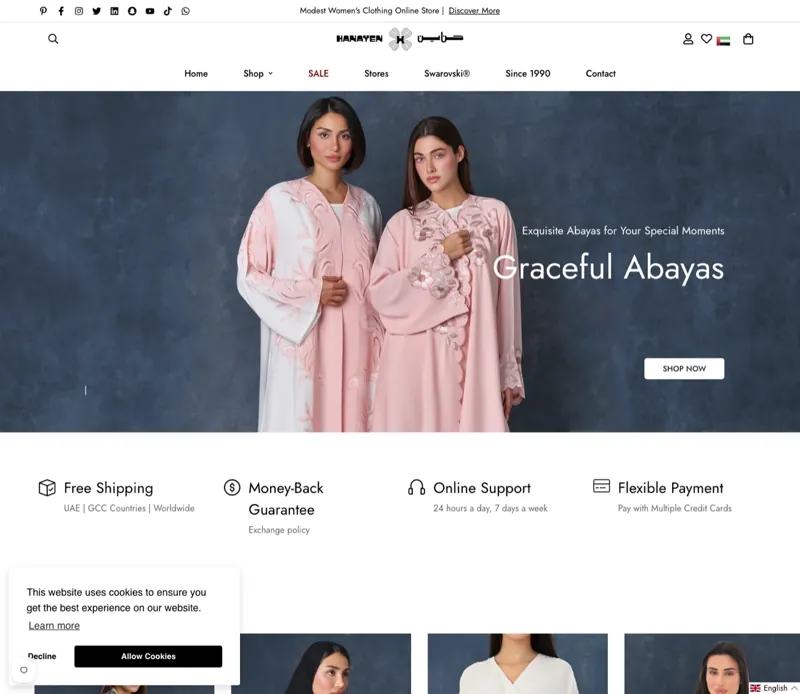
E-commerce · Fashion · Dubai
A Dubai luxury abaya house trading since 1990, carrying its craftsmanship into a quick mobile checkout.
hanayen.comStraight answers
Yes. Many retail clients want both: a store locator and in stock information for people shopping in person, and a working online store for people who would rather buy without visiting. We scope each part separately so you only build what you need.
Where you already use a point of sale or inventory system, we connect the site to it so stock levels update automatically rather than being maintained twice. Without one, we agree a manual update routine your team can realistically keep up with.
Yes, and we recommend it. A visible, specific returns and exchange policy is one of the simplest ways to reduce pre purchase questions and reassure a shopper who has not bought from you before.
We integrate a payment gateway suited to your business, working within the setup rules the gateway provider and your bank require. Full ecommerce build detail is covered on our ecommerce solutions page.
Every project gets a fixed written quote, scoped to your brief, sent within 45 minutes during business hours with no obligation. The number of products, whether stock is connected live, and payment integration are the main cost drivers.
Sources
Fixed price, in writing
Got it. Your quote is being written now.
In business hours you will have it within 45 minutes. Check your inbox for the confirmation.