
Catalogue and browse, the Dubai OTT website basic
Shows, films, episodes and articles organised by genre, language and collection, with search that copes with a library running into the thousands of titles.
Web Design by Industry
OTT website development in Dubai for channels, publishers and streaming services: a catalogue that stays current, a video player that performs on mobile networks, and subscription pages that convert.
A broadcaster, publisher or streaming brand in Dubai usually already owns a video platform, a transcoding pipeline and a content management tool for editorial teams. What is often missing is the website around it: a catalogue that a visitor can actually browse, a player that behaves on a UAE mobile network, and a subscription page that does not lose people at the payment step. That is the gap our OTT website development in Dubai work is built to close, alongside the wider web design and website development we do for other industries.
Media and OTT sites carry more moving parts than most brochure sites: a content library that changes weekly, a player embedded from a third party service, subscriber accounts, and often live schedules alongside on demand video. We treat those as the core of the brief rather than as an afterthought bolted onto a template.
The three briefs we see most often are not the same project wearing different branding. A broadcaster extending a television channel onto the web usually already has a schedule and a classification process, and needs the site to reflect both accurately. A digital native publisher is closer to a large content operation than a video business, with metadata and search mattering more than a player. A streaming startup is usually building subscriptions and entitlement from nothing, with the payment flow as the single highest stakes page on the entire site. OTT website development in Dubai starts by working out which of these a client actually is, since it changes almost every decision that follows.
The Dubai and wider UAE audience also has its own shape worth understanding before a build starts. A large share of residents watch or read in a second or third language, connections range from fast home fibre to mobile data with real variance, and a household often shares a single subscription across several people and devices rather than each person holding their own. Building for that reality, rather than for the audience a platform might have in a market with more uniform connectivity, changes decisions on everything from video quality defaults to how many profiles a plan reasonably needs to support.
The person approving an OTT or media website brief is rarely the person running day to day content operations. At a broadcaster it is usually a head of digital or a director of digital media, working alongside a technology lead who owns the video and billing infrastructure and has firm views on what the website is and is not allowed to touch. At a smaller streaming or publishing startup, the decision often sits with a founder or a chief operating officer who is personally responsible for the subscription numbers a board or investor will ask about next.
Whoever signs off the brief is measured on engagement and subscriber or reader numbers, not on how the homepage looks in a deck. Getting this sign off right is often the slowest part of OTT website development in Dubai, slower than the build itself. In a first meeting they will typically ask three things: whether the website can sit cleanly alongside the video and billing platforms already chosen, whether the catalogue can be kept current by an editorial team without asking a developer for every update, and whether the site can be built to work properly on a mobile connection, since that is where most of a Dubai audience actually watches or reads. A brief that answers those three questions early moves through internal sign off far faster than one that treats them as details to sort out later.
Not one brief
The label OTT or media covers genuinely different businesses, and treating them as one template misses what actually matters to each. OTT website development in Dubai starts by naming which of these a client actually is.
| What matters most | Where the website effort goes |
|---|---|
| Broadcaster extending a channel online | Live schedule accuracy, catch up windows, classification consistency with the broadcast |
| Digital native publisher | Article metadata, search, section structure and a content model editors can run daily |
| Streaming or subscription platform | Catalogue browsing, entitlement, and a payment flow that does not lose people |
What the site has to do
These are specific to broadcasters, publishers and streaming brands, not general content for every industry.
Shows, films, episodes and articles organised by genre, language and collection, with search that copes with a library running into the thousands of titles.
Your existing video platform embedded with adaptive bitrate playback, subtitle and audio track switching, and a fallback for slower mobile connections.
Sign up, plan selection, payment, and a profile page showing active devices and watch history, built to work with the subscription platform you already use. OTT website development in Dubai treats this flow as core functionality, not a bolt on form.
Metadata and taxonomy
A catalogue is only as good as the metadata behind it. Every title or article needs a consistent set of fields, genre, language, cast or byline, duration or word count, synopsis, classification and release date, entered the same way every time, since a browse page or a search result that mixes formats between titles reads as broken rather than as a minor inconsistency. OTT website development in Dubai builds the data model for this before a single template is designed, because the fields decide what the card, the detail page and the filters can actually show.
Taxonomy is the layer above individual fields: the genres, collections and tags a visitor filters by, and the way related titles or articles are recommended alongside whatever they are currently viewing. A taxonomy that grows organically without a plan tends to end up with several near duplicate genre tags that split a catalogue’s own audience against itself, so we agree the structure with the editorial team before content starts loading in at volume, since this is one of the harder parts of OTT website development in Dubai to undo once a catalogue has grown.
Delivery and playback
The player is the single component a viewer judges the whole platform by, and it needs testing under real conditions, not just office wifi.
Video needs to step down in quality automatically on a weaker connection rather than stalling outright, delivered through a content delivery network positioned to serve a UAE audience with low latency.
Premium or licensed content is usually protected by digital rights management from the video platform itself, and the website’s job is to pass the right entitlement through to the player, not to implement protection of its own.
Subtitle files need a consistent format and encoding across every title, with a language selector that actually reflects what has been supplied for that specific piece of content rather than a generic list.
A live stream and catch up window behave differently from an on demand title, with different caching, different metadata and a schedule that has to stay accurate to the minute, another area OTT website development in Dubai has to plan for deliberately rather than assume works the same as on demand.
Content operations
The single biggest failure point on a media website is a catalogue that goes stale because updating it needs a developer. Our OTT website development in Dubai puts titles, episodes, thumbnails, synopses and scheduling into a content management system your editorial team can run daily. New releases, live event pages and expiring titles are handled through the CMS, not through code changes.
For a channel or publisher running both Arabic and English editions, the CMS keeps both languages attached to the same title record so a translated synopsis or subtitle file never drifts out of step with the original.
Data that moves fast
Beyond the catalogue itself, several data feeds keep a media or OTT site current, each on its own schedule. A live schedule or electronic programme guide typically changes daily and sometimes intraday around breaking events, and needs to come from the broadcast or scheduling system rather than being typed into the website separately. Rights windows, which titles are licensed for which territory and for how long, change on a licensing calendar the content team controls, and a title that stays live past its expiry is a genuine licensing risk, not just a stale page.
Subscriber and entitlement data lives in the billing platform and needs to stay in sync with what the website shows a signed in user, since a lapsed subscriber who still sees premium content, or a paying subscriber who is wrongly shown a paywall, both erode trust quickly. None of these feeds are guessed at during a build. We confirm the source system for each one and how often it updates before agreeing how the website consumes it.
Subscriptions
A subscription page is judged on what happens after the first payment as much as on the payment itself.
Entitlement is the logic that decides what a specific signed in visitor can actually watch or read, and it usually goes further than a single paid or free flag. A household plan might allow a fixed number of simultaneous streams or registered devices, a tiered plan might offer a higher video quality or an ad free experience, and a trial period needs a clear end date the visitor can see rather than a surprise charge. Building this into the website means the account and content pages both check entitlement consistently, so a visitor never sees a title the player then refuses to play.
What happens when a plan lapses matters just as much as the sign up flow. A failed payment usually deserves a grace period and a clear retry path before access is cut, rather than an immediate hard stop that reads as a fault rather than a billing issue. Downgrades, upgrades and cancellations all need their own clear page, since burying a cancellation option behind several menus is the kind of pattern that damages trust with a subscriber base faster than almost anything else on the site.
Monetisation
Not every media or OTT brand in Dubai runs on subscriptions alone, and many run a mix of a free, advertising supported tier alongside a paid one, which is part of what OTT website development in Dubai has to design around from the outset. Where advertising is part of the model, the website needs to work with an ad server for display placements on article and browse pages, and the player needs to support pre roll, mid roll or post roll video advertising through whichever insertion method the video platform provides. Advertising delivered inside the video stream itself behaves differently from advertising inserted by the player client side, and which approach a platform uses affects how reliably an advert plays across different devices and browsers.
Sponsored content and paid placements, common on publisher sites, need to be labelled clearly as advertising rather than blended into editorial content, both because readers expect that distinction and because it is good practice for any UAE consumer facing site under general advertising standards. We do not build tools that actively defeat an ad blocker, since that sits outside what we consider good practice, though we do help a client understand what a blocked advert means for a free, advertising supported tier.
Regulatory angle, not legal advice
Media activity in the UAE, including broadcast, publishing and digital streaming, is regulated nationally. The UAE government’s own media regulation page states that media content must meet national standards set out in federal law, covering areas such as respecting religions, protecting national institutions and not publishing false information, and that oversight of internet content sits with the telecommunications regulator alongside the internet providers.
The National Media Authority lists licensing and permit services covering broadcast activity, media content, and age classification for films and electronic games. If your business publishes or streams media content to a UAE audience, check your own licensing and content classification position with the National Media Authority before launch. We are not able to confirm licensing on your behalf, but we can build the classification labels and age gates the platform requires once you tell us what applies.
The UAE government’s media regulation page confirms that Federal Decree Law No. 55 of 2023 on media regulation organises the media activities of individuals, organisations, media outlets and free zones dedicated to media in the UAE, and that media content standards apply across radio and television broadcasting, cinema and creative productions, newspapers and publications, and digital and electronic media activities. The National Media Authority’s own services listing includes a specific licence for media activities of a commercial nature, which is the kind of service a publisher or streaming business operating in the UAE would typically need to review against its own activity. This is not legal advice, and the exact licence or permit that applies depends on what your business actually publishes, streams or broadcasts, so it should be confirmed directly with the National Media Authority.
The same government page also describes the Telecommunications and Digital Government Regulatory Authority’s Internet Access Management policy, under which internet service providers can be required to restrict access to content that falls into defined categories, and confirms that online advertising, including advertising of specialised products and services, is also monitored under that policy. For an OTT or media website, the practical implication is that content standards apply to what is published, not only to whether a licence has been issued, so classification, moderation and takedown processes are worth planning as part of the website brief rather than treating licensing as a single box to tick before launch. This regulatory awareness is now a normal part of OTT website development in Dubai, not a specialist add on.
Content teams
A publisher or broadcaster with more than a handful of contributors needs a workflow the website’s CMS actually enforces, not one that only lives in a shared document.
A large content team usually has several distinct roles touching the same piece of content before it is public: a writer or content producer, a subtitling or localisation team for anything going out in more than one language, a standards and practices or compliance reviewer checking classification and content standards, and a scheduling desk that decides when something actually publishes relative to a broadcast slot or an embargo. Building the CMS around draft, in review, scheduled, published and expired states, with the right role able to move content between them, keeps a large team from publishing something before it has actually been checked, and it is a piece of OTT website development in Dubai that pays off most once the content team has grown past a handful of people.
Expiry matters as much as publishing on a media site. A licensed title or a time sensitive article that should come down on a set date needs that date built into the content record itself, rather than relying on someone remembering to remove it manually, since a title playing past its rights window is both a trust issue with the audience and a genuine licensing risk with the rights holder.
What stops a visitor
Two problems account for most of the lost visitors we see on media and streaming sites.
Most viewing on a UAE audience happens on a phone, often on mobile data rather than home broadband. A player that buffers on the first few seconds loses the viewer before the content even starts, so OTT website development in Dubai has to test playback under throttled connections, not only on office wifi.
Asking for full payment details before a visitor has watched anything free pushes people away. A clear trial or preview path, with payment requested only once someone has decided to continue, converts better than a paywall on the homepage, a lesson OTT website development in Dubai relearns on nearly every subscription build.
How people search
A visitor researching what to watch and a visitor ready to press play are looking for different things.
| Research stage search | Ready to watch search |
|---|---|
| Best shows or channels to watch in a given genre | Platform name, watch online or subscription price |
| Where to watch a specific show or event | Platform name, sign up or free trial |
| Streaming platform comparisons | Show or article title, direct search |
The first column needs genre and discovery content search engines can actually index. The second column needs the title or plan page itself to load fast and rank on its own. Our SEO services work plans catalogue structure around both, which is part of how OTT website development in Dubai approaches search from day one.
Working with existing systems
Very few OTT or media sites work in isolation, and naming what each integration actually solves helps a brief move faster.
Owns encoding, adaptive bitrate delivery and often DRM, with the website embedding the player rather than rebuilding any of this.
Handles payment, plan changes and entitlement state, which the website reads from rather than tracking independently, a boundary OTT website development in Dubai keeps deliberately clear.
Tracks watch time, drop off points and article engagement, feeding editorial decisions about what the catalogue or content plan needs next, which is one of the quieter benefits OTT website development in Dubai delivers once a site has real usage data.
Email and push notifications for new releases or renewal reminders, planned alongside the account pages rather than added afterwards.
How we build it
The order matters: catalogue structure and player choice come before visual design, because they decide what the templates need to hold.
We map your content types, whether that is shows and episodes, articles and sections, or live events, and agree the metadata fields the CMS needs to hold.
The video player and subscription or payment platform are connected early, since they constrain layout and account page design more than any other decision in OTT website development.
Templates for catalogue, title detail, player and account pages are designed and approved before development, with an Arabic right to left version built alongside English.
Playback is tested on real devices and slower connections, editors are trained on the CMS, and you receive the domain, hosting and CMS logins in your own name.
OTT website development in Dubai moves fastest when the content, technology and legal or compliance sides of a media business each hand over their part of the brief in writing before design starts. In practice, three things go missing most often. The first is a complete, correctly formatted metadata export for the existing catalogue, since a partial export discovered mid build forces the data model to be reworked later. The second is a written answer on classification and licensing status per title or content category, since this affects what labels and age gates the site actually needs to show. The third is Arabic metadata and subtitle files matched one to one with the English catalogue, since Arabic is often treated as a translation task to finish later rather than content that ships alongside the original.
This is one of the more predictable delays in OTT website development in Dubai, and naming it early avoids it. Brand assets are a smaller but common gap too. Poster art, trailer clips and thumbnails in the exact sizes a chosen player and design system need are rarely all ready at once, and gathering them early avoids a late scramble that otherwise falls on launch week.
Arabic on a media or OTT site in Dubai is not a single feature to add once. It touches the catalogue itself, since genre names, synopses and search need to work as well in Arabic as in English, the player, since subtitle and audio track labelling has to read correctly right to left, and increasingly the content itself, where Arabic language titles or articles sit as first class catalogue items rather than a separate section bolted on. A platform that treats Arabic as a translated layer over an English structure tends to show it in the details: search that only works well in English, or a right to left catalogue page that was clearly designed left to right first.
Dubbing and subtitling are also worth planning as separate decisions rather than assuming one covers the other. Subtitles are usually quicker to produce and are expected for most content, while dubbing is a heavier production decision typically reserved for content where the platform has judged the investment worthwhile. Either way, the website needs a clear, consistent way to show a viewer which language options exist for a given title before they press play, not after, and this bilingual discipline runs through every part of OTT website development in Dubai, not only the subtitle files.
What we still see
Most of these are fixable without a full rebuild, but they are worth naming plainly.
Playback tested only on a fast office connection, then buffering badly for the majority of visitors who are on a phone out and about.
Some titles carrying full genre and cast data, others missing fields entirely, which breaks filters and makes recommendations feel random.
A title still playable after its licence has expired, discovered only when a rights holder raises it rather than caught by the platform itself, exactly the kind of gap careful OTT website development in Dubai is meant to close.
A cancellation option buried behind several menus or requiring an email, which damages trust with a subscriber base far more than the retention it appears to protect.
New titles appearing in English immediately and in Arabic weeks later, which reads as the Arabic audience being treated as secondary.
An age rating that exists somewhere in the back office but never actually reaches the visitor looking at the title itself.
The media and OTT businesses we work with rarely judge a website on traffic alone. What tends to matter is watch time or read time per visit, how many free trial or free tier visitors actually convert to a paid plan, and how much of the catalogue is genuinely being discovered rather than a handful of titles carrying all the engagement. None of these are numbers we can promise in advance, since they depend on the content itself and the platform’s own marketing as much as the website, but they are the right things to track once a site is live, and we set up analytics against watch sessions, sign up completion and subscription conversion rather than page views alone.
Churn, the rate at which paying subscribers cancel or lapse, is usually the number that matters most to a streaming business over time, and the website plays a smaller but real part in it: a confusing account area, a payment retry that fails silently, or a content library that feels smaller each month a subscriber checks all push that number in the wrong direction. We treat the account and billing pages as part of the retention story, not only the sign up flow, once a site is live, and review them alongside the catalogue itself when engagement or churn numbers start moving in a direction worth investigating.
Once a catalogue runs into hundreds or thousands of titles or articles, browsing by genre alone stops being enough, and search becomes the primary way most visitors actually find something. A search field that only matches exact titles misses a visitor typing a cast member’s name, a rough description of what they remember, or a misspelling, all of which are common on a phone keyboard, and handling this well is one of the less visible parts of OTT website development in Dubai. OTT website development in Dubai builds search against the same metadata fields the catalogue itself relies on, title, cast, genre and synopsis, rather than treating search as a separate feature bolted onto the site afterwards.
Recommendations sit next to search as the other main discovery tool, and they work best when they are honest about what they are actually based on, recently watched genres, a specific collection, or simply what is new, rather than presented as a single mysterious algorithm. A visitor who sees a recommendation that plainly makes sense trusts the next one more, which matters for a catalogue trying to surface more than its handful of most popular titles.
Most streaming and many publisher platforms now offer more than a single login per subscription, whether that is separate profiles for different members of a household or simply a watchlist and preferences tied to one account. Building this properly means deciding early how many profiles a plan allows, whether a profile needs its own content restrictions for a younger viewer, and how watch history and recommendations are kept separate between profiles on the same account rather than blending together in a way that confuses the recommendation engine and the viewer alike.
A watchlist or saved for later feature is a smaller addition that does a disproportionate amount of work for retention, since a visitor who has already queued up several titles has a reason to come back that a generic homepage does not provide on its own. We treat this as a standard account feature on any subscription based OTT build, not an optional extra reserved for a later phase.
Generic page view analytics tell a media business very little about whether the site is working. What tends to matter is watch time and completion rate per title, where in a video people actually stop watching, which articles or shows drive a free visitor to start a trial, and where in the sign up flow a paying customer gives up before finishing. Building these events into the site from the start, rather than adding basic analytics at launch and hoping to retrofit anything deeper later, means the content and product teams have real data to act on from week one rather than waiting for a second phase of tracking work, which is the kind of groundwork OTT website development in Dubai puts in before launch, not after.
This also feeds back into editorial decisions in a way page views alone cannot. A title with modest total views but a very high completion rate tells a different story to the content team than a title with high views and a steep early drop off, and a catalogue that tracks only the first number is missing half the picture.
Few media or OTT projects start from an empty domain. Most begin with an existing site carrying a real audience, existing search rankings for article and title pages, and often years of accumulated URLs that other sites, social platforms and search engines already link to. OTT website development in Dubai for a migration project has to treat that history carefully, since a broadcaster or publisher moving to a new platform and losing its existing search visibility in the process is losing something that took years to build, not something a redesign gets back automatically.
A careful migration means mapping every URL pattern on the existing site before the new one goes live, deciding which pages need a permanent redirect to their new equivalent, and testing that redirect mapping against the site’s actual highest traffic pages rather than a random sample. Subscriber accounts and entitlement data need their own careful migration plan too, since a subscriber who loses access to content they are actively paying for during a platform switch is the kind of error that generates support tickets and cancellations in equal measure.
We plan a migration in a staged way wherever the scale of the catalogue allows it: content and metadata moved and verified first, account and billing integration tested against a small group before a full switch, and redirects live before the old site is retired rather than after, so there is never a window where a visitor following an old link or a search result lands on a dead page, which is the standard we hold every OTT website development in Dubai migration to.
Media and OTT websites in Dubai often share requirements with other content heavy sectors. See how we approach travel and tourism websites and IT and telecom websites, or start from our web design by industry hub. For the platform underneath any of these builds, our content management system page covers how we choose and configure the CMS, and where production itself needs a permit, our filming permit guide covers what that involves. Where a subscriber facing app sits alongside the website, our mobile app development page covers building or extending one.
Selected work
Work across sectors, with the closest to this industry shown first. Every one is a live site, not a mockup.
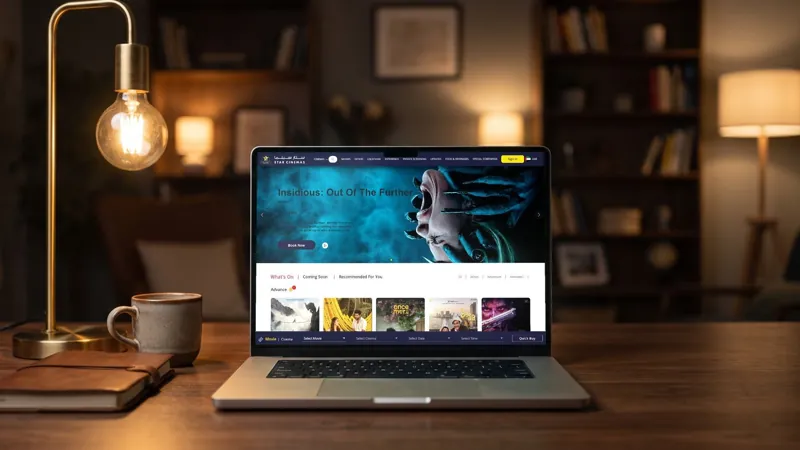
Web app · Ticketing · UAE
The UAE cinema chain operated by Phars Film. Every screening, offer and payment in one place customers can use on a phone.
starcinemas.ae
Mobile app · Events · UAE
A UAE conference platform replacing printed programmes and email chains for delegates and organisers.
meecon.ae
Mobile app · Fintech · United States
A fintech platform connecting merchants, customers and charities in a single payment flow.
purposepayment.comStraight answers
We build the site around your chosen video and payment infrastructure. Player embedding, subscription tiers, account pages and content browsing are within scope; the video hosting, transcoding and DRM platform itself is normally a separate specialist vendor we integrate with.
Media activity in the UAE, including broadcast and digital content, sits under national media regulation. This is not legal advice, so confirm your licensing position with the National Media Authority before publishing content, and tell us the outcome so the site reflects it correctly.
Yes. Arabic metadata, right to left catalogue browsing, Arabic subtitles and audio track labelling are planned into the build from the start rather than added afterwards.
We display the classification your content already carries from the relevant UAE authority, with the icon or label placed consistently across the catalogue and the content detail page. We do not assign ratings ourselves.
Every project gets a fixed written quote, scoped to your brief, sent within 45 minutes during business hours with no obligation. Catalogue size, video infrastructure and the number of subscription tiers are the main cost drivers.
Sources
Fixed price, in writing
Got it. Your quote is being written now.
In business hours you will have it within 45 minutes. Check your inbox for the confirmation.