
Ruby on Rails for a Dubai startup: where it still makes sense, and where it does not
Where Ruby on Rails still makes sense for a Dubai startup, UAE hiring realities, and when a founder should choose something else.
Read the articleWeb Services · Redesign
An audit of your current site before anything changes, a redirect plan that protects your search rankings, and a staged rollout, for Dubai and UAE businesses whose website has outgrown its first design.
A website redesign in Dubai usually starts with a reasonable complaint: the site looks dated, it is slow, it is hard to update, or it simply does not represent the business anymore. The risk is treating that complaint as a licence to rebuild everything from nothing. Some of what is wrong with an old site is genuinely worth fixing. Some of what looks old is quietly earning search visibility, enquiries or repeat visits that a full rebuild can lose overnight if nobody checks first.
This page covers how we approach a redesign specifically: auditing what the current site actually does before changing it, protecting search rankings through the move, deciding what content to keep, and choosing between a staged rollout and a single switch. For a project starting from nothing rather than an existing site, see our website development page.
Before anything changes
A redesign that skips this step is a guess dressed up as a plan. We treat the audit as the first deliverable, not a formality before the real work starts.
Which URLs earn organic visits, which rank for terms that matter to the business, and which have backlinks pointing at them. This list becomes the priority list for redirects later.
A page with modest traffic that reliably produces enquiries is more valuable than a high traffic page nobody acts on. Analytics, where available, settles this rather than assumption.
Sales and support staff often know which page they send links to most often, information analytics alone will not show. A short set of interviews surfaces this before it is lost in the redesign.
The audit produces a plain list: keep as is, keep but improve, merge with another page, or retire. Every page on the current site gets one of these four decisions before design work starts, not during it.
Search
Google’s own guidance on site moves is direct about the mechanics: use server side permanent redirects, specifically 301 or 308, rather than client side redirects, which it says should only be used as a last resort. Every URL that matters from the audit gets mapped individually to its new address, and the redirect points at the genuinely equivalent page, not a generic redirect to the homepage, which Google’s guidance also warns against.
Rankings can still fluctuate temporarily even on a well executed move, and Google is explicit that this is normal rather than a sign something has gone wrong. What is avoidable is the damage from missing redirects, a robots.txt or noindex tag left blocking the new site, or a sitemap that still lists the old URLs after launch.
Search
This is one of the more commonly rushed steps, and Google is specific about the timeframe.
| Guidance | What Google’s site move documentation says |
|---|---|
| Redirect type | Server side permanent redirects, 301 or 308, used wherever possible |
| How long to keep redirects | At least one year, to give search engines enough time to transfer ranking signals fully |
| Old sitemap | Can be removed once Google has processed the move and the new sitemap is being used |
| Expected fluctuation | Temporary ranking changes are normal during a site move and not necessarily a sign of a mistake |
A year sounds long for a set of redirects nobody wants to think about again, but removing them early is one of the more common, avoidable causes of lost rankings after a website redesign, particularly for pages that took years to earn their position in search results.
Content
Not every page from the old site deserves a place on the new one, and not every page needs rewriting either. The audit’s four way decision, keep, keep and improve, merge, or retire, is where a redesign either respects the work the old site already did or throws it away for no reason beyond a fresh design.
Pages that rank well and convert but look dated are usually worth keeping and improving rather than replacing: the words are doing their job, even if the layout is not. Pages that overlap heavily with each other are candidates to merge into one stronger page with a single, clear redirect target. Pages that earn no traffic, no links and serve no current purpose are honest candidates to retire, with a redirect to the closest relevant page rather than left as a dead link.
Content
Content migration is where a redesign quietly loses detail if it is treated as a copy paste exercise rather than a planned step.
Copy is checked for accuracy and currency as it moves, not assumed correct because it was correct when it was written, sometimes years earlier.
Every image, brochure and downloadable file referenced by a kept page is tracked and moved with it, rather than left behind on the old server and quietly broken.
Where the current site has Arabic pages, each one is migrated alongside its English equivalent, with the same review and the same redirect discipline, so the two languages do not drift out of sync during the move.
This is also the point where metadata often gets lost by accident: title tags, meta descriptions and structured data that took real work to get right on the old site need to be carried across deliberately, not regenerated from a generic template on the new one.
Rollout
A website redesign does not have to launch as one event. Redesigning a site section by section, or template by template, and rolling each one out once it is tested, spreads risk and gives real data on how each change performs before the next one goes live. The trade-off is a longer overall timeline and a period where the site runs on two designs at once, which needs to look deliberate rather than unfinished.
A single switch, the whole site replaced at once, suits a business with a smaller site, a hard deadline such as a rebrand launch date, or a design that genuinely does not work half migrated. It concentrates the risk into one launch day, which makes the audit, the redirect map and the testing beforehand even more important than on a staged rollout.
Testing
A redesign carries a specific testing risk a first build does not: every existing user habit built around the old site is a potential point of confusion on the new one.
Every mapped redirect is checked to confirm it goes to the correct new page and returns the right status code, not sampled and assumed to work for the rest.
Every form on the new site is tested to confirm it submits, reaches the right inbox and CRM, and fires the tracking events the old site’s forms fired, so reporting does not show a sudden, false drop in enquiries.
A redesign is often sold on being faster; that claim is tested against the old site’s actual load times, not assumed true because the new one looks lighter.
Device and browser testing follows the same discipline as any new build described on our website development page: real phones, tablets and desktop browsers, in both languages where the site is bilingual, before anything touches the live domain.
A website redesign in Dubai often surfaces a decision that has nothing to do with visual design: whether the platform underneath the site is still the right one. A site built on an ageing, heavily customised platform sometimes needs more than a new layout, and the redesign becomes an opportunity to address the underlying build at the same time. If that turns out to be the case, our WordPress development page and our wider website development page cover the platform side of that decision, separately from the redesign process on this page.
The opposite is also common: a business assumes a redesign requires a full platform change when the existing CMS is perfectly capable and the actual complaint is the theme, the content and the structure built on top of it. Establishing which situation applies, honestly, is part of the first conversation before any design work begins, since it materially changes the scope and the approach.
Measuring
A redesign is finished when it launches. Whether it succeeded is a separate question, answered weeks later with evidence rather than opinion.
Search Console data on the pages identified as important in the audit, compared before and after, shows whether the redirect strategy actually protected rankings.
GA4 data on form submissions, calls and other tracked actions, compared against the same period on the old site, is a more honest measure than traffic alone.
Core Web Vitals data at the 75th percentile of real visits, not a single test on a fast office connection, shows whether the new site is actually faster for real visitors.
Agreeing these measures before launch, not after, is what turns “does it look better” into an answerable question. Our web analytics page covers the tracking setup this comparison depends on.
The best compliment a website redesign can earn is that regular visitors barely notice the search rankings moved and the enquiries kept coming, because nothing that was working got quietly broken along the way.
Selected work

Website · Luxury real estate · Dubai
A brokerage at the top of the Dubai market, where the buyer judges the agency by its website first.
billionairehomesdubai.com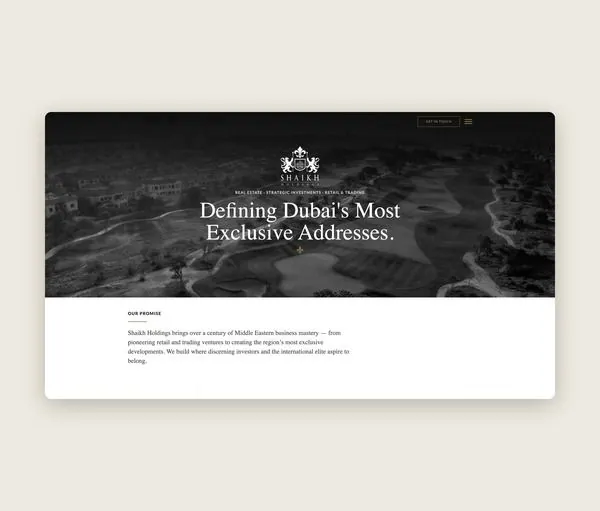
Website · Corporate · Dubai
A Dubai investment house with a century of business behind it. The site speaks to institutional investors, not shoppers.
shaikhholdings.com
Website · Property development · Abu Dhabi
An ADX listed holding company building master planned communities, with a site that holds investors and residents at once.
modon.comTiming
Not every complaint about a site calls for a full redesign. Website redesign in Dubai is worth planning when the signals point at the structure and the platform, not only the surface look.
New services, new locations or a new audience the original site was never built to organise, showing up as awkward navigation or pages crammed into categories that no longer fit.
A site designed years ago around desktop use, with mobile treated as an afterthought, often fights against how most visitors actually browse today.
A site so heavily customised that every small change risks breaking something, or that consistently fails Core Web Vitals targets, has crossed from cosmetic complaint into a real business cost.
A website redesign in Dubai is a bigger commitment than routine website maintenance or a smaller visual refresh, and it is worth being honest about which one the business actually needs before starting.
Rebrand
A website redesign in Dubai is often triggered by a wider rebrand: a new logo, new colours, a repositioned message. This adds a layer the technical migration work does not cover on its own, since every page’s tone, imagery and structure may need to shift to match the new brand, not just its colour palette applied over the old layout.
We separate the two conversations deliberately. Brand decisions, the logo, the palette, the voice, are usually settled first, with the marketing or leadership team. Website redesign in Dubai then translates that brand into a working site: templates, components and content that express it consistently across every page, not only the homepage that gets the most attention during approval.
Mistakes
Most redesign problems we are asked to fix afterwards trace back to one of a small number of avoidable decisions.
A redesign started from opinion rather than data loses pages nobody realised were earning search visibility or repeat visits, because nobody checked before removing them.
A redirect map built the week before launch, under time pressure, tends to miss exactly the older, less visible pages that were quietly earning the most search value.
A staging site indexed by accident, or a noindex tag forgotten on the new live site, are both common, both avoidable, and both damaging if caught late.
Every one of these is a process failure, not a design one, which is why our approach to website redesign in Dubai treats the audit, the redirect map and the launch checklist as core deliverables, not administrative steps around the real work.
Process
Website redesign in Dubai follows the same six stage way of working we use across our web services, adapted for an existing site rather than a blank one.
We gather the brief and run the content and search audit together, since the audit often changes what the brief should actually ask for.
A fixed written quote, scoped to the audit findings and the rollout approach agreed, sent within 45 minutes during business hours with no obligation.
Design and development proceed against the kept, improved, merged and retired page list, with the redirect map built alongside the new site rather than after it.
You approve the design in full before development, and test the finished site on staging, including redirects, forms and tracking, before anything goes live.
Launch, with the redirect map active, the sitemap updated and Search Console monitored in the days that follow.
Performance against the goals set before launch is reviewed once there is enough data to judge it fairly, not the day after launch.
Working together
A website redesign in Dubai moves faster and stays honest when a handful of decisions and access points are ready early.
Without historical data, the audit relies on guesswork instead of evidence, which is the opposite of how a redesign should start.
Sales, support and whoever edits the site regularly often know things analytics alone will not show about what actually works and what is genuinely a problem.
Staged or single switch, agreed early, shapes the whole project plan rather than being decided midway through.
Cost
A website redesign in Dubai is priced against the actual work the audit reveals, not a flat rate per page.
A visual refresh on an existing, sound structure costs less than a full information architecture rebuild with new page types and new navigation.
Pages kept as is cost little to migrate. Pages needing a genuine rewrite, not just a copy paste into a new template, take proportionally longer.
A large site with hundreds of URLs to map, or several third party integrations to rebuild against the new templates, adds real, quantifiable work.
Every website redesign in Dubai gets a fixed written quote, scoped to your brief, once the audit has established the actual scope, so the price reflects the real project rather than a guess made before anyone has looked at the current site in detail.
Access
A redesign is a natural point to address accessibility issues that accumulated on the old site: contrast that fails for readers with low vision, forms that cannot be completed with a keyboard alone, or images with no meaningful alternative text for a screen reader. These are worth fixing during a rebuild rather than left for a separate project later, since the templates are already being rebuilt from scratch.
Website redesign in Dubai for a business with government, education or healthcare visitors carries a stronger practical case for this, since these audiences are statistically more likely to include visitors using assistive technology, even where no specific legal requirement applies to a particular sector. We treat accessible contrast, readable text sizing and keyboard navigable forms as a baseline on every redesign, not an optional extra requested separately.
Bilingual
A bilingual site adds a layer to every decision on this page, not a separate process bolted onto the end.
Every Arabic URL needs its own equivalent redirect, tested separately from its English counterpart rather than assumed to follow automatically.
The relationship between the English and Arabic versions of each page has to be re-established on the new site’s URLs, not just copied from the old site’s structure.
Arabic copy is checked by someone reading it as Arabic, not by comparing it word for word against the English version, since a redesign is a natural point to catch content that was originally translated rather than written for Arabic readers.
Where a redesign includes new Arabic development from scratch, our Arabic website development page covers the right to left build considerations in more depth than fits here. A redesign that treats Arabic as a checkbox to tick rather than a genuine second audience tends to reproduce whatever gap existed on the old site, only with a newer visual design sitting on top of it.
A website redesign in Dubai for a site with a booking system, a store or a customer portal carries extra weight beyond the marketing pages, since these are the parts of the site actually doing transactional work for the business. A redesign that changes the checkout flow, the booking form or the portal login without careful testing risks breaking something that directly affects revenue, not just appearance. We treat these sections with the same testing discipline described on our web application development page, whether or not the rest of the site counts as a full application.
Ecommerce sites carry a specific version of this risk: product URLs, category pages and checkout steps often carry significant, hard earned search value, and a website redesign in Dubai for a store needs the same audit and redirect discipline applied to every product and category page, not only the marketing pages that get the most attention during design review. Our ecommerce solutions page covers store specific considerations such as payment gateways and tax invoices that a redesign involving a store also has to account for.
Common patterns
The reasons behind a redesign shape what the project actually needs to deliver, so naming the real reason early is worth the honesty.
New services, a new market, a merger or an acquisition, where the current site was built to describe a business that no longer matches what the company actually does today.
Pages that used to rank have slipped, often because competitors have invested in structure and content the current site never addressed, a pattern our SEO services team sees regularly.
Slow load times, a platform version nobody wants to keep patching, or a developer who built the original site and is no longer reachable.
Website redesign in Dubai triggered by search stagnation is worth pairing with a content strategy conversation alongside the technical rebuild, since a faster, better structured site with the same thin or outdated content will only partly solve the underlying problem. A new template around an old, thin page rarely produces the recovery a business is hoping for on its own, however much faster or more polished the new template happens to be.
Governance
A website redesign in Dubai solves the problems visible on day one. Without a plan for who owns the site afterwards, many of the same problems, inconsistent pages, an outdated plugin list, content nobody updates, tend to reappear within a couple of years. This is less a technical risk than an organisational one, and it is worth addressing directly at handover rather than assumed to sort itself out.
We agree, as part of every website redesign in Dubai, who is responsible for publishing new content, who approves structural changes such as a new page type, and how often the site is reviewed against its own component library so it does not quietly drift page by page the way the original site likely did.
Website redesign in Dubai for a business that has genuinely outgrown its structure sometimes reveals, part way through the audit, that the underlying information architecture needs to change more than the visual design does. A services business that has grown from three offerings to fifteen, for example, often finds its original three tab navigation cannot organise fifteen coherently, and the redesign becomes as much about grouping and hierarchy as it is about colours and layout. This is exactly the kind of finding the audit exists to surface early, before a new visual design is built on top of a navigation structure that was already the real problem.
The same pattern shows up in reverse for a business that has simplified: a site built for a much broader range of services than the company still offers can carry pages, categories and navigation items that actively confuse a visitor about what the business does today. Website redesign in Dubai in this situation is often more about subtraction than addition, retiring pages deliberately rather than adding new sections to an already cluttered structure. A leaner, more honest site structure tends to convert better than a large one padded with pages the business no longer wants to talk about, even though removing pages can feel like a step backwards during planning rather than genuine progress.
Search behaviour
A redesign is a natural point to check whether the site’s structure still matches how people actually search for the business today, not just how it looked when the original site was built.
A visitor comparing options searches differently from one ready to enquire, and a redesigned site benefits from pages that answer both, rather than every page written as if every visitor is ready to buy.
Where a business serves specific areas, a website redesign in Dubai is a chance to make that explicit in page structure rather than relying on one generic contact page to cover the whole country.
Services or products added since the original site launched that never received a proper page, patched instead into an existing one where they do not really belong.
This is where a website redesign in Dubai and an SEO review genuinely overlap, and treating them as one conversation, rather than a design project followed by a separate SEO project, tends to produce a structure that does not need revisiting again within a year of launch.
Content gaps
A website redesign in Dubai moves at the speed of the content it depends on, and gaps here are one of the most common causes of a delayed launch.
Pages flagged as keep and improve need someone to actually write the improvement, not just approve a design around the old text.
Old sites often carry outdated team photos, discontinued product images or a superseded logo file, and sourcing current versions can take longer than the design work itself.
A redesign that needs approval from several stakeholders moves faster when that group is identified at the start, rather than discovered when a late reviewer asks for changes after development is already underway.
We plan around this rather than assume it will not happen: a realistic schedule for a website redesign in Dubai accounts for content gaps as a known risk, with a clear point at which a delayed asset holds up the whole project versus one that can be added after a soft launch.
Launch
A website redesign in Dubai does not have to solve every ambition in the first release. A sensible first phase covers the pages that matter most, correctly migrated and redirected, with a genuinely tested core experience, rather than every planned feature launched at once and tested under pressure.
A realistic phase two for most redesigns includes newer page types that were nice to have but not essential, deeper personalisation, or additional languages beyond the core pair. Naming phase two honestly during planning, rather than quietly dropping it, keeps a smaller first launch from feeling like a compromise nobody agreed to. Teams that agree this split up front tend to find the second phase easier to fund too, since it is proposed against evidence from the live site rather than argued for in the abstract before anything has launched.
A website redesign in Dubai for a business running paid advertising alongside the site carries a particular timing consideration: campaigns pointing at old URLs need their destination updated once the new site is live, and any landing pages built specifically for a campaign need to be accounted for in the audit even if they sit outside the main navigation. A redirect map that only covers the visible site structure and misses campaign specific landing pages can quietly break active advertising the day the redesign launches, wasting spend on clicks that land on a broken or unrelated page until someone notices.
The same applies to email marketing and any printed material carrying a web address, a QR code on a brochure, a signature link, a partner’s website linking to a specific page. None of these update themselves, and a website redesign in Dubai is a reasonable moment to audit where the business’s own URLs appear outside the site itself, so the redirect strategy covers the traffic that actually matters, not only what a crawler of the site itself would find, since offline and third party links can quietly outlast the memory of anyone who set them up in the first place.
Summary
A great deal of this page comes down to a handful of disciplines applied consistently, rather than any single clever technique.
Know what the current site is actually doing before deciding what changes, using data rather than opinion.
Every URL that matters mapped individually to its genuine equivalent, kept in place for at least a year as Google recommends.
Not every page needs rewriting, and not every page deserves to survive; the audit tells you which is which.
Search visibility, enquiries and speed, compared against the old site with real data, not judged on appearance alone.
A website redesign in Dubai that follows these disciplines is slower to plan than jumping straight into new visuals, and it is also far less likely to quietly undo years of hard earned work the old site had already put in. The extra week or two spent on the audit and the redirect map at the start of the project is consistently the best time investment on the whole timeline, since it is genuinely the single step most likely to prevent a costly, avoidable mistake that only becomes visible months after launch, once the real damage to search visibility and enquiries has already quietly and largely, permanently, irreversibly been done.
From the blog

Where Ruby on Rails still makes sense for a Dubai startup, UAE hiring realities, and when a founder should choose something else.
Read the article
Choosing a CMS for a UAE business by who edits it, what it integrates with and who maintains it, not by which platform sounds most impressive.
Read the article
Laravel against WordPress for a Dubai business: where a content site ends, an application begins, and what happens when WordPress is pushed past that line.
Read the articleStraight answers
It can, if it is done carelessly. Google's own guidance on site moves says redirects should be kept in place for at least a year and warns that rankings can fluctuate temporarily even on a well planned move. Our process is built around avoiding the avoidable losses: missing redirects, blocked crawling and a sitemap left pointing at old URLs.
We start with an audit, not an opinion: which pages get visits, which earn links, which convert enquiries, and which the team relies on even if traffic looks low. Content and pages proven to work are kept and improved rather than replaced for the sake of a fresh look.
Often, yes. A staged rollout, redesigning one section or template at a time, reduces risk and lets you see how each change performs before the next one goes live. It takes longer overall than a single switch, and we discuss which approach suits your site and your team's capacity before deciding.
Every page worth keeping is migrated deliberately: reviewed, matched to its best URL on the new site, and redirected from its old address. Nothing is left to be recreated from memory or silently dropped.
Against goals agreed before launch: search visibility on the pages that mattered before, enquiry or conversion rate, and load speed compared with the old site, tracked through GA4 and Search Console rather than judged by appearance alone.
Every project gets a fixed written quote, scoped to your brief, once we understand how many templates are changing, how much content needs migrating and whether the rollout is staged or a single switch.
Sources
Fixed price, in writing
Got it. Your quote is being written now.
In business hours you will have it within 45 minutes. Check your inbox for the confirmation.