
Property search on the website
Filters for area, price band, bedrooms, property type and completion status, with results that load quickly on mobile, where most Dubai property searches start.
Web Design by Industry
Property website design in Dubai built around listing search, off plan projects, agent profiles and the permit numbers RERA expects to see on every advertised unit.
Property website design in Dubai has one job a brochure site does not: it has to let a buyer or tenant search and shortlist units without picking up the phone. A visitor searching for an apartment wants to filter by area, bedrooms and budget within seconds, see a clear listing reference, and know the advertisement is genuine. A template built for a generic service business rarely supports any of that, which is why real estate sites need their own structure from the first wireframe.
This page covers the pages a Dubai property website actually needs, the Dubai Land Department rule that touches advertised listings, and how a build fits alongside a CRM and a portal feed you may already run.
Core pages
Buyers, tenants and off plan investors are three different visitors, and property website design in Dubai treats each one as a separate journey rather than one long list.
Filters for area, price band, bedrooms, property type and completion status, with results that load quickly on mobile, where most Dubai property searches start.
Short pages for each community you cover, linking to the listings inside it, which also gives search engines a reason to send local traffic beyond the homepage.
A separate template built around a payment plan structure, handover milestones and floor plan downloads, distinct from a ready property listing.
A page per agent or team showing their listings and language skills, so a visitor can choose who to contact rather than reaching a generic inbox.
A booking form tied to the listing reference, sent to the right agent with the date and time the visitor prefers.
General calculators and explanatory content are common, kept clearly separate from any specific rate or offer, which stays with your bank or broker partner.
Advertising rules
The Dubai Land Department runs a real estate ad permit service through its Trakheesi system, which covers newspaper, outdoor, printed and online advertisements, alongside promotional campaigns and open house events. The service description states that applicants log in to the system, complete the required information and, if they are a broker, provide proof of a marketing contract with the property owner before the permit is issued. For property website design in Dubai, the practical point is that a listing page needs a visible field for the permit or reference number the advertisement is registered under, and that field should be easy for your team to update as listings change.
This is not legal advice, and it is not a complete summary of every advertising rule that may apply to a listing, an agent or a developer. Confirm the current requirement for your specific advertisements directly with the Dubai Land Department before a campaign goes live.
What stops a buyer
Two problems come up again and again on agency and developer sites we review.
| Problem | Effect on the visitor | What we build instead |
|---|---|---|
| Search that only filters by area, not price or bedrooms | Buyers give up and go back to a portal | Combined filters that update results without a full page reload |
| One enquiry form for every listing type | Agents chase basic details by phone | Forms that carry the listing reference and ask only what that listing type needs |
| Listings that go stale after a unit sells | Wasted enquiries and a site that looks unmanaged | A CMS or feed connection your team can update themselves |
Many Dubai buyers now message an agent on WhatsApp before they call or email, so property website design in Dubai increasingly includes a WhatsApp button on every listing that opens a chat with the listing reference already filled in. It is a small addition, but it removes a step between a visitor liking a unit and an agent hearing about it.
Build and content
Property website design in Dubai moves fastest when listing data is ready before development begins.
Whether listings come from a CRM export, a portal feed or manual entry decides how the site connects and how often it updates.
Property photography and floor plans you already hold, plus logo and colour guidelines if they exist.
Who should appear on agent pages, and how enquiries should route between team members or offices.
Whether the site needs Arabic alongside English, since many buyers and tenants in the UAE search in both.
The wider approach to development, hosting and handover is covered on our website development page, and interface decisions such as filter design sit under UI UX design. Once the site is live, SEO services covers ranking for area and property type searches, and a site that also sells merchandise or plans belongs under ecommerce solutions.
The person who signs off property website design in Dubai is rarely the person who will use the site every day. At an agency, it is usually the principal or the head of marketing, measured on listing volume, qualified leads and how many of those leads convert to a signed viewing. At a developer, it is a marketing director or a sales and CRM lead, measured on registrations against a specific launch and how fast the site can turn a new project announcement into a functioning landing page with a payment plan. Both will open the first meeting with the same question, in different words: how does a lead reach the right person without a manual step in between. A broker principal wants to know an enquiry lands with the listing agent, not a shared inbox nobody owns. A developer’s sales lead wants to know a launch registration reaches the CRM the sales team already lives in, with the source campaign attached, because that number gets reported upward within days of a launch.
A second recurring question is about control. Agencies and developers in Dubai both work with property data that changes constantly, so whoever signs off the project wants to know who updates a listing when it sells, who edits an off plan payment plan when a phase changes, and whether that update needs a developer each time or can be done by the marketing team directly. Property website design in Dubai that gets this meeting right spends most of it on data flow and ownership, not on colour and layout, because those are the two things that determine whether the site still works six months after launch.
The visitor
Property website design in Dubai has to serve at least three different intentions on the same site, and a page built for one often fails the other two.
They want to narrow a large list to a handful of real candidates fast, using area, price, bedrooms and completion status. The point they leave is a search that reloads slowly or a results page that hides the listing reference.
They want the payment plan, the handover date and the developer’s track record on one page, without downloading a brochure to find any of it. The point they leave is a payment plan buried inside a PDF instead of shown on the page itself.
They are comparing agencies as much as units, and they read agent profiles, reviews and recent listings before they call. The point they leave is a site with no named agent and no evidence of recent activity.
All three visitors eventually want the same thing from the site: a fast way to confirm this listing or this agency is genuine, current and worth a phone call or a WhatsApp message. Property website design in Dubai earns that confirmation with a visible listing reference, a real agent name and a permit or reference number a visitor can check, not with copy that says the agency is trustworthy.
Data and feeds
A property website in Dubai is rarely the first place a listing is entered. Most agencies enter a unit into a CRM or a portal dashboard first, because that is where the sales team already works and where Bayut, Property Finder and Dubizzle expect listings to arrive. The website then needs to either pull from the same feed or receive a scheduled export, because entering every listing twice is exactly the kind of manual step that causes stock to go stale. A unit that sells on Monday and still shows as available on the website on Friday costs an agency a wasted enquiry and, more importantly, makes the whole site look unmanaged to the next visitor who notices.
Off plan stock behaves differently again. A developer’s available unit list for a single tower can change by the hour during a launch, so an off plan page usually needs either a live connection to the sales system or a clearly assigned person who updates unit and floor availability at set times during a launch window, with the site stating clearly when stock was last checked.
Integrations
These are the systems a Dubai property website typically has to connect to, named specifically because “integrations” on its own tells a client nothing about what gets solved and what does not.
Dubai agencies commonly run their listings and pipeline through property specific CRMs. A connection here can push new and updated listings to the website automatically, but it does not replace the CRM, and the website should never become the place agents manage a deal.
Most agencies already export an XML or CSV feed to these portals. The same feed, or a parallel export, can often populate the website too, so a listing is entered once and appears in both places with consistent details and photography.
A WhatsApp button on a listing that opens a chat with the listing reference already in the message removes a step between a visitor liking a unit and an agent hearing about it. See our WhatsApp API integration page for how this connects to a shared team inbox rather than one agent’s personal phone.
Area guides and search filters both rely on accurate community boundaries, since “Dubai Marina” and “JBR” are treated as separate areas by buyers even where the geography overlaps.
Agencies and developers with a large, frequently browsed portfolio sometimes commission a dedicated mobile app alongside the website, usually once the website’s search and enquiry flow is proven and the volume of repeat visitors justifies it.
Knowing which listings get views but no enquiries, and which areas draw search traffic but few conversions, is web analytics work specific to a property site rather than generic traffic reporting.
Property website design in Dubai almost never stands alone. An agency’s own site usually sits alongside listings syndicated to Bayut, Property Finder and Dubizzle, and each portal has its own listing requirements around photography count, description length and, in practice, expects a valid permit reference against the listing. The Dubai Land Department’s real estate ad permit service, run through Trakheesi, describes electronic advertisements and real estate promotion platforms among the categories it covers, and sets out that a broker applicant provides a marketing contract with the property owner before a permit is issued. A real estate promotion platform permit application specifically also asks for a copy of the platform’s design showing its size, alongside a site tenancy contract, which is a reminder that Trakheesi treats a dedicated property advertising platform as its own category, distinct from a single advertisement.
Separately, the Land Department also runs a licence and permit verification service, which lets anyone check the e-copy of a licence or permit issued for real estate activities, through the website or the Dubai REST app, with an immediate result. For a property website, the practical implication is that a listing page benefits from showing its permit or reference number in a format a visitor could plausibly check, rather than as a decorative label, because a checkable number is part of what makes a listing look genuine next to portal listings that already carry one.
None of this is legal advice, and it is not a complete summary of Trakheesi, Madhmoun QR requirements for print and audiovisual advertising, or any other advertising rule that may apply to a specific campaign, agent or developer. Confirm the current permit requirement for your listings, your marketing platform and your specific advertising formats directly with the Dubai Land Department before a campaign or a new website section goes live.
Search behaviour
Property search terms in Dubai split fairly cleanly into two intentions, and property website design in Dubai answers both with different pages rather than forcing one search box to do everything. A research search looks like “apartments for sale in Dubai Marina” or “best areas for families in Dubai”: broad, exploratory, usually from someone weeks or months from a decision. A ready to buy search looks like a specific building, tower or community paired with bedroom count, or includes a listing reference copied from a portal: narrow, specific, from someone close to contacting an agent.
Area guide pages are built for the first kind of search, since they can rank for a community name and give a visitor enough context to decide where to look next. Listing pages and saved search filters are built for the second, since that visitor already knows roughly what they want and needs the fastest possible path to a specific unit and a specific agent. A site structure that only has a homepage and a generic listings page misses the first kind of search entirely, because there is nothing on the site written for “Dubai Marina” as a topic rather than a filter value.
A permit number that a visitor cannot check is just another line of text. A search that makes a buyer wait is a buyer who goes back to the portal instead.
Ready property compared with off plan
The two listing types answer different questions, so property website design in Dubai gives them different page structures rather than one shared template.
| Question the visitor is asking | Ready property | Off plan project |
|---|---|---|
| What am I paying and when | A price and, where relevant, service charges | A staged payment plan tied to construction milestones |
| When can I move in | An availability or vacancy date | A projected handover date, usually a range |
| What proof do I have of the unit | Current photography, floor plan and a listing reference | Render images, a floor plan and a developer track record |
| Who do I contact | A named listing agent | A sales team or a registration form tied to the project |
Property website design in Dubai moves at the speed of the listing data behind it, and the single most common delay is not design or development, it is incomplete or inconsistent listing content. A feed that is missing floor plans for half a project, or photography that has not been refreshed since a unit was staged for sale two years ago, holds up a launch date far more often than a build decision does. Agent details are the second common gap: a website that is meant to show named agents on every listing needs photographs, short bios and contact preferences gathered from the team in advance, and this is frequently the last thing supplied because it falls between marketing and sales ownership.
For off plan projects, the payment plan and handover timeline usually come from the developer’s sales or finance team rather than marketing, which means securing that content early avoids a launch page going live with a placeholder payment plan. Arabic content, where a site needs it, is best supplied by someone who understands property terminology in Arabic specifically, since a general translation of “freehold” or “service charge” can read oddly to a buyer who already knows the correct property term.
Launch and phase two
Launching property website design in Dubai with every possible feature at once tends to push the date back for no real benefit, when a smaller working version would get real listings live sooner.
Property search with the core filters, listing pages with permit and agent detail, area guides for your main communities, a viewing request form, and a working connection to at least one listing source, whether that is a CRM export or a portal feed.
A live CRM sync rather than a scheduled export, saved searches and alerts for returning visitors, a dedicated off plan payment plan builder, agent performance pages, and Arabic content for property website design in Dubai once the English version is live and generating genuine enquiries to learn from.
Arabic matters differently across the Dubai property market depending on who the site is built for. A brokerage focused on the secondary and rental market, where a meaningful share of enquiries come from Arabic speaking residents, usually gets real value from a fully bilingual site with right to left Arabic pages, not a translated homepage sitting above English listings. A developer selling off plan units to an international investor base may see comparatively little Arabic search demand on the marketing site itself, while still needing accurate Arabic contract and disclosure documents handled separately from the website. The right answer depends on who actually searches for your listings, not on treating Arabic as a box every site must tick identically.
Where Arabic is built, property terminology needs care: freehold, leasehold, service charge, title deed and permit number all have specific, commonly used Arabic property terms, and a generic translation used in property website design for Dubai that avoids them sounds slightly off to a buyer who already knows the correct wording from a portal listing or a bank document.
What we see go wrong
Beyond the search and enquiry problems covered earlier on this page, a few mistakes recur across agency and developer sites we review.
A listing with no reference number, or one buried in fine print, gives a visitor no way to sense check the advertisement against what they may already have seen on a portal.
A single generic contact form with no listing context forces agents to chase basic details by phone before they can even qualify a lead.
Pasting brochure text into a web page loses the payment plan structure a web visitor actually wants to see at a glance, and it is rarely written for someone scanning on a phone.
The metrics that matter for a Dubai property website differ from a general business site, and property website design in Dubai should be built with these in mind from the structure stage rather than added as an afterthought once analytics are connected. Agencies typically watch enquiries per listing and how many of those enquiries convert to a booked viewing, since traffic without a genuine viewing request is not worth much. Developers running an off plan launch typically watch registrations against a specific campaign or project, and how quickly a launch page moves from live to fully subscribed. Both sides also watch which area guides and listing types draw return visits, since a buyer or investor rarely decides after one session, and a site that gives them a reason to come back with new information tends to convert better than one that shows the same static content on every visit. None of this depends on invented benchmark figures: it is about the site being built to report the numbers that already matter to your business, connected through web analytics set up around listings and areas, not just page views.
The viewing request
A viewing request is the point where property website design in Dubai actually earns its keep, and it fails most often because the form asks the wrong questions or reaches the wrong person. A visitor who has just found a unit that fits their budget and area wants two things quickly: confirmation the unit is genuinely available, and a simple way to propose a time. A form that instead asks for a full budget breakdown, financing status and move in date before it will submit puts a wall in front of a visitor who was one click from a booked viewing.
The listing reference travelling with the request matters as much as the form fields. An agent who receives “interested in viewing” with no reference has to search their own listings to work out which unit the visitor means, and by the time they reply the visitor may already be on a portal looking at three competing units. A request that carries the listing reference, the page the visitor came from and their preferred contact method routes to the right agent immediately and reads as a site that was actually built for the business using it, not a generic contact form with a property theme applied over it.
An agent profile page does more work in property website design for Dubai than it might seem to on the surface, because in a market with a large number of agencies competing for the same buildings, a visitor deciding who to call is often comparing agents as much as units. A useful agent page shows current listings tied to that person, the areas and property types they specialise in, and the languages they work in, since a buyer who prefers to communicate in Arabic, Russian or Mandarin will often choose an agent on that basis alone. What does not help is a page that repeats generic praise with no listings attached, since it gives a visitor nothing to verify the agent actually has live stock in the area they are searching.
For agencies with larger teams, a simple routing rule behind the scenes, so an enquiry for a listing with no assigned agent falls to a team inbox rather than disappearing, avoids the common failure mode where a lead arrives outside business hours and nobody owns following it up the next morning.
Named systems
These come up often enough in briefs for Dubai agencies and developers that it is worth naming what each type of system does, and what it does not replace.
Systems built specifically for real estate, holding listings, contacts and deal pipeline together, are common across Dubai agencies. A website connection reads listing data out of these systems; it does not replace the CRM as the place agents manage a deal.
Bayut, Property Finder and Dubizzle each provide a dashboard for entering and managing listings that get syndicated to their own platforms. Their exports are a practical source for populating a website feed, provided the data is complete enough to reuse.
General calculators help a visitor understand rough affordability, but they are not a quote and are kept clearly separate from any specific rate, which stays with a bank or a broker partner rather than the agency’s own site.
Most property search sessions in Dubai now start on a phone, often from a portal listing, a social media post or a WhatsApp forward from a friend or colleague rather than a direct search on the agency’s own site. That changes what a mobile property search page has to do well: filters need to work with one thumb, results need to load without a long wait on mobile data, and a listing page needs the WhatsApp button placed where a visitor’s thumb already is, not below a long description they have to scroll past first.
Many buyers now message an agent on WhatsApp to ask a quick question, such as whether a unit is still available, before they call or fill in a form at all. Giving WhatsApp equal billing with a phone number and a form is part of property website design in Dubai done properly, and it tends to capture more of these early, low commitment questions than a site that pushes every visitor toward a traditional contact form.
Rentals compared with sales
A Dubai agency that handles both sales and rentals is really running two different search experiences behind one design. A tenant searches on monthly or annual rent, move in date and whether a unit is furnished, and usually decides faster than a buyer, often within days rather than weeks. A buyer searches on price, payment terms and, for a mortgage buyer, whether the unit qualifies for financing, and typically takes longer to decide because more money and more paperwork are involved. Filters, listing fields and even the tone of an enquiry form should reflect that difference rather than forcing a tenant to wade through fields written for a buyer.
Property website design in Dubai handles this with a rental and sales toggle near the top of the search experience, rather than a single mixed results list, so a visitor never has to mentally filter out listings that are the wrong transaction type before they can even start comparing the ones that matter to them.
Once listing sources, CRM connections, agent structure and language requirements are confirmed, a property website’s timeline is largely predictable, and it is the parts left unconfirmed that cause slippage. A feed that turns out to be missing the field a search filter relies on, discovered midway through development instead of during the brief, is the single most common cause of a schedule slipping on a Dubai property build, so property website design in Dubai starts with a working sample of the actual listing data rather than a placeholder.
Full designs for search, listing pages, area guides and off plan templates go through the agency or developer’s sign off before a line of code is written, in line with our usual way of working. The build itself connects to whichever listing source you actually run, be that a CRM export, a live feed or manual entry, and the search, filter and enquiry logic is built around that connection rather than around an assumed ideal one. Real device testing matters more here than on many other industry sites we build, because so much property searching in Dubai happens on a phone while someone is already out viewing other units nearby, often on patchy connectivity.
Handover puts the domain, hosting and CMS logins in the agency or developer’s own name, and includes a walkthrough of the specific tasks your team will actually do: adding a unit by hand when the feed lags, checking that a feed connection is still live, and updating an off plan payment plan when a project phase moves on. From there, SEO and advertising work aimed at area and property type searches, rather than relying on the portals alone for visibility, sits under the optional monthly retainer described on our SEO services page.
Related industries
Relevant if you offer mortgage introductions or financial guidance alongside listings.
For property groups that also run facilities, storage or moving services.
Relevant for developers whose website also needs to show project progress and contractor tenders.
See the full range of industry pages we design and build for.
Selected work
Work across sectors, with the closest to this industry shown first. Every one is a live site, not a mockup.
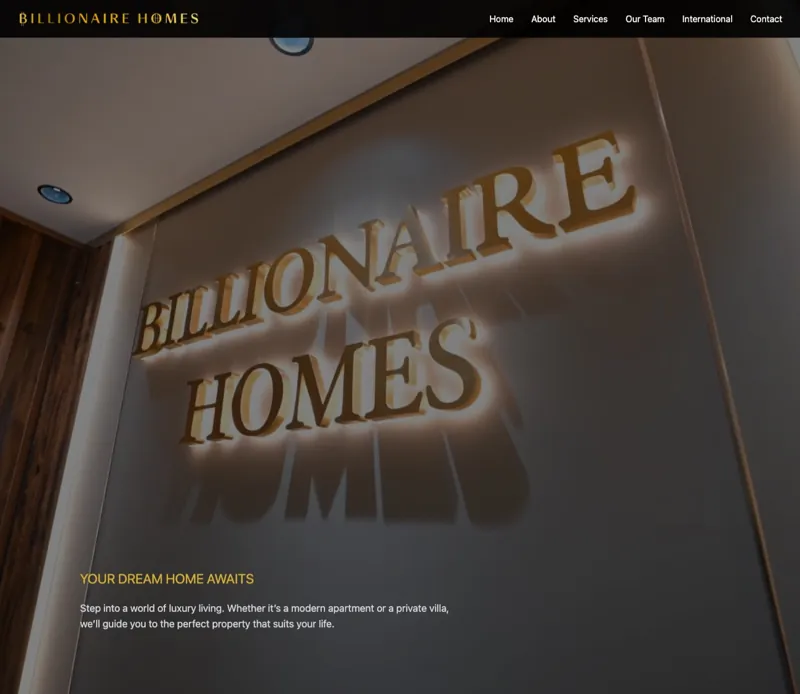
Website · Luxury real estate · Dubai
A brokerage at the top of the Dubai market, where the buyer judges the agency by its website first.
billionairehomesdubai.com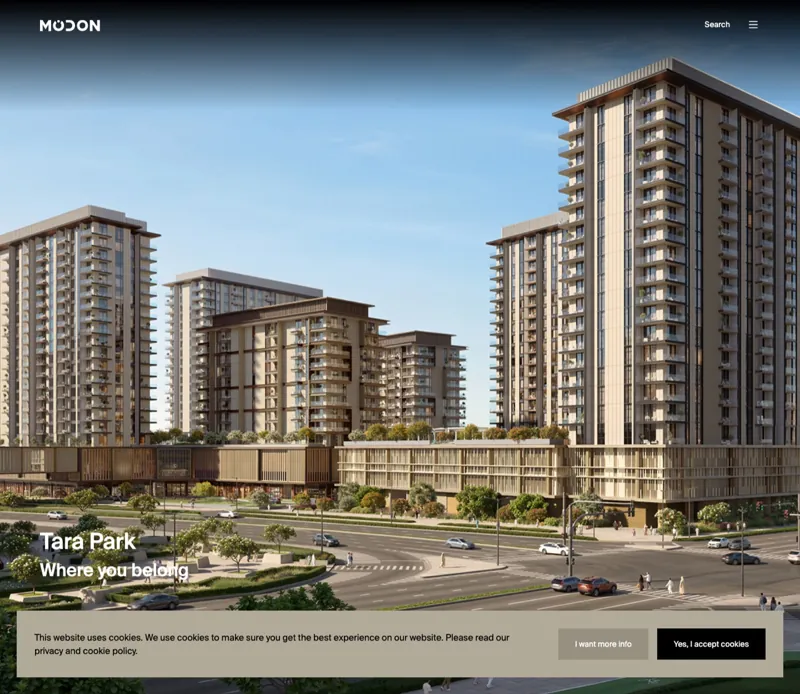
Website · Property development · Abu Dhabi
An ADX listed holding company building master planned communities, with a site that holds investors and residents at once.
modon.com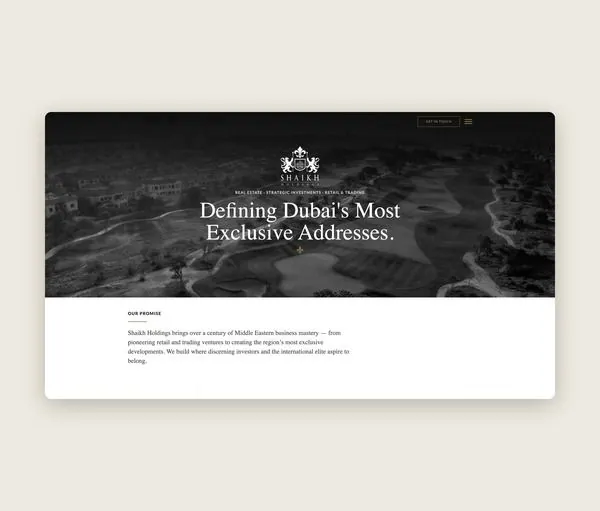
Website · Corporate · Dubai
A Dubai investment house with a century of business behind it. The site speaks to institutional investors, not shoppers.
shaikhholdings.comStraight answers
Usually, yes. Most Dubai agencies already export listings to Bayut, Property Finder or Dubizzle, and that same feed, or an export from your CRM, can often populate your own site so a listing only has to be entered once.
The Dubai Land Department's real estate ad permit service, run through the Trakheesi system and supervised by RERA, covers online advertisements alongside print and outdoor media. Confirm the current requirement for your listings directly with the Dubai Land Department, since this is not legal advice.
Yes, with separate search filters and listing fields for each, since a renter and a buyer look for different information. Off plan projects usually get their own page type again, built around a payment plan and handover timeline rather than a price and move in date.
Each listing is normally tied to a named agent or a team inbox, so an enquiry routes automatically and includes the property reference, the visitor's message and which page they were on.
Every project gets a fixed written quote scoped to your brief, sent within 45 minutes during business hours with no obligation. Listing volume, the number of languages and whether you need a CRM connection are the main drivers.
Sources
Fixed price, in writing
Got it. Your quote is being written now.
In business hours you will have it within 45 minutes. Check your inbox for the confirmation.