
Searchable catalogue, the core of Dubai manufacturing website design
Categories, materials, dimensions and applications a buyer can filter by, rather than a single page listing everything with no structure.
Web Design by Industry
Manufacturing website design in Dubai for factories, fabricators and industrial suppliers: product data buyers can actually search, a downloadable spec library, and an enquiry route that reaches sales with the right detail attached.
A manufacturing or industrial supply website in Dubai is rarely selling to a browsing consumer. The visitor is a procurement officer, an engineer or a buyer with a specification in hand, checking whether your factory can actually make what they need before they pick up the phone. Manufacturing website design in Dubai has to answer that question on the page, with real product data, not a single contact form standing in for a catalogue.
This is part of our wider web design and website development work. The detail below is specific to factories, fabricators and industrial suppliers rather than a general services template, and it goes well beyond a single landing page: a manufacturer’s site in Dubai usually needs to carry hundreds or thousands of items, a document library, and an enquiry process a busy buyer can complete in one sitting.
What the site has to do
A buyer with a spec sheet needs different pages than a retail shopper, and manufacturing website design in Dubai should be built around that difference.
Categories, materials, dimensions and applications a buyer can filter by, rather than a single page listing everything with no structure.
Downloadable technical documents against each product so an engineer can check compliance before contacting your sales team.
A form that captures specification, quantity and delivery location in one step, so the first reply from your team can be useful rather than a request for more information.
What the factory can actually produce, at what scale, described honestly rather than as a general “about us” page.
A separate route for existing trade partners, kept apart from the general enquiry form so account holders are not treated like a first time visitor.
What markets you already export to, and what documentation a buyer can expect to receive with an order, without promising specific timelines.
The buyer
The person approving a factory or industrial supplier website in Dubai is rarely a marketing hire. On a smaller manufacturer it is usually the owner or general manager, who is measured on order intake and factory utilisation and wants the site to stop tying up the sales team with unqualified enquiries. On a larger industrial group it is more often a commercial or sales director, who is measured on the quality of leads reaching the pipeline and how quickly a specification turns into a quotation, not on visitor numbers or design trends.
In the first meeting, this buyer asks practical questions rather than creative ones: can the site hold the full part range without a developer touching it every week, can a distributor log in and see their own pricing, and can the enquiry form capture enough detail that the first reply from sales does not have to start with “can you tell us more about what you need”. Manufacturing website design in Dubai earns approval by answering those questions concretely, with a working demonstration of the catalogue and the enquiry flow, not with a mood board.
On a factory with an in house engineering function, a technical manager is sometimes pulled into the sign off too, usually to check that spec sheets and tolerances are represented correctly before anything goes live, since a wrong figure on a product page is a far more costly mistake for a manufacturer than it would be on a retail site. This is one of the clearest differences between manufacturing website design in Dubai and a general business site: the person approving the build is checking for accuracy as much as for appearance, and a proposal that only shows visual mockups without a working catalogue structure rarely gets past this stage.
Product data
Many industrial suppliers already hold accurate product data somewhere, usually a spreadsheet or an ERP export, and the mistake is treating the website as a separate task that starts from nothing. Manufacturing website design in Dubai works better when the site imports from what you already maintain, then lets you correct and extend it through a content management system rather than asking a developer for every change.
Categories should reflect how a buyer actually searches, by application or material, not only by your internal department structure, which rarely matches how a customer thinks about the problem they are solving. A pipe fitting supplier, for example, is usually searched by material and pressure rating first and by internal product family a distant second, so the filter structure on the site should follow the buyer’s language rather than the factory’s own naming convention.
The buyer’s journey
A technical buyer moves through a manufacturing website in a fairly predictable order, and each step is where a badly built site loses them.
The visitor usually already knows the material, dimension or application they need, often from an internal bill of materials, so a homepage built around brand storytelling rather than a search or category entry point wastes the first click.
If the catalogue cannot be filtered by the fields that matter for that category, the buyer either gives up or falls back to a generic enquiry, which produces a weaker lead than a filtered one would.
A missing or outdated datasheet is where a technically qualified buyer drops off, since they will not put a product forward internally without documentation to attach to their own request.
By this point the buyer expects the form to already know what they were looking at, and a generic “name, email, message” form after a detailed browsing session feels like a step backwards.
A reply that ignores the specification and asks the buyer to repeat themselves is the single most common reason a qualified enquiry goes to a competitor instead.
Regulatory angle, not legal advice
UAE manufacturers sit under the Ministry of Industry and Advanced Technology’s own services directory, which we opened directly and which lists several services worth understanding before a factory publishes claims on its website. Industrial Registry services require industrial establishments to register and keep their data current, a requirement that sits under Federal Decree Law No. 25 of 2022 and its executive regulations. Conformity Certificate Services cover both regulated and non regulated products, including specific categories such as vehicles, drones, tyres and efficiency labelled goods, and issue the certificates that prove a product meets the relevant technical requirement. A separate National Conformity Mark service lets a manufacturer apply to display the UAE’s own compliance mark once that requirement is met. In Country Value certification, issued after a factory assessment, scores a supplier’s contribution to the local economy and can affect how a bid is scored in a government or semi government tender. MoIAT also runs Halal Certification Services, relevant to manufacturers of food, cosmetics or other Halal sensitive products.
Any of these that genuinely apply to your business are worth stating accurately on the site, since a serious buyer’s compliance team will often ask to see the certificate itself rather than take a webpage at its word. Product safety, packaging and export documentation vary by industry and destination market, and rules can change. If your products are regulated, for example food contact materials or construction products, check current requirements with MoIAT or your export compliance adviser rather than relying on this page, and only publish a certification, registry or ICV claim your business can currently document. This is not legal advice.
Distributors and export
A manufacturer’s website often serves two very different audiences at once, and treating them the same loses both.
A trade partner already knows your product range and wants their own pricing, order history or account manager, not a public enquiry form that treats them like a stranger. A simple login area, even a lightweight one connected to your existing systems rather than a full custom build, removes friction from a relationship you already have.
A buyer researching a new supplier abroad wants to know which markets you already export to and what documentation typically accompanies an order, such as a certificate of origin or packing list, described in general terms rather than promised as automatic for every shipment, since export documentation and customs requirements depend on the destination country and product.
Export documentation and customs procedures for shipments leaving the UAE sit with Dubai Customs and the relevant free zone or federal authority for your product category. State only the documentation you can currently provide and confirm requirements with your customs broker before publishing specific claims.
Free zones and mainland
Many UAE factories operate from an industrial free zone such as Jebel Ali or Dubai Industrial City, while others hold a mainland industrial licence, and the difference affects the website in a couple of practical ways rather than the design itself. A free zone manufacturer’s site usually needs to be clear about which markets it can sell into directly and which require a local distributor or mainland partner, since free zone and mainland trading rights are not the same and a vague “we ship anywhere” claim can mislead a buyer checking that detail. A mainland manufacturer bidding into government or semi government tenders is also the group most likely to need the In Country Value certification referenced above, since ICV scoring generally applies to procurement inside the UAE rather than to export sales.
None of this is legal or customs advice, and the practical detail of what a specific free zone or mainland licence permits should be confirmed with the relevant free zone authority or your company’s own legal adviser before it is stated on the website. What the site can safely do is describe your actual licence type and trading structure accurately, without implying a market access the business does not currently have.
Capability content
A technical buyer wants to know whether your factory can genuinely deliver at the scale their project needs, described specifically rather than as a general promise.
What processes the factory actually runs, for example cutting, moulding, assembly or finishing, so a buyer can tell whether a custom requirement is even possible before they ask.
General statements about shift patterns or production capacity are useful, provided they are accurate and not stated as a fixed output figure the business cannot actually commit to for every order.
What inspection or testing happens before a product ships, described as a process rather than a vague claim of “strict quality control” with nothing behind it.
Integrations
A catalogue of any real size is easier to maintain when the website connects to systems you already run, rather than duplicating data entry.
Systems such as SAP Business One, Odoo or Zoho hold product codes, stock status and pricing tiers that many manufacturers already maintain, and a website can import from a scheduled export rather than duplicating that data by hand.
Where a catalogue runs into thousands of variants, a dedicated product information system feeding the website keeps specification, image and document data consistent across the catalogue and any distributor facing systems.
A request for quote submitted on the site works better when it reaches the right regional or product line contact automatically, rather than landing in one shared inbox for every enquiry regardless of what was requested.
Ongoing data
A catalogue that goes stale is worse than a smaller one that stays accurate. Stock or availability status, where you choose to show it, needs an owner who updates it on a defined schedule rather than leaving it to whoever remembers. Certification and registry information should be checked whenever a certificate renews, since an expired certification shown as current is exactly the kind of gap a compliance focused buyer will catch. Pricing tiers for distributors, where they exist behind a login, change often enough that they usually need to sync from the same system your sales team already quotes from, rather than being maintained separately on the website.
Deciding who owns each of these updates, sales, operations or a specific admin role, before launch avoids the common failure mode where a website looks abandoned within months simply because nobody was assigned to keep it current.
What stops a buyer
These problems repeat across manufacturing and industrial supplier websites we review.
A PDF catalogue or a single long page forces a buyer to read everything to find one part. A structured, filterable catalogue, the kind good manufacturing website design in Dubai produces, gets a serious buyer to the right product in under a minute instead.
“Name, email, message” tells your sales team nothing about what is actually needed. A request for quote form with specification, quantity and delivery fields lets the first reply move the conversation forward, and it is one of the smallest changes with the biggest effect on manufacturing website design in Dubai.
An existing trade partner forced through the same public enquiry form as a stranger, with no account area or reference to the relationship you already have, reads as indifferent rather than efficient.
A spec sheet that still shows a discontinued product code or an old standard reference undermines trust in everything else on the page, even where the rest of the catalogue is accurate.
More mistakes we see
These come up less often than a missing filter or a weak form, but they are just as costly once a buyer notices them.
“World class” and “state of the art” tell a technical buyer nothing. Naming the actual processes, equipment categories or capacity a factory runs, described plainly, does more to build confidence than any amount of promotional language, and it is one of the fastest fixes on an existing manufacturing website.
Procurement officers and site engineers increasingly check a supplier’s catalogue from a phone on a factory floor or in a meeting, and a filter or spec sheet that only works properly on a desktop screen loses that visitor at exactly the moment they were ready to act.
Search behaviour
Search behaviour in this industry splits fairly cleanly into two kinds. A research search looks for a category, standard or material, the kind of term an engineer types while still comparing options, for example a material and application combination rather than a brand name. A ready to buy search is narrower and more specific, often a part number, a product code already seen on a drawing, or a phrase that includes “supplier” or “manufacturer” alongside the exact product, which signals the buyer already knows what they want and is now choosing who to buy it from.
A manufacturing website in Dubai answers both kinds of search by giving categories their own page with genuine content, not just a filtered product grid, so a research stage search has somewhere useful to land, while individual product and part pages carry the specific codes and terms a ready to buy search is typing. No search volumes or click through figures are quoted here, since none have been verified for this page.
Content you supply
The build moves at the pace of the product data and documents you provide, not the design.
A spreadsheet that looked complete often turns out to be missing dimensions, materials or category assignments for a portion of the range, which has to be resolved before catalogue pages can be finished.
These are frequently scattered across different people or held as scanned paper copies, and gathering them into a single set ready for upload is often the single biggest source of delay on these projects.
Technical accuracy usually needs sign off from an engineering or quality contact, not only the person managing the website project, and building that review step into the schedule avoids late stage rewrites.
Language
Bilingual work matters here in a narrower way than on a consumer site.
Regulatory and compliance pages, and a company overview aimed at government or semi government buyers, are where a proper right to left Arabic version earns its place, since these are the pages a local procurement team is most likely to read in Arabic.
Detailed technical catalogues are frequently used by engineers and buyers who correspond in English regardless of first language, so translating every product page by default is often lower priority than getting the English data structure right first.
We agree which pages genuinely need a bilingual version with you rather than translating the whole catalogue by default, since a partial or inconsistent translation is worse than a clearly English only technical section.
How we work
The stages stay the same as any project, but the emphasis shifts toward data and verification.
You tell us what you need, who it is for and what it has to achieve. A short call or a WhatsApp message is enough to start.
A written scope and a fixed price within 45 minutes during business hours. No obligation.
Design, writing, production or build, done by the people who specialise in that exact work.
You see the work before it goes anywhere, comment in one place, and approve it.
Final files, live campaigns or a launched site, handed over with everything you need to use them.
Where the work is ongoing, we measure what happened and decide the next step with you.
Design
A catalogue heavy, technical site rewards restraint over decoration.
A product page often needs to show several dimensions, materials and downloads at once, so a template built for a handful of fields breaks down fast. Manufacturing website design in Dubai favours a structured spec table over decorative layout on these pages.
A buyer narrowing a catalogue by material, then dimension, then application expects the result count to update clearly at each step, with an obvious way to remove a filter, rather than a clever interaction that looks good but slows the search down.
Product photography and datasheet thumbnails add up quickly across a large catalogue, so image handling and page speed get more attention on a manufacturing site than the visual design itself.
| Catalogue approach | Works well when | Struggles when |
|---|---|---|
| Single long page, no filters | Under roughly twenty products with little variation | Range grows past a page a buyer can realistically scroll |
| Categories with filters, no ERP link | A stable range that changes rarely | Frequent changes mean the site drifts out of sync with reality |
| Categories fed from ERP or spreadsheet export | A large or frequently updated range | Underlying data is incomplete or inconsistently coded |
| Full product information management system | Thousands of variants across multiple brands or lines | The ongoing cost is not matched by the size of the catalogue |
| Public buyer enquiry | Existing distributor or reseller | |
|---|---|---|
| Entry point | Public request for quote form | Account login, where one is built |
| What they see | Standard catalogue and published information | Their own pricing tier and order history, if connected |
| What the form captures | Specification, quantity, delivery location | Order reference or account number, not a repeat introduction |
| Where it routes | General or regional sales contact | The account’s named contact where one exists |
A spec sheet that opens in one click is worth more to an industrial buyer than any amount of homepage copy.
How we build it
Manufacturing website design in Dubai starts from your product data, not from a template of pages.
We review your existing spreadsheet, catalogue or ERP export and agree how it maps to categories, filters and individual product pages.
Spec sheets, certifications, images and technical copy are collected against a checklist before design starts, so nothing is missing at launch.
Templates for the catalogue, category and product pages are approved, then built into a content management system your team can update directly without waiting on a developer for every change.
Search and filters are tested against your real catalogue size, tracking is connected, and domain, hosting and CMS logins are handed to you in your own name.
Phasing
The first version of a manufacturing website should carry the full catalogue structure, working search and filters, spec sheets against every product that has one, and a request for quote form that actually reaches the right team. That core is what a buyer or a procurement check reads first, so it should not be compromised to launch faster with a distributor login or live stock feed half finished.
A sensible phase two adds the things that depend on internal systems being ready rather than on design or content: a distributor login connected to your ERP, live stock or availability status, a second language for pages where it genuinely earns its place, and analytics detailed enough to show which categories generate the most qualified enquiries so the catalogue structure can be refined with real usage rather than a guess.
Measuring it
The owner or sales director judges the site on the quality of what reaches the sales team, not on visitor counts.
A rising share of request for quote submissions that already state specification and quantity, compared with vague general messages, shows the form is doing its job.
Which categories get their datasheets opened most often is a useful, honest signal of where real buyer interest sits, without needing an invented benchmark to be meaningful.
How quickly a specific, detailed enquiry gets a specific, useful reply is a fair measure of whether manufacturing website design in Dubai and the sales process behind it are actually working together.
Hosting and access
Ownership questions come up early on an industrial project, usually from whoever manages IT rather than marketing.
Every manufacturing website design in Dubai project we build hands over the domain, hosting account and content management system logins to you directly, not to an agency held account, so the site is never locked to a supplier relationship.
A sales team updating enquiry routing needs different access to an engineering contact updating spec sheets, and setting that up properly at launch avoids someone accidentally editing a page they should not touch.
Three visitors, one site
Manufacturing website design in Dubai rarely has one audience, and treating every visitor the same is where a lot of these sites fall short.
Comparing several manufacturers before shortlisting, this visitor reads capability, certification and category content before ever reaching a product page, and a manufacturing website design in Dubai that skips this content loses them before the catalogue is even opened.
Already has a specification and wants the datasheet fast, so a manufacturing website in Dubai built around this visitor needs its search and filters to work well, not just look tidy.
Wants their own pricing and order history rather than the general public catalogue, and a manufacturing website design in Dubai that ignores this visitor pushes a valuable relationship back into email and phone calls it had already moved past.
Swapping an industry name into a generic web design template produces a page that reads the same as fifty others, and it produces a website that behaves the same way too: a catalogue that cannot be filtered, a contact form that cannot capture a specification, and no honest answer to the regulatory questions a compliance minded buyer actually asks. Manufacturing website design in Dubai only earns its keep when it is built around a factory’s real product data, its real certifications, and the real difference between a public enquiry and an existing distributor relationship. Everything on this page, from the catalogue structure to the request for quote fields to the Ministry of Industry and Advanced Technology services referenced above, is written for that specific brief rather than adapted from a general service page.
We treat manufacturing website design in Dubai as a long technical buying cycle rather than a single transaction, since the same visitor may return several times across weeks or months while a specification is finalised internally, before a request for quote is ever submitted. A site that keeps a returning technical buyer oriented, with a consistent catalogue structure and datasheets that do not disappear or change address between visits, supports that cycle far better than a site optimised only for a single fast conversion. That patience is built into how we scope and deliver manufacturing website design in Dubai from the first brief through to launch and the improvements that follow it.
Manufacturing sites share ground with other technical, catalogue heavy sectors. See our approach to construction websites, IT and telecom websites and oil and gas websites, or start from the web design by industry hub. For structuring a large product catalogue with online ordering, see our ecommerce solutions page, and for the wider capability driven pattern this sector shares with other business buyers, see B2B website design. If your ERP or catalogue needs a dedicated integration built rather than a standard export, our ERP developer and API integration developer pages cover that work, and UI UX design covers how we design a filterable catalogue that stays usable as it grows. Search visibility for product and category searches is covered under SEO services.
Selected work
Work across sectors, with the closest to this industry shown first. Every one is a live site, not a mockup.

Website · Property development · Abu Dhabi
An ADX listed holding company building master planned communities, with a site that holds investors and residents at once.
modon.com
Website · Furniture · Middle East
A design led furniture brand that launched with no digital home, now shown as carefully as its pieces.
stulo.com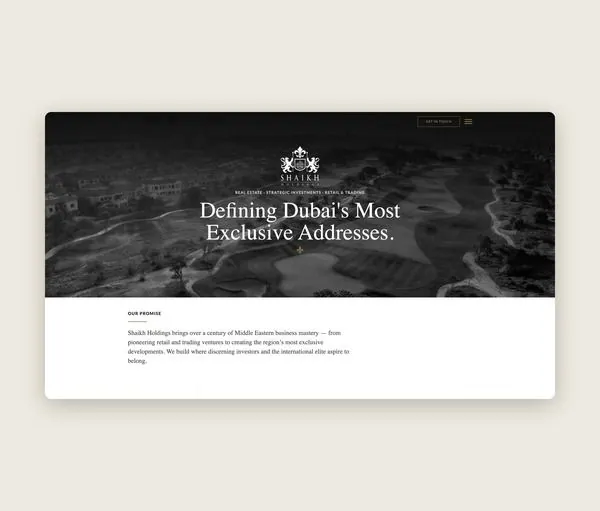
Website · Corporate · Dubai
A Dubai investment house with a century of business behind it. The site speaks to institutional investors, not shoppers.
shaikhholdings.comStraight answers
Yes. We structure catalogues by category, application or material so a buyer can filter down rather than scroll through everything, and we can pull data from a spreadsheet or ERP export rather than asking you to enter every item by hand.
Most industrial buyers expect to request a quote rather than see a fixed price, since cost depends on volume, specification and delivery terms. We design the enquiry step so the buyer only has to state what they need once.
Yes, downloadable spec sheets, datasheets and certificates can sit against each product or category so a buyer's technical team can check compliance before they ever contact sales.
Where it is useful, yes. Many industrial buyers correspond in English even when Arabic is their first language, so we agree with you which pages genuinely need a bilingual version rather than translating everything by default.
Every project gets a fixed written quote, scoped to your brief, sent within 45 minutes during business hours with no obligation. Catalogue size, the number of product categories and any ERP integration are the main cost drivers.
Sources
Fixed price, in writing
Got it. Your quote is being written now.
In business hours you will have it within 45 minutes. Check your inbox for the confirmation.