
Finance website product pages
Plain language pages describing how each product or policy type works, written for a first time reader rather than an existing client.
Web Design by Industry
Finance website design in Dubai for advisers, brokers and insurance intermediaries, built around product explanations, licence disclosure and enquiry forms that stay inside what a licensed activity allows.
Finance website design in Dubai has to earn trust before it earns a click through to an enquiry form, because a visitor comparing advisers, brokers or insurers is deciding who to trust with money, not just who has the nicest homepage. That trust comes from clarity rather than polish: clear product explanations, visible licensing information, and wording that never promises more than a licensed financial activity is allowed to promise.
This page covers the pages a Dubai finance or insurance site needs, where regulatory bodies touch the content, and the wording choices that keep a site both persuasive and compliant, since finance website design in Dubai is judged on trust before it is judged on style.
Core pages
A finance or insurance visitor is usually trying to understand a product and decide whether to speak to someone, in that order.
Plain language pages describing how each product or policy type works, written for a first time reader rather than an existing client.
A clear statement of which body licenses your activity, shown consistently across the site rather than buried in a footer link.
Names, qualifications and areas of focus, so a visitor can choose who they would rather speak to before making contact.
Forms that gather enough detail to route an enquiry to the right adviser without collecting sensitive financial information online.
A clear explanation of how personal and financial information submitted through the site is handled and stored.
Arabic and English versions carrying equal detail, since financial decisions are rarely made from a shortened translation.
Regulated activity
Financial activity in the UAE sits with more than one regulator depending on what a business actually does. The Capital Market Authority regulates securities trading, public companies, investment funds and disclosure requirements on the mainland, while banking and insurance activity sits with the Central Bank of the UAE. A finance or insurance website should reflect whichever regulator applies to the business, and that starts with checking your own licensing category rather than assuming a general finance template covers it.
This is not legal advice, and it does not attempt to summarise every rule a specific licensed activity must follow. Confirm current advertising and disclosure requirements directly with your regulator, and route any product wording through your compliance team before it goes live, not only at launch.
DIFC and ADGM entities
A growing number of the advisers, brokers and fund managers we build for are not licensed on the UAE mainland at all. They sit inside the Dubai International Financial Centre or Abu Dhabi Global Market, two financial free zones with their own regulators and their own rulebooks, and a website for a DIFC or ADGM entity has to follow those rules rather than a generic Dubai finance template. Good finance website design in Dubai starts by working out which regulator, mainland, DIFC or ADGM, actually applies before a single page is drawn.
The Dubai Financial Services Authority, the DIFC’s independent regulator, operates a Financial Promotions Prohibition under Article 41A of the DIFC Regulatory Law 2004. In a guide published to explain it, the DFSA defines a Financial Promotion broadly, as any communication that invites or induces someone to take up a financial service or product, which on a website means the homepage, the product pages and the enquiry form all count. Under that guide, it is unlawful to make a Financial Promotion in or from the DIFC unless the person making it is DFSA authorised, is licensed by another UAE financial regulator such as the Central Bank, is a reporting entity making a mandatory disclosure, or the communication is specifically exempt. A communication counts as exempt where it is approved by an authorised firm, made only to professional clients who are not individuals, made to someone who has actively asked for it, issued by a government or non commercial government entity, or made incidentally in the course of legal or accountancy services, and a website falling outside all of those categories needs the promotion to come from, or be approved by, an authorised person before it goes live. Every Financial Promotion the DFSA allows must be clear, fair and not misleading, must show the firm’s name, address and regulatory status, and, where it shows past performance or a forecast built on past performance, must present a balanced view, explain how the figures were derived, and carry a prominent warning that past performance is not a reliable guide to future performance.
The Abu Dhabi Global Market runs a parallel restriction under its own Financial Services and Markets Regulations 2015. Section 18 of that Regulations sets out that a person must not, in the course of business, communicate an invitation or inducement to engage in investment activity, unless that person is an authorised or exempt person in ADGM, is licensed and supervised by a UAE financial services regulator, has the communication approved by an authorised person, or the communication falls under a listed exemption.
None of this is legal advice, and neither guide is a substitute for reading the current DFSA or FSRA rulebook with your own compliance adviser. What it means in practice for a website build is that a DIFC or ADGM entity needs its regulatory status, registration number and the applicable regulator named clearly, that any performance figures on the site need the balanced view and the past performance warning built into the page layout rather than added as an afterthought, and that content aimed at professional clients needs to say so and to be kept away from anyone who does not meet that definition. Getting that structure right is a core part of finance website design in Dubai for any firm licensed in a financial free zone.
Most finance and insurance activity outside the free zones sits with the Central Bank of the UAE, and the Central Bank’s own Consumer Protection Standards reach further into a website than most clients expect before we explain it. Article 2 of those Standards, on Disclosure and Transparency, requires licensed financial institutions to apply disclosure rules across every channel including websites and mobile apps, to publish that disclosure information in both Arabic and English, and to display the institution’s full legal name and a regulatory disclosure statement naming the Central Bank as licensor on transaction documents and marketing material. It also requires a schedule of fees, including third party fees, to be clearly on display on the institution’s website, and it sets out a Key Facts Statement that must be given to a consumer before a product is sold, written in clear language and, where it carries a warning, shown in a highlighted box in bold type rather than buried in small print.
Article 5 of the same Standards, on Business Conduct, is just as relevant to how a site is built. It requires marketing and advertising communications to respect a consumer’s expressed consent and preferences, treats a consumer as opted out of promotional contact unless they have actively opted in, and bars licensed institutions from marketing loans or financing to individual consumers by cold telephone call. It also prohibits sending direct advertising or promotional material to anyone under 18, and it requires that the design, marketing, sale and distribution of a product be appropriate for the consumer segment it targets, with a documented suitability assessment behind anything that goes beyond generic product information. A Dubai website built around finance products has to design its consent and preference settings with that opt in requirement in mind from the first wireframe.
For a website, the practical consequences are specific rather than abstract. A newsletter or enquiry form signup needs a genuine opt in, not a pre ticked box. A fee schedule, where the institution publishes one, belongs on the site itself rather than only in a branch. A Key Facts Statement, where your compliance team produces one, deserves its own clearly linked page rather than a download buried three clicks deep. Age gating on marketing content, and a documented rationale for who a given product page is written for, both need to exist before launch, not retrofitted after a Central Bank review, which is one more reason finance website design in Dubai takes longer to plan properly than most industries this section of the site covers. This is a summary of two articles in a long Standards document, not legal advice, and your compliance function should confirm current requirements against the full Consumer Protection Regulation.
Where a business on this page is an insurance broker rather than a bank or an investment adviser, a specific regulation applies. The Central Bank’s Insurance Brokers’ Regulation, which took effect in February 2025 after the Central Bank absorbed the functions of the former Insurance Authority, sets out the conditions for licensing an insurance broker, the rights and obligations a broker owes to insurance companies and clients, and the Central Bank’s powers of supervision. It requires an insurance broker to hold valid brokerage agreements with at least two insurance companies, and those agreements must be fair and disclose all material contractual rights and obligations, which is a useful discipline to carry across into how a broker’s website describes which insurers it places business with. Reflecting that structure honestly is a small but important part of finance website design in Dubai for any broker operating under a Central Bank licence.
The Regulation does not set website content rules line by line, and this page does not attempt to summarise a document written for licensing and prudential supervision rather than marketing. What it does establish, and what a broker’s site should reflect, is that the broker operates under a Central Bank licence with defined obligations toward clients, that the broker’s relationship with each insurer is a documented one rather than an informal referral, and that regulatory scrutiny of an insurance broker’s conduct is active and current, not a historic footnote from a regulator that no longer exists. A broker profile page that states the licence clearly, and product pages that avoid implying an exclusive or unusually close relationship with a specific insurer unless that relationship is genuinely documented, both sit comfortably inside what the Regulation expects. Confirm current obligations with the Central Bank directly, since this is not legal advice.
The Insurance Brokers’ Regulation also names, among the earlier instruments it builds on, the Insurance Authority’s 2020 resolution concerning electronic insurance, which is a useful reminder that online insurance activity in the UAE has been subject to its own dedicated rules for several years now, not treated as an unregulated extension of a paper based business. We have not reviewed that resolution’s full text directly, so we do not summarise its detail here, and any business planning to sell or bind cover entirely online should ask the Central Bank specifically what applies to electronic distribution of its products, rather than assume a general website build covers it. Where a client is ready to sell online, this is one of the first questions worth raising with the Central Bank before finance website design in Dubai moves past the planning stage.
Compliance review is usually treated as a launch gate, a checkpoint the site passes once before going live. On a finance or insurance site that assumption causes more problems than it solves, because rates change, products are withdrawn, adviser rosters turn over and regulators update their own guidance, and every one of those events can make previously approved wording wrong without anyone editing the page. A finance or insurance client is better served by a simple change control habit: any edit to a product page, a rate, a disclosure statement or an adviser profile goes through the same named compliance contact who signed off the original wording, with a record of what changed and when, rather than being treated as a routine content update anyone on the marketing team can make directly.
This matters most at two points. The first is a rate or fee change, where the gap between the rate changing internally and the website updating is exactly the kind of gap the Central Bank’s disclosure rules are written to close. The second is a product being withdrawn or amended, where an old product page left live after the product itself has changed creates a genuine risk that a visitor enquires about terms that no longer exist. Building the site with product content held in a small number of clearly owned places, rather than duplicated across several pages, makes both of these updates faster and less likely to be missed. This is a build decision as much as a governance one, and it belongs in the finance website design in Dubai brief from the start rather than as a fix applied after the first missed update.
What stops an enquiry
A cautious buyer of a financial product is easily put off, and it usually comes down to one of these habits.
| Common habit | Why a cautious visitor reacts badly | The fix |
|---|---|---|
| Product pages written in dense policy language | A visitor cannot tell if the product fits their situation | Plain explanations first, technical detail available further down |
| No licence or regulator information visible | A cautious visitor leaves to check elsewhere and may not return | Consistent, visible disclosure across every relevant page |
| One generic contact form for every product | Advisers chase basic details before they can respond properly | Enquiry forms tailored to the product being asked about |
A finance or insurance website rarely has one decision maker, and knowing who they are early changes how the project runs. At a bank or an insurer, the person commissioning the site is usually in marketing, but the person who determines whether any given sentence can go live is compliance, and the two do not always agree on timeline. At a boutique advisory or a broker, the founder often plays both roles, which speeds up small decisions but slows down anything that touches a licence condition they are not completely sure about, and rightly pauses to check. At a DIFC or ADGM entity, a designated compliance officer or the firm’s authorised individual for financial promotions is frequently a named, personally accountable role, and their sign off is not optional paperwork, it is the difference between a lawful and an unlawful promotion under the rules described above. Understanding who holds that authority is one of the first things worth establishing before finance website design in Dubai gets anywhere near a wireframe.
What every one of these buyers asks about in the first meeting is remarkably consistent: what happens if compliance rejects a page after design is finished, who owns the wording once the site is live, and whether the agency understands that a finance site is judged by a different, stricter standard than a restaurant or a gym website. Answering those questions honestly at the brief stage, rather than promising an easy compliance pass we cannot control, is what keeps a finance or insurance project on schedule, and it is a conversation every finance website design in Dubai brief should include on day one.
The buyer’s journey
A finance or insurance visitor moves through one of three journeys, and a site that treats them as one journey loses people at the point where the wrong questions are asked.
| Journey | What it asks for | Where it usually ends |
|---|---|---|
| Insurance quote or eligibility check | Cover type, sums insured or asset value, basic risk or health questions, no sensitive financial data collected online | An indicative quote or eligibility result, followed by a call from an adviser to confirm and formalise it |
| Adviser enquiry | Name, contact details, the general nature of the enquiry, sometimes an approximate investable amount as a range rather than an exact figure | Routed to the adviser or broker best placed to respond, usually by phone or a booked call |
| Full online account opening | Identity documents, proof of address, source of funds declarations and a formal application form, usually behind identity verification | An account or policy reference number, with onboarding continuing off the public website inside a secure client portal built as part of the wider finance website design in Dubai project |
Product disclosure
A product page on a finance or insurance site is not a sales page with extra caution added, it is a disclosure document that also has to read well. The most common failure we see is a product page written entirely in marketing language, with the actual terms, exclusions and costs pushed into a separate policy wording document that almost no visitor opens before enquiring. A better structure treats the policy wording or terms document as the source of truth and summarises it accurately on the page, rather than writing independent marketing copy and hoping it does not contradict the document compliance already approved.
Illustrative examples deserve particular care. A worked example showing how a premium or a return might behave under one set of assumptions helps a first time reader understand a product, but every such example needs a clear illustrative label, the assumptions stated next to the number, and, where relevant, the same past performance warning covered under DIFC and Central Bank rules above.
Behind the site
A finance or insurance site depends on information that changes on its own schedule, supplied by people who are not usually thinking about the website.
Interest rates, premium bands or fund performance figures that change on a schedule set by treasury, actuarial or investment teams, not by whoever last updated the site.
Approved product literature that has its own version control, where the website needs to track which version is currently live and retire the old one properly.
Who is currently licensed, qualified and available to take enquiries, since an adviser who has left the firm should not still be collecting leads through their profile page.
A provider that checks a document and a face against it before an account opens, feeding a result back into the site’s application flow rather than a manual review queue alone.
Wherever adviser and broker teams already track clients, an enquiry from the website should land there directly rather than in an inbox someone checks once a day.
The system of record for policies or accounts is rarely replaced by a website project, so the site’s job is usually to connect cleanly to it, not to duplicate it.
Search behaviour in this industry splits fairly cleanly into two intents, and a site structured for only one of them loses the other. A research search looks like a question: what is family takaful, how does a Dubai life policy pay out, what does a broker actually do that a direct insurer does not. Someone typing that is usually weeks away from applying and wants to understand a concept, not receive a quote form. A ready to buy search names the product and often the city: life insurance quote Dubai, motor insurance broker Dubai, wealth adviser Dubai. Someone typing that is close to a decision and wants a fast, clear route to speak to someone or start a quote.
Product and explainer pages answer the first intent, and they belong on the site regardless of how directly they convert, because a visitor who finds a clear answer to a research question tends to come back when they are ready to buy. Enquiry and quote pages answer the second intent, and they need to be reachable in one or two clicks from anywhere on the site, not just from the homepage. No search volume figures are quoted here, since we have not measured them for your specific products, but the pattern of research search against ready to buy search holds consistently across the finance and insurance sites we have built.
Getting started
A finance or insurance build is unusually dependent on documents that already exist inside the business before design starts, and the single biggest cause of delay is not design revisions, it is waiting on a document that compliance has not finished approving yet.
Phasing
Launching everything at once usually means launching nothing on time, since every additional product multiplies the compliance review queue, and staging the launch is a normal part of finance website design in Dubai rather than a sign the project is behind.
| Stage | What it usually includes |
|---|---|
| Phase one | Homepage, licence and regulator disclosure, one or two priority product pages, adviser profiles, a single enquiry form |
| Phase two | The remaining product range, quote or eligibility tools, a second language built out in full, and a client portal login if one is planned |
Arabic matters for a different reason on a finance or insurance site than it does for most other industries. Under the Central Bank’s Consumer Protection Standards described earlier, disclosure information for licensed financial institutions must be available in both Arabic and English, which turns Arabic from a nice to have into a stated requirement for a large share of the businesses this page is written for, and into a genuine part of finance website design in Dubai rather than an optional extra. A shortened or loosely translated Arabic version, common on general business sites, is a genuine risk here, because a client reading a family takaful product description or a policy exclusion in Arabic needs the same level of detail as the English version, not a summary of it.
The practical implication for a build is that Arabic product and disclosure pages need a translator who understands financial and insurance terminology specifically, and that compliance sign off should cover the Arabic wording as its own review, not as an assumed mirror of an approved English page. A right to left layout that keeps tables, forms and comparison structures legible in Arabic is a design requirement on top of the translation itself, and it is one of the areas where finance website design in Dubai differs most from a single language site aimed only at English readers.
The Central Bank’s Consumer Protection Standards ask licensed institutions to track service performance, including how quickly they acknowledge, respond to and resolve a consumer complaint, and that expectation sits oddly with the number of finance and insurance sites we review that have no visible route to raise a complaint at all. A cautious visitor deciding whether to trust a firm with money reads the absence of a complaints route as a warning sign, not as a sign that complaints never happen. A short, clearly linked page explaining how to raise a concern, who handles it, and roughly how quickly a response can be expected, is a small addition that does real work for trust, and it gives the business itself a documented channel it can point to if a regulator ever asks how complaints are handled.
This does not need to be elaborate. A named contact or department, an email address or form, and a plain statement of the general process is usually enough for a first version, with anything more formal, such as published response time targets, added once the business has agreed internally what it can reliably commit to. What matters is that the page exists, is easy to find from the footer or a product page, and is not confused with the general sales enquiry form, since a complaint routed into the same queue as a new business enquiry tends to get the wrong kind of urgency applied to it. Small as it sounds, a clear complaints page is one of the more overlooked details in finance website design in Dubai, and one of the simplest to put right once someone notices it is missing.
What goes wrong
A page written and published before compliance has reviewed the final wording, then quietly edited later once someone notices, leaving no clear record of what was ever actually approved.
A rate, premium band or fund figure that changed weeks ago but is still showing on the site, because updating it was nobody’s specific job.
A shortened Arabic summary standing in for a full translation, which reads as an afterthought to an Arabic speaking client comparing it against the English page.
A generic enquiry form that cannot tell an adviser whether someone wants a pension review or a motor insurance quote, so the first reply is a request for information the form should have gathered. Careful finance website design in Dubai treats the enquiry form itself as a piece of product content, not an afterthought bolted onto the bottom of a page.
A profile for someone who has left the firm, still collecting enquiries months later, which is both a poor experience and a compliance gap if that person is no longer licensed.
A licence claim stated without a number or a way to check it, which is exactly the kind of unverifiable claim a cautious finance visitor is trained to distrust. Fixing this is rarely a design problem, but it is still part of finance website design in Dubai, since the licence detail has to sit somewhere a visitor will actually look.
The metric that matters most for a finance or insurance site is rarely the one a generic analytics dashboard highlights first. Raw enquiry volume is a weak signal on its own, since a form that collects unqualified enquiries can generate a high number that advisers then spend hours filtering. A more useful measure is how many enquiries an adviser or broker actually calls back and how many of those become a real conversation, which means the enquiry form fields matter as much as the traffic driving people to it. For insurance specifically, tracking how many quote or eligibility checks are actually completed, rather than abandoned partway through, tends to expose exactly which question in the flow is losing people. We do not publish invented benchmark numbers here, since a realistic target depends on your product, your price point and your existing reputation, and any number quoted without that context would not be honest. What we can say from building several of these sites is that finance website design in Dubai succeeds or fails on a small number of well built forms, not on the overall page count.
Our website development page sets out how we handle hosting and handover generally, product and disclosure wording is shaped alongside our copywriting services, and once a compliant version is live, SEO services can build visibility for product and adviser searches, with UI and UX design work on quote and application flows once the first version is live and being used.
Build and content
A finance or insurance build moves quickly once this is ready.
Every product or policy type the site should describe, and the regulator or licence that covers each one.
Names, qualifications and photographs for anyone who should appear with a public profile.
Who signs off wording before it goes live, and how quickly they can turn around a review during the project.
Any approved product literature that website copy should align with rather than contradict.
How long compliance sign off usually takes at your organisation, since that internal timeline, not the design work itself, is often what actually decides the launch date.
Our website development page sets out how we handle hosting and handover generally, product and disclosure wording is shaped alongside our copywriting services, and once a compliant version is live, SEO services can build visibility for product and adviser searches.
Related industries
Shares the same need for careful, non promissory wording around a licensed and regulated profession.
Relevant if your business also introduces clients to mortgage or property finance products alongside listings.
The complete list sits on our industry hub, covering every trade we design and build websites for.
A finance or insurance business often already has approved product literature, a compliance function and a defined licence category before a website project starts, and the site should be built to sit inside that existing structure rather than invent its own wording. Treating the site as another compliance surface, alongside brochures and disclosure documents, avoids the common trap of marketing copy drifting away from what the business is actually licensed and able to say. Finance website design in Dubai that ignores this usually needs a rewrite within months, once compliance reviews the live pages properly.
The businesses we build for in this space range from a two person mortgage brokerage working from a single Dubai office to a DIFC registered fund manager with a compliance department larger than its marketing team, and the website work looks different for each of them even where the underlying pages, forms and structure are similar. What stays constant is the discipline behind the build: nothing goes live that has not been checked against what the firm is actually licensed to say, every claim traces back to an approved document rather than to what reads well, and the site is built expecting to be updated as rates, products and regulatory guidance change, rather than treated as a one time project that is finished once it launches. That discipline, more than any specific page or feature, is what separates finance website design in Dubai from a general business website with a few extra disclaimers added.
Selected work
Work across sectors, with the closest to this industry shown first. Every one is a live site, not a mockup.

Mobile app · Fintech · United States
A fintech platform connecting merchants, customers and charities in a single payment flow.
purposepayment.com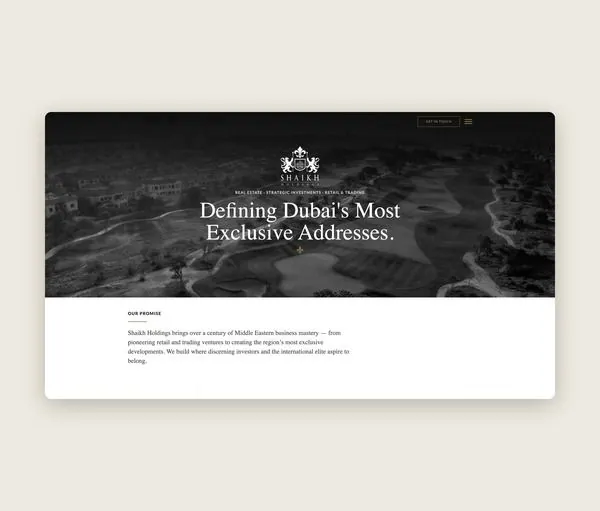
Website · Corporate · Dubai
A Dubai investment house with a century of business behind it. The site speaks to institutional investors, not shoppers.
shaikhholdings.com
Website · Property development · Abu Dhabi
An ADX listed holding company building master planned communities, with a site that holds investors and residents at once.
modon.comStraight answers
No. Promised returns, assured outcomes or headline rates sit outside what we write for a finance or insurance site, since these are the areas licensed financial activity is scrutinised most closely for. Product detail belongs in a proper disclosure document, not marketing copy, and that boundary shapes finance website design in Dubai more than any single page template does.
Showing which body licenses your activity, such as the Central Bank of the UAE for banking and insurance or the Capital Market Authority for trading and investment services, is common practice and builds trust with a cautious visitor. Confirm exactly what must be disclosed and how with your regulator directly.
Often the safer and more common pattern is an enquiry or eligibility check that routes to an adviser, rather than a full online application, particularly where identity verification and formal disclosure documents are required before any agreement.
Illustrative examples can help explain how a product works, but they need to be clearly marked as illustrative and reviewed by your compliance team, since a reader can mistake an example for a promise.
Every project gets a fixed written quote scoped to your brief, sent within 45 minutes during business hours with no obligation. The number of products, compliance review rounds and languages are the main cost drivers.
Sources
Fixed price, in writing
Got it. Your quote is being written now.
In business hours you will have it within 45 minutes. Check your inbox for the confirmation.