
Lawyers website practice area pages
A dedicated page per area of law, written in plain language first, with more technical detail further down for a reader who wants it.
Web Design by Industry
Lawyers website design in Dubai built around practice area pages, lawyer profiles and consultation requests, written to reflect the professional standards the Legal Affairs Department expects.
Lawyers website design in Dubai has to do two things at once: read as calm and professional to a visitor who is often dealing with a difficult situation, and describe services accurately enough that the wrong person does not enquire about the wrong matter. A generic corporate template rarely manages either, because it treats a law firm like any other consultancy rather than a regulated profession with its own standards for how it presents itself.
This page covers the pages a Dubai law firm or legal consultancy site needs, what the Legal Affairs Department regulates, and the practical wording choices that keep a site professional without sounding evasive. It goes into the working detail firms tend to ask about once they move past the first meeting: how DIFC and ADGM work differ from onshore courts, how a confidential enquiry should actually be handled once it lands, and what the site needs to keep current as a firm’s own team and practice areas change.
Core pages
A visitor to a law firm site is usually trying to work out two things quickly: does this firm handle my kind of matter, and can I speak to someone soon.
A dedicated page per area of law, written in plain language first, with more technical detail further down for a reader who wants it.
Qualifications, practice areas and languages spoken, so a visitor can see who they would actually be dealing with.
A short form that captures the general nature of a matter without asking someone to explain sensitive details before they have spoken to anyone.
Clarity on whether the firm operates onshore, in the DIFC, or across both, since that affects which court or arbitration process applies.
Arabic and English pages that carry equal weight, not a shortened Arabic summary of a longer English page.
A visible phone number and WhatsApp option, since a legal enquiry often starts as an urgent question rather than a browsing session.
Professional standards
The Legal Affairs Department of Dubai describes its role as licensing advocacy and legal consultancy, registering advocates and legal consultants, and regulating their affairs. That licensing role is the reason a law firm site is not treated like a typical service business online: the practice itself is licensed, and how it presents itself is expected to reflect that.
Beyond the department’s own licensing role, the general practice we build towards for legal advertising in Dubai avoids promising an outcome, avoids comparing the firm against named competitors, and keeps the tone measured rather than promotional. This page is not legal advice and does not attempt to summarise every professional conduct rule that may apply to a specific firm or matter. Confirm current requirements directly with the Legal Affairs Department or your firm’s own compliance adviser.
What stops an enquiry
Two patterns come up often on firm sites we review.
| Problem | Effect on the visitor | What we build instead |
|---|---|---|
| One general contact form for every matter type | Enquiries land with the wrong lawyer and get passed around | A form that asks for the general practice area first |
| Practice area pages written only for other lawyers | A worried visitor cannot tell if the firm handles their situation | Plain language first, technical detail available further down |
| No visible way to reach someone quickly | Urgent enquiries go to a competitor with a phone number on screen | A phone number and WhatsApp link in the header on every page |
A firm’s own team is often the best judge of which practice area pages get the most genuine enquiries versus the most casual browsing, and that difference is worth discussing early, because it changes which pages deserve the most detail and which can stay short. Feeding that judgement back into the build is a normal part of lawyers website design in Dubai once the site has been live for a while.
Build and content
A law firm build moves quickly once this is ready.
The full list of areas the firm covers, and whether lawyers specialise in one area or several.
Bios, qualifications, bar admissions and photographs for each person who should appear.
Who at the firm reviews wording before publication, so nothing goes live without sign off.
Whether Arabic content is translated in house or needs to be written as part of the project.
Any old brochure copy or case summaries that should not carry over, since reused wording from a previous site is a common source of avoidable compliance risk.
Development, hosting and handover are covered on our website development page, tone and wording sit close to our copywriting services, and SEO services covers ranking for practice area searches once the site is live. Lawyers website design in Dubai works best as an ongoing relationship rather than a one off project, since practice areas and lawyer profiles change as a firm grows.
Who signs off the site
On most Dubai firms we speak to, the person who commissions the website is not the managing partner alone. It is usually the managing partner together with whoever handles business development, sometimes a single fee earner wearing both hats at a smaller consultancy. That person is measured on qualified enquiries reaching the right practice group, not on visitor numbers or time on page, so the questions they ask in a first meeting tend to be practical rather than aesthetic: can an enquiry be routed straight to the right lawyer, can a partner’s own profile be updated without a developer, and will the site still look credible next to the DIFC or ADGM registered firms a client might be comparing it against.
A second, quieter buyer is the compliance minded partner who wants sign off on wording before anything goes live. Lawyers website design in Dubai that ignores this second reviewer tends to stall in review, because nobody built a step for it into the project plan. Getting this buyer involved early is one of the clearest lessons from lawyers website design in Dubai projects that stay on schedule.
The visitor’s journey
Almost nobody browses a law firm site for pleasure. They arrive with a specific matter in mind and a limited amount of patience for finding out if the firm can help, which is exactly what good lawyers website design in Dubai has to plan for from the first page.
A visitor scans the practice area list or a search result snippet first, looking for their own situation in the wording rather than a legal term they may not know. A page titled only “Commercial Litigation” loses a reader who typed “supplier is not paying me” and does not recognise the label as relevant.
Once the practice area looks right, the next click is usually towards a lawyer profile, checking qualifications, admissions and whether the person speaks their language.
Some enquiries are genuinely urgent, such as a served notice with a deadline attached. Others are exploratory. The site needs to let a visitor signal urgency without forcing every enquiry through the same slow form.
This is the point where a bad site loses people. A form that asks for full case details before anyone has spoken to a human feels risky to someone dealing with a sensitive matter, and a share of visitors abandon rather than type details into an unfamiliar web form.
The point where a bad site loses a visitor is almost always that last step: an enquiry form that asks for too much, too soon, from someone who has not yet decided to trust the firm with the details. Good lawyers website design in Dubai treats that single step as the most important part of the whole build.
Team pages
A profile page for a fee earner in Dubai carries more weight than a typical staff bio, because admission and qualification are the visible proxy for competence a visitor cannot otherwise judge. A useful profile states plainly where the person is admitted to practise, whether that is a UAE advocacy licence, registration as a legal consultant, or admission in another jurisdiction such as England and Wales or a US state, since Dubai firms commonly employ lawyers qualified elsewhere who work as legal consultants rather than advocates before the local courts.
Alongside admissions, a profile should be honest about scope: which practice areas the person actually works in day to day, which languages they work in, and whether they appear before onshore courts, DIFC Courts, ADGM Courts or arbitration panels. A profile that lists ten practice areas for every lawyer reads as generic rather than credible, and a careful reader in Dubai’s legal market tends to notice. This is exactly the kind of detail lawyers website design in Dubai has to get right on a page that otherwise looks simple.
Jurisdiction
A Dubai firm’s website often has to explain, briefly and correctly, which court or process applies to a given matter, since the answer genuinely differs by jurisdiction and by what the contract in question says.
| Forum | What it means for the website | Source to check |
|---|---|---|
| Onshore Dubai courts | The default forum for matters outside a free zone contract, generally conducted in Arabic. A firm page should be clear about whether it handles onshore litigation directly. | Legal Affairs Department of Dubai |
| DIFC Courts | DIFC Courts states it has automatic jurisdiction over matters arising out of the DIFC, and separately hears civil or commercial claims where parties agree in writing to bring the matter to it, known as opt in jurisdiction, whether that agreement is made before or after a dispute arises. It does not hear criminal matters. A page describing DIFC work should reflect that opt in route accurately rather than implying DIFC Courts can hear any dispute a client brings. | DIFC Courts: Opt In |
| ADGM Courts | A separate common law court system attached to Abu Dhabi Global Market, built as a digital courts platform and applying English Common Law principles. Relevant to a Dubai firm with Abu Dhabi based clients or ADGM registered counterparties, and worth naming separately from DIFC rather than treating the two free zone court systems as interchangeable. | ADGM Courts |
This is a description of how these courts present themselves publicly, not legal advice on which forum applies to a specific matter or contract. Which court has jurisdiction over a given dispute depends on the contract, the parties and the facts, and should be confirmed with a qualified lawyer rather than assumed from a website. Lawyers website design in Dubai can explain the difference clearly, but it cannot replace that advice.
Trust and discretion
A law firm enquiry form is not a typical lead capture form, because the information in it can itself be sensitive, and because the firm may not yet be able to act for the person sending it. Two practical needs follow from that. First, the form and the email or system it lands in should be treated as carrying confidential information from the moment it is submitted, even before anyone has agreed to take the matter on. Second, most firms want a lightweight conflict check to happen before a substantive reply goes out, meaning the enquiry needs to reach someone who can check the other party’s name against existing clients and matters before any detail is discussed further.
We build the enquiry form to support that workflow rather than work against it: a first field for the general nature of the matter and the other party’s name where relevant, routed to whoever runs conflict checks, with the fuller narrative reserved for a follow up conversation once a conflict check has cleared. This is a description of how the website should be built, not legal advice on how a firm should run its own conflict procedures, which should follow the firm’s own policy and professional obligations. Confidentiality of this kind is one of the features that makes lawyers website design in Dubai different from a typical business enquiry form.
Advertising
Legal practice in the UAE is a licensed activity, and the way a firm presents itself publicly, including on its own website, sits inside that licensing framework rather than outside it. Federal Decree Law No. 34 of 2022 introduced a formal, federal framework regulating the profession of law and legal consultancy, administered through the Ministry of Justice, alongside the Legal Affairs Department of Dubai’s own role licensing advocates and legal consultants and regulating their affairs within the emirate. Between them, these bodies are the ones with authority over what a licensed lawyer or firm may say about its own services.
We do not treat this page as a substitute for that framework. In practice, we write law firm websites to avoid promised outcomes, avoid direct comparison with named competitors, handle testimonials with the client’s clear consent, and keep language measured rather than promotional, because that general posture is consistent with how regulated professional services are commonly expected to present themselves in the UAE and is unlikely to cause a firm avoidable difficulty. This is the working standard we apply across every lawyers website design in Dubai project, regardless of practice size. This is not legal advice, and a firm’s compliance partner or the Legal Affairs Department should confirm current requirements for a specific website before it goes live, since professional conduct rules can be updated and applied more specifically than a general web design brief can capture.
Behind the pages
Most of what keeps a law firm site accurate lives in systems the site has to work with, not in the pages themselves. Good lawyers website design in Dubai treats those systems as part of the brief, not an afterthought.
Enquiry data usually needs to reach a practice management or CRM system the firm already runs, rather than sitting only in a website inbox that one person checks.
A booking tool connected to a fee earner’s actual diary avoids the back and forth of confirming a slot by email, provided the firm is comfortable with a visible calendar for consultations.
Once a matter is underway, clients often need to send signed documents, identity papers or evidence. A secure upload route, or a link to a client portal the firm already uses, keeps that traffic off open email.
Engagement letters and simple consent forms increasingly get signed electronically. Where the firm uses a particular e-signature provider, the site should link into that flow rather than ask a client to print and scan.
Firms that publish legal updates need a simple way for lawyers to submit a short piece without going through a developer, and a review step before it appears under the firm’s name.
Admissions, practice areas and photographs change as people join, move teams or qualify further. One named person at the firm, usually in business development or the managing partner’s office, should own keeping profiles accurate.
Search behaviour
The words someone types tell you roughly how close they are to instructing a lawyer.
| Type of search | What it usually signals | What the site should show |
|---|---|---|
| A broad practice area plus Dubai | Early research, comparing several firms or just learning the area exists | A clear practice area page in plain language, with a route to go deeper |
| A specific situation described in plain words | Someone trying to work out if their problem is even a legal one | Content that names the situation, not just the legal term for it |
| A firm name, or “lawyer near me” | Closer to instructing, often comparing two or three specific firms | Fast loading pages, visible phone number, credible team profiles |
| A named lawyer or partner | Someone referred by word of mouth, checking the firm is real | An easy to find, accurate profile for that specific person |
We do not use invented search volumes on this page. The pattern above is about intent, not numbers, and should be treated as a way to structure a site rather than a promise about traffic. Matching that intent, section by section, is the core discipline behind lawyers website design in Dubai.
Language
Arabic on a law firm site is rarely optional in the way it might be for a retail brand.
Onshore litigation in the UAE is generally conducted in Arabic, and clients who expect to end up in onshore court often want to read about the firm and the process in Arabic from the start, not only English.
Commercial contracts across Dubai frequently exist in both Arabic and English, sometimes with one version stated to govern. A firm that handles contract disputes benefits from explaining that distinction on the site itself, in both languages.
We build Arabic pages as full equivalents, not shortened summaries of the English page, since a client reading in Arabic is making the same decision as a client reading in English and deserves the same depth. Certified or sworn legal translation for court documents is a separate, licensed activity that must be handled by a translator licensed by the UAE Ministry of Justice, not by a website’s own content. Bilingual lawyers website design in Dubai has to hold both languages to the same standard.
What goes wrong
Patterns we see often enough to call them common.
| Mistake | Why it costs enquiries |
|---|---|
| Practice areas named only in legal terminology | A visitor who does not know the term “conveyancing” or “tortious liability” cannot find their own problem on the page |
| A single generic bio photo grid with no admissions listed | Nothing on the page lets a client judge who they would actually be working with |
| DIFC, ADGM and onshore work described interchangeably | A client with a free zone contract cannot tell if the firm actually appears before the right court |
| Arabic content that is a shortened summary of the English page | Arabic speaking clients get a worse experience and notice it |
| One enquiry form for every practice area, with no conflict check step built in | Enquiries get delayed while someone manually checks for conflicts after the fact |
| Old case results or testimonials carried over from a previous site without review | Wording that was never checked against current professional conduct expectations stays live by accident |
A worried client is not reading a law firm’s website for style. They are reading it to decide whether to trust a stranger with a serious problem. That single fact should shape every choice in lawyers website design in Dubai.
Measuring the site
Firms we work with tend to judge a site on a small set of practical outcomes rather than raw traffic.
Whether new enquiries land with the lawyer who actually handles that matter, rather than needing to be redirected internally after the fact.
How quickly a routed enquiry gets a first reply, since a slow first response is a common reason a prospective client instructs a competitor instead.
Some practice areas bring browsing traffic and rarely convert, others bring fewer visitors who almost always enquire. Knowing the difference changes which pages deserve investment.
We do not attach invented benchmark numbers to any of these, since a sensible target depends on the firm’s size, practice mix and current enquiry volume, and should be set with the firm rather than assumed from outside. Even without invented numbers, lawyers website design in Dubai should be judged on outcomes like these rather than traffic alone, and that judgement should sit with the firm running the lawyers website design in Dubai project.
Launch planning
Most Dubai law firm sites do not need everything at once, and trying to launch every feature together is a common reason a project slips.
Practice area pages for the firm’s genuine strengths, lawyer profiles with admissions, a working enquiry form with a conflict check step, and Arabic content for the pages a client is most likely to need in Arabic first. This is enough for a firm to look credible and take enquiries properly from day one.
A publications or insights section for legal updates, consultation booking tied to individual diaries, a client portal link for document exchange, and additional practice area pages as the firm’s own priorities become clearer from real enquiry data rather than guesswork.
Splitting the build this way also means the firm is judging phase two decisions against real enquiry patterns from phase one, rather than deciding everything up front before the site has taken a single genuine enquiry. Phased lawyers website design in Dubai tends to produce a better second phase for exactly this reason.
Getting the brief right
A law firm build moves as fast as the content behind it, and a small number of items cause most delays.
Bar admission and registration details sometimes sit with an individual lawyer rather than the firm’s central records, and chasing this one detail across a team is a common source of delay once a launch date is set.
Projects stall when nobody has been named as the person who signs off practice area copy before it goes live. Naming that person at kickoff, not at review stage, keeps the schedule realistic.
Arabic copy written and reviewed alongside the English, not translated afterwards under time pressure, produces a page that reads naturally rather than as a translation.
Readability
A practice area page is not a marketing page dressed up in legal language, it is closer to a reference page that has to work for two very different readers at once.
The first reader is skimming, often on a phone, trying to confirm in a few seconds that the firm covers their situation before deciding whether to read further or move on. Balancing both readers on one page is a core skill in lawyers website design in Dubai. The second reader has already decided the firm is relevant and wants enough substance to judge competence: how the firm typically approaches that kind of matter, what a first meeting usually covers, and who on the team handles it. A page written only for the second reader loses the first one before they ever reach the useful detail, and a page written only for the first reader reads as thin to anyone doing real due diligence. Clear headings, a short plain language summary at the top of the page, and more detail further down solve this without needing two separate pages. Interface decisions like this, where the same page has to serve two reading patterns without confusing either one, sit closer to user experience design than to copywriting alone.
Beyond the core pages
A handful of secondary pages come up often enough across Dubai firms to be worth planning for from the start, even where they are not the firm’s main service.
Some firms offer notarial services or document attestation support alongside advocacy work. Where this is genuinely offered, it needs its own short page as part of the wider lawyers website design in Dubai, rather than a mention buried in a general services list, since it is often searched for on its own.
Firms that refer matters to correspondent firms in other jurisdictions, or receive referrals from them, sometimes want a page describing that network. This should describe the relationship honestly rather than implying a formal alliance the firm does not have.
Larger firms use the website to recruit trainee lawyers and paralegals. This page competes for attention with the client facing content, so it usually works better as a clearly separate section rather than mixed into practice area pages.
Fees, without publishing prices
Legal fees are harder to state publicly than most other professional services, because the same practice area can cover a routine, predictable matter and a complex, unpredictable one at very different cost.
This is one of the more specific decisions in lawyers website design in Dubai: a company formation or a standard tenancy contract review is genuinely more predictable to scope than a contested litigation matter that could settle in weeks or run for years. Some Dubai firms are comfortable naming a fixed fee for the predictable end of their work, such as document drafting or a standard consultation, while keeping litigation and complex advisory work on a scoped quote basis. We follow the firm’s own decision here rather than defaulting to either extreme, and we never invent a figure or a typical cost range on a firm’s behalf.
What the site can always do, regardless of how fees are structured, is explain what happens next: that a first conversation is used to scope the matter, roughly what that conversation covers, and how the firm provides a cost estimate once it understands the work involved. That is more useful to a visitor than silence, and safer than a published figure that will not hold for every matter described as similar.
Working relationship
A law firm site is one of the few industry sites on this page that keeps changing for reasons entirely outside marketing.
Lawyers join, leave, get promoted or qualify in a new area, and every one of those events touches a profile page that a client may be reading right now.
A firm that starts with commercial litigation often adds arbitration, employment or regulatory work within a year or two as demand shifts, and the site needs to be able to add a new practice area without a full rebuild.
Professional conduct expectations and the regulatory bodies that oversee them are not static, and content written to reflect current guidance can need a second look a year or two later.
This is why we treat lawyers website design in Dubai as a relationship rather than a single delivery, with a named point of contact who can make small content changes without reopening the whole project each time.
Devices and access
A worried client rarely opens a law firm site on a large desktop screen in a calm moment.
More often the site gets opened on a phone, sometimes quickly, sometimes from a work computer during a break where privacy matters. That means the enquiry form has to work cleanly on a small screen without the visitor losing their place, phone and WhatsApp links have to be tappable rather than small text in a footer, and pages have to load quickly enough that an anxious reader does not give up and search for a competitor instead. We test every lawyers website design in Dubai project on real phones and browsers before handover, not only the browser used during development, because a form that works perfectly on one device and fails silently on another is one of the more common reasons an enquiry never arrives.
Before you brief us
A faster, more useful first meeting comes from having a few answers ready rather than a finished brief.
Not every area a firm is licensed for brings meaningful enquiry volume. Knowing which ones genuinely matter shapes which pages get written first and in the most depth.
A clear answer here changes how the site explains jurisdiction to a visitor, and whether the DIFC and ADGM comparison on this page needs to be reflected prominently or only briefly.
Related industries
Relevant for firms with a strong conveyancing or property practice, where clients arrive from a property transaction already in progress.
Shares the same need for careful, non promotional wording around a regulated activity where claims are checked closely.
Another regulated professional service where a patient or client is often anxious, and where credentials and confidentiality carry the same weight online as they do in person.
Useful where a firm’s advisory or corporate work overlaps with consulting style engagements rather than pure litigation.
See the full range of industry pages we design and build for across Dubai and the UAE.
Selected work
Work across sectors, with the closest to this industry shown first. Every one is a live site, not a mockup.
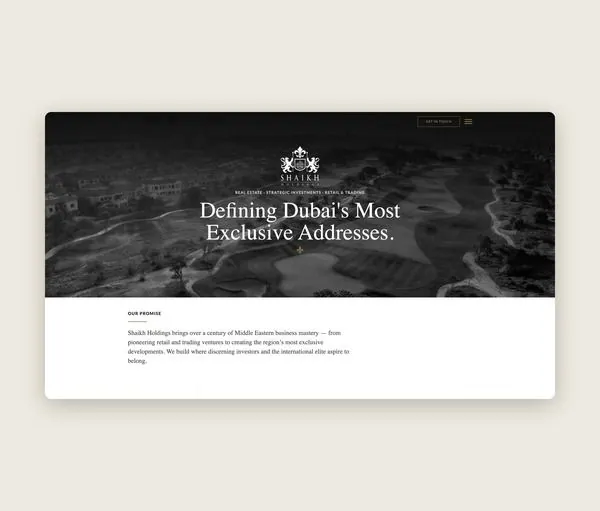
Website · Corporate · Dubai
A Dubai investment house with a century of business behind it. The site speaks to institutional investors, not shoppers.
shaikhholdings.com
Website · Property development · Abu Dhabi
An ADX listed holding company building master planned communities, with a site that holds investors and residents at once.
modon.com
Mobile app · Fintech · United States
A fintech platform connecting merchants, customers and charities in a single payment flow.
purposepayment.comStraight answers
Be careful here. Promises about the outcome of a case sit outside what is generally acceptable for legal advertising in Dubai, so we write around described experience and practice areas rather than specific results, and this should be confirmed with your own compliance judgement, since it is not legal advice.
As many as your firm needs. A small consultancy might list two or three consultants, while a larger firm structures profiles by practice area so a visitor can find the right person for their matter.
Yes, most lawyers website design in Dubai includes a consultation request form that asks for the general nature of the matter, so the right person can respond, alongside a phone number for anyone who prefers to call directly.
Many Dubai firms serve both Arabic and English speaking clients, and court and contract work often touches both languages, so a genuinely bilingual site is common rather than a translated afterthought.
Every project gets a fixed written quote scoped to your brief, sent within 45 minutes during business hours with no obligation. The number of practice areas, lawyer profiles and languages are the main cost drivers.
Sources
Fixed price, in writing
Got it. Your quote is being written now.
In business hours you will have it within 45 minutes. Check your inbox for the confirmation.