
Business stationery in Dubai: what the set actually needs to contain
Which stationery pieces a UAE company actually uses, what a tax invoice and a letterhead must carry, and what belongs on a company stamp.
Read the articlePrint and Stationery Design
The phases of Executive Council Resolution No. 124 of 2023, what Dubai Municipality lists as banned and exempt as of September 2026, and how switching materials changes packaging artwork.
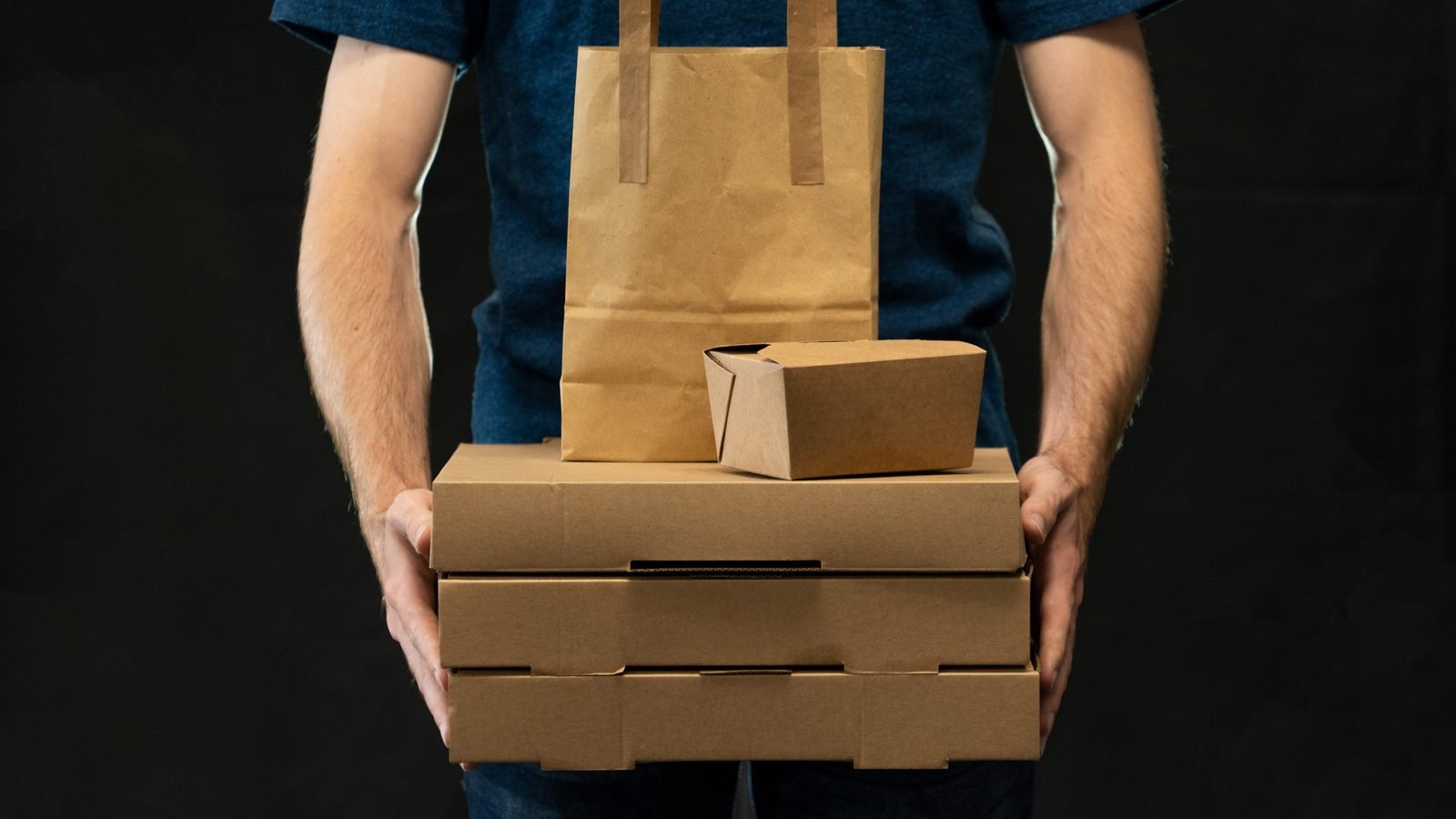
Dubai’s single use plastic ban is being introduced in phases for food packaging under Executive Council Resolution No. 124 of 2023. As of September 2026, plastic bags, non plastic single use bags, styrofoam cups and food containers, plastic straws and stirrers, and since 1 January 2026 plastic plates, tableware, beverage cups and their lids are all on the banned list, while Dubai Municipality says the ban is not being applied to plastic containers during 2026. For food businesses, that means most of the pieces a customer touches are moving to paper, board, plant fibre or reusable materials.
Those material changes from the Dubai plastic ban affect how packaging is printed and branded. This guide sets out what the official sources say and what to change in your packaging artwork as a result. It is not legal advice, and the rules may be updated, so confirm details with Dubai Municipality before ordering stock.
Key points
The Dubai Government Media Office announced the plastic ban affecting packaging, Resolution No. 124, on 31 December 2023. It regulates plastic and non plastic single use products, and applies within the emirate including free zones and the Dubai International Financial Centre. Dubai Municipality’s FAQ adds special development zones to that scope.
| Effective date | Items named by the official sources | Source |
|---|---|---|
| 1 January 2024 | Single use plastic bags | Dubai Government Media Office |
| 1 June 2024 | Single use bags made of non plastic materials | Dubai Government Media Office |
| 1 January 2025, with soft implementation until 31 May 2025 | Styrofoam cups, plastic straws, styrofoam food containers, plastic stirrers, plastic table covers and plastic cotton swabs | Dubai Municipality phase three poster and FAQ |
| 1 January 2026 | Plastic plates, plastic tableware, plastic beverage cups and their lids | Dubai Municipality phase four infographic |
The Media Office release also listed plastic food containers in the final phase. Dubai Municipality’s January 2026 infographic, however, carries a note that the ban will not be applied to plastic containers during 2026. For Dubai packaging planning under the plastic ban, treat plastic containers as a temporary reprieve rather than a permanent exemption.
The Dubai plastic ban packaging exemptions are specific, and it is worth reading them precisely before assuming your product qualifies.
The recycled materials exemption on the phase four infographic is short and does not define a minimum recycled share. If your supplier offers a plastic cup or lid on that basis, ask them for written documentation of its recycled content and check with Dubai Municipality that it meets the exemption before you print your brand on thousands of them.
This summary reflects the Dubai Government Media Office release and Dubai Municipality pages read on 14 September 2026. Rules, dates and exemptions can change. It is general guidance for packaging planning, not legal advice.
The Dubai plastic ban resolution for packaging is not only a list of banned items. According to the Media Office release, sellers are required to offer specified reusable alternatives at reasonable prices and to take part in initiatives and programmes aimed at reducing plastic. It also describes fines for violations that increase for a repeat offence within a year. Dubai Municipality’s FAQ says banned products may not be sold within the emirate after the full implementation date, and that complaints can be made to the Department of Economy and Tourism through the Dubai Consumer app or consumerrights.ae.
In practice, that shifts some of the burden onto communication. Customers need to know that a reusable bag or cup is available, what it costs, and why the paper straw has replaced the plastic one. Those messages belong on menus, counter cards and social posts as much as on the packaging itself.
Dubai Municipality’s infographics pair each plastic ban packaging item with examples of alternatives. Knowing which one you are moving to is the starting point for the artwork brief, because each material takes print differently.
| Banned item | Alternatives shown by Dubai Municipality | Branding implication |
|---|---|---|
| Styrofoam food containers | Paper and plant based containers; reusable containers | Moulded plant fibre is hard to print directly; branding usually moves to a sleeve, band or sticker |
| Plastic plates | Paper plates, plant based plates, reusable plates | Printed paper plates are possible; plant fibre plates usually carry no print |
| Plastic tableware | Wooden or bamboo, plant based, metal and lightweight reusable utensils | Branding shifts to the cutlery pouch or napkin wrap |
| Plastic beverage cups and lids | Plant lined paper cups or cups lined with natural wax; sugarcane or plant fibre cups; reusable cups; paper or plant fibre lids | Paper cups print well, but the design wraps as a curve and meets a seam |
| Styrofoam cups and plastic straws | Paper and plant based cups; reusable, steel or glass cups; paper, plant based, steel or glass straws | Straw wrappers and cup sleeves become the brand surface |
Plastic packaging is often clear or white and printed with sharp, saturated colour. Its replacements behave differently, and a direct copy of the old artwork usually disappoints.
Brown board absorbs ink and darkens every colour laid on it. Pale brand colours can nearly vanish. Designs that work on kraft tend to use one or two strong colours, bold shapes and generous line weights. If a brand colour must stay true, ask the manufacturer whether they can print a white base under it.
These print closest to the old look, but the artwork is laid out flat on a curved template and meets a glued seam. Logos placed across the seam break, and wide wordmarks distort on tapered cups. Ask for the supplier’s flat template before design starts.
Bowls, clamshells and plates pressed from plant fibre have textured, uneven surfaces that few suppliers can print on. Treat the container as unbranded and put the brand on a paper band, a sealing sticker or the bag instead. Stickers also let one plain container serve many menu items, with the product name printed on the label.
As more pieces become plain, the small printed parts carry more of the brand: cup sleeves, straw wrappers, cutlery pouches, napkin bands and sealing labels. Design them as a family so the brand reads consistently when a delivery bag is opened. Our fast food box design page covers dielines and box shapes in detail.
Switching materials under the Dubai plastic ban tempts brands to print words like eco friendly, biodegradable or plastic free on their packaging. Be careful. Federal Law No. 15 of 2020 on Consumer Protection, Article 17, prohibits describing a good or service in a manner that contains incorrect data, and Article 1 defines a misleading advertisement as one based on deceptive information or omitting essential information. A cup with a plastic lining described as plastic free, or a container described as compostable when no composting route exists for customers, invites complaints.
We design the printed parts of food service packaging for the Dubai plastic ban on your supplier’s templates and hand over files for the manufacturer you choose; we do not manufacture packaging or certify materials. For retail packs and labels, see packaging design. For the menus and leaflets that travel with an order, see takeout menu design, and for posts announcing the switch, social media design. All print formats are on the print design hub, and our print ready file checklist covers what suppliers need from the artwork. Tell us which items you are replacing and we will reply with a written fixed price proposal within 45 minutes during business hours.
Straight answers
Yes. The Dubai Government Media Office announcement says the resolution covers the emirate including free zones and the Dubai International Financial Centre. Dubai Municipality also names special development zones. If you trade in another emirate as well, check that emirate's own rules separately.
The Media Office announcement lists non plastic single use bags among the items covered from 1 June 2024, so a free paper carrier is not a simple workaround. Reusable bags and exemptions are treated differently. Confirm the status of the exact bag you plan to order with Dubai Municipality before printing a large run.
Dubai Municipality's phase four infographic states that the ban will not be applied to plastic containers during 2026, while plates, tableware, beverage cups and lids are listed as banned. That position is time limited, so plan now for what you would use if containers are brought in later.
Only if you can back up exactly what the words mean. The Consumer Protection Law prohibits describing a product with incorrect data, and a vague green claim is hard to defend. Specific, checkable statements from your supplier are safer than general ones.
Dubai Municipality's FAQ directs complaints about non compliance to the Department of Economy and Tourism, through the Dubai Consumer app or the consumerrights.ae website. That is one more reason to finish using up banned stock before the relevant date.
Sources
Fixed price, in writing
Got it. Your quote is being written now.
In business hours you will have it within 45 minutes. Check your inbox for the confirmation.
Keep reading
Which stationery pieces a UAE company actually uses, what a tax invoice and a letterhead must carry, and what belongs on a company stamp.
Read the article
The questions, PDF/X settings and final checks that turn artwork into files a printer in Dubai can run without calling you back.
Read the article
What UAE VAT law and the Consumer Protection Law mean for the prices printed on your restaurant menu, and how to lay them out.
Read the article