
Automotive website design with a filterable stock list
Filters by make, model, year, mileage and body type let a buyer narrow a large inventory in seconds instead of scrolling through everything.
Web Design by Industry
An automotive website in Dubai has to carry a full vehicle stock list, real specifications and a service booking route, not only a brand story. We build sites around the inventory and the paperwork behind it.
Most automotive website design in Dubai fails at the one thing a buyer actually wants: a proper stock list they can filter and compare. A homepage with a hero image of a showroom does nothing for someone trying to decide between two trims of the same model. The site needs to work like a catalogue first, with vehicle specifications, mileage, condition and images per unit, and a brand story second.
Dealers, workshops and rental fleets all fall under this page, and each reads the site differently. A buyer wants stock and finance information, a service customer wants a booking slot, and a fleet manager wants a way to ask about availability without wading through retail content built for someone else. Automotive website design in Dubai works best when each of these visitors gets their own clear path from the homepage.
This page covers the pages an automotive site in Dubai actually needs, what RTA’s own vehicle ownership process means for a listing, and how a build fits around the stock data, workshop calendar and trade in process a dealer or workshop already runs.
What the site has to do
Beyond the homepage, an automotive site is really a small number of tools wearing a website’s clothing.
Filters by make, model, year, mileage and body type let a buyer narrow a large inventory in seconds instead of scrolling through everything.
Side by side comparison of engine, features and trim level helps a buyer choose between similar vehicles without leaving the page.
A booking form that asks for the vehicle and the work needed routes straight into a workshop calendar rather than a generic enquiry inbox.
A short form for a seller to submit their vehicle details starts the trade in conversation without a phone call.
Multi branch dealers need clear location pages with hours and directions for each showroom and workshop separately.
A simple catalogue for parts and accessories keeps existing customers on the site instead of searching elsewhere.
Compare
A dealer, a workshop and a rental fleet share a platform pattern but need different priority content.
| Business type | Priority content | Common integration |
|---|---|---|
| New or used car dealer | Filterable stock list, trade in form, finance enquiry | Dealer management system feed |
| Workshop or service centre | Service menu by vehicle type, booking calendar | Workshop scheduling tool |
| Rental fleet | Availability by date, pickup location, vehicle class | Fleet or rental management system |
| Parts and accessories retailer | Part number search, compatibility by model | Inventory or point of sale feed |
Rental specific booking flows are covered separately under rent a car website design.
Vehicle trading
The Roads and Transport Authority’s own trade licence NOC service lists vehicle sales among the commercial transport activities that need RTA approval before a business can hold or renew the relevant trade licence category. That approval sits behind the scenes of the trade licence rather than on the website itself, but it shapes two things a site should get right: a listing should never imply a vehicle sale is complete before ownership transfer has actually happened, and any claim about being an approved or registered dealer should match the licence the business actually holds.
Separately, RTA also runs its own Transfer Vehicle Ownership service, described on its own page as covering a Sale and Purchase agreement between buyer and seller, the change of a vehicle’s registered ownership, and an insurance refund certificate for a disposed vehicle, with separate routes for an individual and a corporate applicant. A dealership listing does not need to explain this process to a visitor, but it is a reminder that, however far an online conversation with a buyer progresses, the sale itself is not finished until this transfer has gone through.
This is not legal advice. Dealers should confirm current RTA and Dubai Economy requirements directly rather than relying on a website’s copy for that answer.
What stops an enquiry
Weak automotive website design in Dubai loses buyers before they even reach a specific listing. Out of date stock is the biggest cause. A listing still showing a vehicle that sold weeks ago wastes the buyer’s time and damages trust in the rest of the listings. Missing basics such as mileage, service history or accident status push a cautious buyer to a competitor with fuller information. And a long enquiry form on mobile, where most automotive browsing in Dubai happens, loses people who would have called instead.
Build
The stock feed decides most of the technical build, so it gets confirmed before design starts.
We confirm how stock data is currently held, whether it can export automatically, and what specification fields are available per vehicle.
The stock list, comparison tool and booking forms are built inside our wider website development process, sized to the actual catalogue.
Stock feed import, service booking calendar and trade in form routing to your CRM are connected once the data structure is confirmed.
The current stock list with filters goes live first. Service booking and parts follow once the main showroom pages are tested.
Search visibility for model and area terms is covered under SEO services.
The person who approves automotive website design in Dubai is rarely the person who updates it week to week. At a dealership, it is usually the general manager or the sales director, measured on units sold, finance penetration and how many genuine enquiries the stock list produces against how many visitors browse it. At a workshop or service centre, it is more often the service manager, measured on bay utilisation and how full the booking calendar looks a week out. A rental fleet operator sits closer to the workshop side, measured on fleet utilisation rather than a single sale.
All three open the first meeting with a version of the same question, asked in different words: does a website visitor turn into a person my team can actually act on, with the right vehicle, the right service slot or the right trade in already attached to the enquiry. A general manager wants a buyer enquiry to arrive with the stock reference and finance interest already noted, so a salesperson is not starting from zero on the phone. A service manager wants a booking to land directly in the workshop calendar, not a general contact form that someone has to read and re-key by hand. Automotive website design in Dubai that gets this meeting right spends most of it on how data reaches the right desk, not on colour choices, because that is what decides whether the site is still useful six months after launch.
The visitor
Automotive website design in Dubai has to serve at least three different intentions from the same site, and a page built for one often fails the other two.
They want to narrow a large inventory to a handful of real candidates using make, model, year and mileage, then compare trim and specification without leaving the page. The point they leave is a stock list with no filters, or a listing missing mileage and condition detail.
They already own the vehicle and want a specific job done on a specific day, and they want to see that the booking has actually landed somewhere rather than vanished into a form. The point they leave is a booking form with no vehicle type field, forcing a follow up call to establish basics the form should have captured.
They want a fast, low effort way to submit their vehicle details and get a response, without a showroom visit as the first step. The point they leave is a valuation request that asks for more detail than a first enquiry should need, such as full service history before any indicative figure is offered back.
A fleet manager enquiring about a batch of vehicles is a fourth, smaller group, and automotive website design in Dubai usually gives them a separate route into the same enquiry system rather than the retail stock list, since their questions about volume and delivery timing are different from a single buyer’s.
Data and history
A stock listing as part of automotive website design in Dubai is only as useful as the data behind it, and that data rarely starts life on the website itself. Most dealers already hold it in a dealer management system or a workshop spreadsheet, entered by a sales or service team member the moment a vehicle arrives on the lot or leaves the workshop. Automotive website design in Dubai works best when the site reads from that same source, either through a scheduled export or a live feed, rather than treating the website as a second place where stock has to be entered by hand. A vehicle that sells on a Monday and still shows as available on Friday is a wasted enquiry and a visible sign to the next visitor that the listings are not kept current.
History matters as much as the current condition. A used vehicle listing that states mileage without accident history, service history or the number of previous owners leaves a cautious buyer with more questions than it answers, and those questions usually get asked of a competitor’s fuller listing instead. Workshop history in particular is data a dealership or independent workshop already holds internally, and surfacing an honest summary of it on a used vehicle listing, rather than leaving buyers to ask, tends to produce fewer time wasting enquiries from buyers who were never going to proceed once they learned the real condition.
Service booking
A service booking form, as automotive website design in Dubai treats it, fails most often not because it looks poor, but because it asks the wrong questions and lands in the wrong place. A customer who already knows their vehicle needs a brake inspection wants to state that, pick a date, and get a slot confirmed, not fill in a generic message box and wait for a callback. Automotive website design in Dubai treats a service booking as data that should reach a workshop calendar directly, carrying vehicle type, the service or fault described, and a preferred date and time, so a service advisor can confirm or offer an alternative slot without first phoning the customer to ask basic questions the form should have captured.
A booking also needs a visible state once it is submitted. A customer who receives no confirmation at all is left wondering whether the booking worked, and will often call the workshop directly anyway, which defeats the purpose of the form. A short confirmation, followed by a message if the workshop needs to reschedule, keeps a customer informed without needing a full live booking engine on every site.
Finance and warranty
A buyer weighing up a purchase almost always wants some sense of financing before they commit to a showroom visit, even where automotive website design in Dubai never states an actual rate or monthly figure. What a listing can usefully offer instead is plain guidance: whether finance is arranged in house or through a partner bank, roughly what documents a buyer should expect to bring, and whether a down payment is typically required. None of that commits the dealership to a number, but it saves a buyer from arriving unprepared or, worse, assuming finance is unavailable and simply not enquiring at all.
Warranty content matters just as much, particularly on used stock, where a buyer often cannot tell from a photo whether a vehicle still carries a manufacturer warranty, a dealer warranty, or none at all. Stating warranty status clearly on every listing, rather than leaving it to a phone call to establish, removes one of the more common reasons a cautious buyer hesitates before sending an enquiry.
Multi branch
A dealer group running more than one location needs the site to make branch differences obvious rather than treating every location as identical.
| Content need | Single branch dealer | Multi branch dealer group |
|---|---|---|
| Location detail | One address, hours and directions block | A location page per branch, each with its own stock and staff |
| Stock filtering | Filter by model and price alone | Filter by branch as well, since a buyer usually wants to view in person |
| Service booking | One workshop calendar | Booking form asks which branch, routing to the right calendar |
| Enquiry routing | One sales inbox or WhatsApp number | Enquiries route to the branch holding the vehicle, not head office |
A parts and accessories section is a smaller piece of automotive website design in Dubai than the main stock list, but it keeps existing customers coming back to the dealership or workshop instead of searching a generic parts marketplace. The most useful version is not a full catalogue with every part number, which is difficult to keep current for most dealers, but a straightforward enquiry route: a customer states the part they need, the vehicle it fits, and a registration or chassis reference if they have one, and a parts team responds with availability and next steps. Compatibility by model matters here specifically, since a part that fits one model year but not another is a common source of a wasted trip if the site does not make the fitment clear before the customer commits to an order.
Where a dealer does hold a searchable parts catalogue already, whether through a supplier system or an internal spreadsheet, that same source can often feed a simple search tool on the website, saving the parts team from answering the same fitment questions by phone throughout the day.
Trade in
Handled well, this is one of the quieter strengths of automotive website design in Dubai. A trade in or valuation form is often the first contact point for a seller who has not yet decided whether to sell privately or to the dealership, so the form needs to feel low effort rather than like the start of a full sale process. Automotive website design in Dubai keeps a first valuation request short: registration or make and model, approximate mileage, general condition and a few photos if the seller has them. Asking for a full service history or an in person inspection at this stage is a reason for a seller to abandon the form and try a competitor instead.
What happens after submission matters just as much as the form itself. A seller who submits a valuation request and hears nothing for several days will usually assume the dealership is not interested and move on. A short acknowledgement, followed by either an indicative range or an invitation to bring the vehicle in for a proper appraisal, keeps the seller engaged while the dealership’s own valuation process runs its course.
Integrations
These are named specifically because “integrations” on its own tells a dealership nothing about what actually gets solved.
Many Dubai dealers already run stock, sales and service records through a dealer management system. A connection here can push current stock and its specification to the website automatically, rather than requiring a listing to be entered twice.
Where a workshop already runs its calendar through a scheduling tool, a service booking form can write directly into it, so a slot a customer sees as available is genuinely available.
A WhatsApp button on a stock listing that opens a chat with the vehicle reference already filled in removes a step between a visitor liking a vehicle and a salesperson hearing about it. See our WhatsApp API integration page for how this connects to a shared team inbox.
General finance calculators help a buyer understand rough affordability, kept clearly separate from any specific rate or approval, which stays with the dealership’s own finance partner rather than the website.
A dealer group running several showrooms and workshops occasionally wants its own mobile app, typically for saved vehicles, service reminders or a loyalty scheme, once the core website has demonstrated real demand for it.
Knowing which listings get views but no enquiries, and which models draw search traffic but few contacts, is web analytics work specific to a stock led site rather than generic traffic reporting.
Search behaviour
Search terms around automotive website design in Dubai fall fairly clearly into two intentions, and automotive website design in Dubai answers both with different pages rather than expecting one stock list to serve both. A research search looks broad and exploratory, comparing a model against its rivals or asking what a given trim includes, from someone weeks away from a decision. A ready to buy search looks narrow and specific, naming a model, year and area, or copying a stock reference from a listing already seen elsewhere, from someone close to contacting a salesperson.
Model and comparison pages answer the first kind of search, since they can rank for a model name as a topic and give a visitor context before they narrow to a specific listing. The stock list and individual listing pages answer the second, since that visitor already knows roughly what they want and needs the fastest path to a specific vehicle and a specific salesperson. No search volumes are claimed here, since none are verified for this page, but the pattern of broad research questions giving way to narrow, specific ones holds across most vehicle categories.
A stock listing that leaves out mileage or accident history is not a shortcut. It is a reason for the buyer to keep searching somewhere else.
Condition and photography
Photos decide whether a buyer trusts a used vehicle listing more than almost any other single element on the page. Stock photography sourced from a manufacturer catalogue works for a new vehicle, since every unit of that model and trim looks the same, but it actively misleads a buyer on a used listing, where the exact vehicle for sale may carry marks, wear or modifications the stock image hides. A short, consistent set of angles taken of the actual vehicle, front, rear, both sides, the odometer reading and the interior, gives a buyer enough to judge condition honestly before they book a viewing.
A simple condition grade alongside the photos, described in plain terms rather than an internal code only staff understand, helps a buyer sort a large stock list quickly. What matters is consistency: a grading system only builds trust if it is applied the same way across every vehicle, rather than varying by which salesperson listed it.
Automotive website design in Dubai moves at the pace of the stock and specification data behind it, and the most common delay is not design or development, it is incomplete listing content. Photography is the first gap: a stock list with a handful of vehicles missing images looks unfinished next to the rest, and photography is frequently the last thing supplied because it sits between the sales floor and marketing rather than clearly belonging to either. Specification detail is the second gap, particularly for used vehicles, where accident and service history has to be gathered from workshop records rather than typed from memory.
For workshops, a current service menu with realistic time estimates per job type is often missing at brief stage, even though it directly shapes what the booking form should ask for. Content for parts and trade in sections tends to be the last supplied, since neither is usually anyone’s single responsibility inside a dealership until the website forces the question of who owns it.
Launch and phase two
An automotive website does not need every feature on day one, and trying to launch with all of them tends to delay the whole project.
Filtered stock with full specification, a service booking route by vehicle type, every showroom and workshop location, and one working link to a stock source, even if that link starts as a manual weekly upload rather than a live feed.
Swap the manual upload for a live dealer management system connection, add the trade in and parts enquiry tools, build out finance guidance, and add Arabic once genuine enquiry volume shows it is worth the investment.
How much Arabic an automotive website needs depends heavily on the customer sitting in front of the salesperson or the mechanic, not on a blanket rule. An independent workshop with a mostly Arabic speaking clientele gains the most from Arabic on the pages that describe faults and services, since a customer is often able to explain a rattle or a warning light more precisely in their first language than in English. A showroom selling to a broad, largely expatriate buyer base may find comparatively little browsing demand for an Arabic stock list, yet still needs Arabic finance and warranty documentation prepared correctly, since paperwork obligations do not follow browsing habits.
Wherever Arabic does appear on the site, specification and finance wording deserves particular attention. Trim levels, warranty terms and payment language each carry established Arabic equivalents inside the UAE motor trade, and a buyer who already knows those terms from a manufacturer’s own literature will notice a loose or overly literal translation immediately.
What we see go wrong
Weak automotive website design in Dubai tends to repeat the same handful of mistakes. Beyond the stale stock and thin listings covered earlier on this page, a few mistakes recur across dealer and workshop sites we review.
A generic contact form asked to serve a buyer, a service customer and a seller at once forces every enquiry through the same slow, manual triage before it reaches the right team member.
A stock list with no salesperson attached to each vehicle gives a buyer no sense of who they would actually be dealing with, which matters more for a used vehicle purchase than most other enquiries.
A service page listing internal job codes instead of plain descriptions of common problems makes a customer guess at what they actually need before they can even book.
Good automotive website design in Dubai is judged on outcomes, not on how the site looks. A dealership does not judge a website by the same numbers a general business would use, so automotive website design in Dubai is planned around the figures that actually matter to a showroom or a workshop from the outset rather than bolted on once the site is finished. A sales team wants to know how many enquiries each stock listing produces and how many of those turn into a showroom visit or a test drive, because raw traffic on its own tells them nothing about whether the stock list is doing its job. A service team instead watches how full the booking calendar looks against available bay time, and what share of those bookings arrived through the website rather than a phone call, since that ratio changes how the front desk is staffed. A buyer or a service customer rarely commits on a single visit to the site, so both teams also pay attention to which vehicles, offers or services pull a visitor back a second time. None of this needs an invented benchmark figure to be useful. What it needs is web analytics wired to stock and booking events specifically, not a generic page view count that says nothing about a sale or a booked bay.
Mobile behaviour is one of the clearest patterns automotive website design in Dubai has to answer for. A buyer comparing stock rarely sits at a desktop to do it. They are usually holding a phone, flicking between two or three dealer sites open as separate tabs, sometimes while forwarding a listing to a friend or family member for a second opinion. That habit puts real pressure on how a listing page is built: filters have to work cleanly with a thumb, photos have to appear without a long wait on a mobile connection, and a way to call or message has to sit within easy reach rather than underneath a specification table the buyer has not finished reading yet.
A short WhatsApp message asking whether a specific vehicle is still on the lot has become a common first move for a buyer, often ahead of a phone call and well ahead of filling in a form. A dealership that puts WhatsApp on equal footing with a phone number and an enquiry form, rather than treating it as an afterthought, picks up more of these quick, low commitment messages, which is often the point at which a serious buyer first makes contact.
A dealer or workshop who knows the stages a build moves through can plan a launch date around them instead of being caught out by one. Everything starts with pinning down where stock data actually lives today, whether service booking should write into an existing scheduling tool, how many showroom or workshop branches the site needs to represent, and which languages the business genuinely needs, since these choices affect the build far more than any layout decision. Skip that groundwork and it usually surfaces halfway through the project, commonly as a missing field in the stock feed that the specification pages were built to expect, and fixing it then costs considerably more time than confirming it upfront would have.
Every design, from the stock list through to the trade in form, is shown to the dealer and signed off before a single line of the build begins, so nobody is meeting the finished site for the first time at launch. On the development side, whatever source the stock comes from, a dealer management system export, a live feed, or someone typing listings in by hand, that source is wired into the filter, comparison and booking logic rather than bolted on afterwards. Because most stock browsing happens on a phone, frequently while the buyer is standing in another dealer’s showroom at the same time, testing on real handsets gets particular attention rather than being left to a desktop preview.
Handover puts the domain, hosting and CMS logins in the dealer’s own name, alongside a recorded walkthrough that covers adding a listing by hand, checking that a stock feed is still connecting properly, and updating the service menu when workshop pricing changes. From there, competing for model and area related searches, rather than depending on stock listings to rank on their own, is what our SEO services retainer covers.
Related
Sites for rental fleets, a close relative of dealer and service sites.
Sites for parts and component suppliers feeding the automotive trade.
Sites for fleet and transport operators with similar vehicle data needs.
Sites for parts and vehicle importers with similar shipment and stock data needs.
A parts catalogue that also needs online ordering belongs under ecommerce solutions, and filter or comparison design specifically sits under UI UX design. Browse every industry from web design by industry.
Selected work
Work across sectors, with the closest to this industry shown first. Every one is a live site, not a mockup.
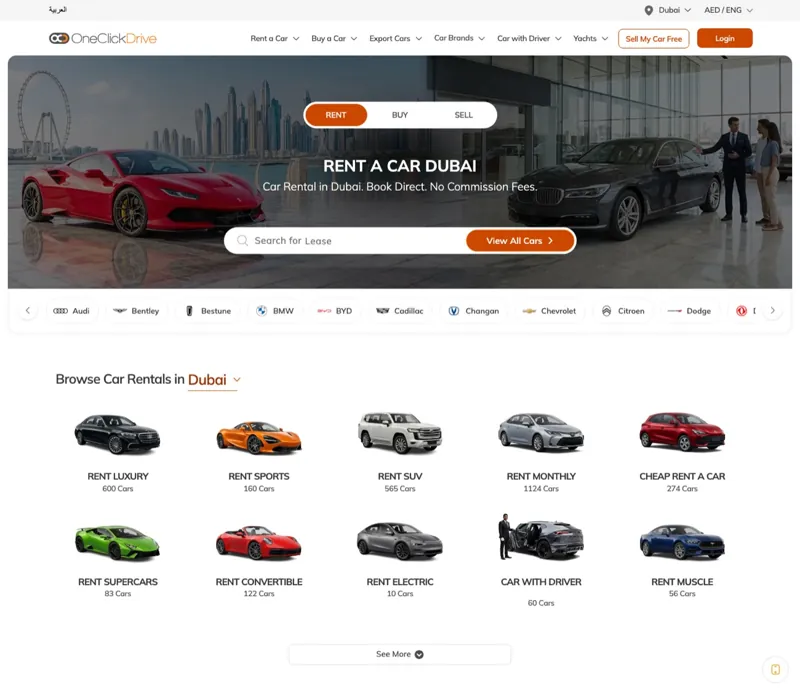
Platform · Car rental · UAE
A car rental marketplace where suppliers list fleets and renters compare and book, under real traffic.
oneclickdrive.com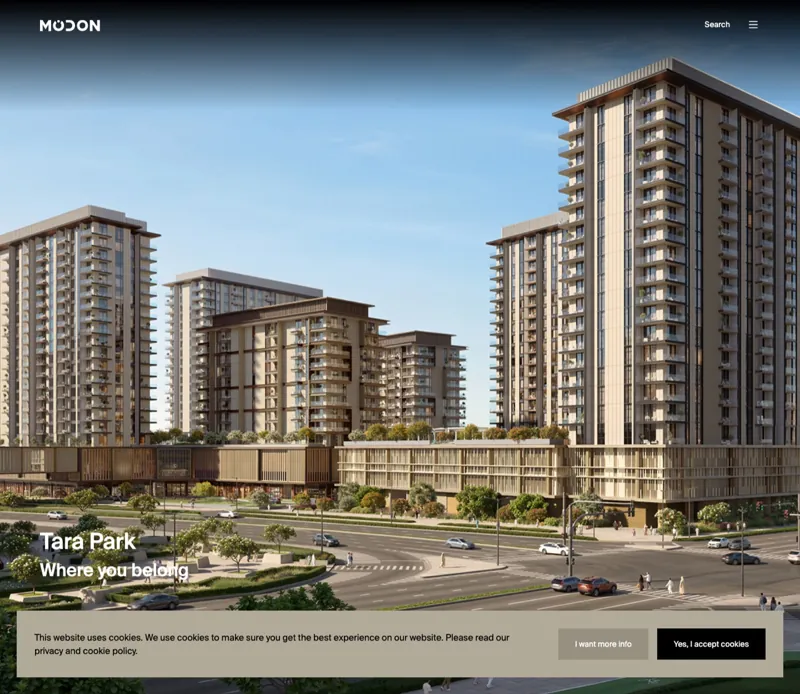
Website · Property development · Abu Dhabi
An ADX listed holding company building master planned communities, with a site that holds investors and residents at once.
modon.com
Website · Furniture · Middle East
A design led furniture brand that launched with no digital home, now shown as carefully as its pieces.
stulo.comStraight answers
Yes, if your dealer management system or spreadsheet can export a regular feed, we can build the site to import it. Where there is no export, listings are added manually and we agree who updates them.
That is your decision as the dealer, since we do not set your commercial terms. Our own agency copy never states prices, but the vehicle listings on your site are your product data and can include them if you choose.
Yes, a booking form with vehicle type, service needed and preferred date is standard, feeding into your workshop calendar or CRM. Confirmation and any rescheduling still goes through your service team.
No, ownership transfer and registration run through RTA's own processes, and we are not a legal adviser. The site's job is to generate a genuine enquiry and be clear that a sale is not final until RTA registration is complete.
Every project gets a fixed written quote scoped to your brief, sent within 45 minutes during business hours with no obligation. Stock volume, the number of showroom locations and any dealer system integration are the main cost drivers.
Sources
Fixed price, in writing
Got it. Your quote is being written now.
In business hours you will have it within 45 minutes. Check your inbox for the confirmation.