
Import export website categories with real specification sheets
Buyers need technical detail, not marketing description, so each category links to a downloadable specification or data sheet where one exists.
Web Design by Industry
An import export website in Dubai sells trust before it sells a product line. We build these sites around clear product categories, supplier proof and a request for quote route instead of a shop front.
An import export website in Dubai is rarely browsed casually. The visitor is usually a procurement manager checking whether a trading company is legitimate before sending a serious enquiry, often from another country and without the chance to visit in person. Import and export website design in Dubai has to do that convincing job quickly: clear product categories, real company detail and an easy way to ask a specific question. Traders, distributors, manufacturers with an export arm and re export specialists all fall under this brief, and each reads slightly differently to a buyer, which is why this page treats the differences between them as content decisions, not just design choices.
This is different from a retail site. There is rarely a cart or a published price list. The site’s real product is the enquiry it generates, so the categories, specification sheets and company pages all exist to get a serious buyer to send a request for quote.
The rest of this page works through what that means in practice: the fields a wholesale product page and a request for quote form actually need, how minimum order quantity and incoterms are explained without a single price attached, what a certificate of origin and a document library involve, and the data and integrations that keep a catalogue serving more than one market honest as it grows.
What the site has to do
A trading company’s site is built around proving capability, not browsing a shop.
Buyers need technical detail, not marketing description, so each category links to a downloadable specification or data sheet where one exists.
Listing the certifications and compliance documents the company genuinely holds, without inventing any, reassures a cautious overseas buyer.
Naming the actual manufacturers or origin countries a company sources from builds credibility that generic trading language cannot.
A structured form asking for product, quantity and destination captures a usable enquiry rather than a vague message.
Plain explanations of the shipping terms a company works under help an overseas buyer understand what they are actually quoting for.
Where a meaningful share of buyers come from a specific market, translating the core pages for that market matters more than a long list of languages.
Proof
Overseas buyers cannot visit a trading office before ordering, so the site has to carry the proof a visit would normally provide.
A verifiable physical address, ideally with a map and a landline number, signals a genuine operating business rather than a shell listing.
A named sales or export contact, rather than a generic info address, gives a buyer someone specific to follow up with, which is exactly what an import export website in Dubai needs to feel like a real company.
How long the company has traded and in which categories, stated plainly without invented figures, reads as more credible than vague claims of experience, and honesty here is what separates a trustworthy import export website in Dubai from a generic one.
Listing the regions the company actually ships to, rather than implying it covers everywhere, sets a realistic expectation before a quote is requested, and it is a detail every import export website in Dubai should get right early.
Customs
Any company that legally imports or exports through Dubai needs a customs client code, registered through Dubai Customs’ own client registration service. The registration itself is a back office matter rather than something a website needs to display, but it shapes what the site should and should not claim. A site should not describe itself as licensed to handle a category of goods it does not actually hold approval for, and any language about restricted or controlled commodities should be checked directly with Dubai Customs rather than assumed from general trading experience.
This is not legal advice. Specific commodity restrictions and licensing categories change, and a trading company should confirm current requirements with Dubai Customs before publishing claims about what it can move. Where a business genuinely trades in a controlled or restricted category, health products, chemicals, dual use goods, the website should be even more conservative in its claims, describing what the company does in general terms and directing specific commodity questions to a direct enquiry rather than publishing a page that could be read as a blanket approval to trade in that category.
What stops an enquiry
Vague product descriptions are the main cause, since a serious buyer wants a specification sheet, not adjectives. A missing physical address or company registration detail is the second, since overseas buyers are naturally cautious about sending money to an unverifiable trading company. And an enquiry form that asks too little, such as no field for quantity or destination, produces enquiries nobody can properly quote.
The buyer
The person who commissions an import export website design in Dubai, part of our wider web design by industry work, is usually the owner of a trading company or the head of sales, and they are judged on a single number more than any other: how many of the enquiries the site produces turn into a quoted, priced order. They are less interested in design trends than in whether a specific overseas buyer, checking the company out for the first time, will trust it enough to send a real enquiry with quantity and destination attached.
In the first meeting, this buyer usually asks whether the site can be updated quickly when a product line changes, whether the enquiry form actually reaches the right person on their sales team without getting lost, and whether the company can show enough of its real operation, real address, real named contacts, real certifications, to overcome the natural caution an overseas buyer has about a trading company they have never met.
What a buyer does
A procurement contact rarely browses casually. They arrive with a specific product need and check the site against a short mental list before deciding whether to write.
Most buyers land on a specific product category from a search engine, so that page, not the homepage, has to carry the trust signals and the specification detail.
A product description written in marketing language, with no downloadable sheet showing dimensions, materials or grade, is where a serious buyer usually stops reading and leaves.
A missing physical address, or only a generic info email, is one of the fastest ways an import export website design in Dubai loses a cautious first time buyer.
A single open text box, with no fields for quantity, destination or intended use, produces an enquiry the buyer is not confident will actually be understood, so many simply do not send it.
Without a clear statement of destination coverage, a buyer outside the obvious core markets often assumes the company does not serve them and moves on to a competitor.
Buyers sourcing from unfamiliar suppliers want to know roughly how long a quote will take, and a page that states this plainly reduces the number who chase by phone instead.
Catalogue
A wholesale product catalogue reads completely differently from a retail one, and treating them the same is one of the most common mistakes we see. A retail shopper wants a photograph and a price. A wholesale buyer wants a specification sheet, a pack size, a grade or standard the product meets, and a way to ask about a quantity that does not fit neatly into a fixed price list. Product pages built around import export website design in Dubai should be structured for this comparison, not for an emotional purchase decision.
This also changes how a catalogue should be organised. Grouping by application or industry the buyer works in, alongside grouping by product type, helps a specific kind of buyer, a hardware distributor, a food importer, a construction supplier, find the right category quickly instead of scrolling a long undifferentiated list.
A retail catalogue sells a product. A wholesale catalogue proves the company can actually supply it, at the quantity and to the standard the buyer needs.
Terms
Two pieces of trade terminology come up constantly on an import export website in Dubai, and both can be explained clearly without publishing a single price. A minimum order quantity states the smallest amount a company will supply in one order, and publishing it plainly, even as a range that varies by product, saves both sides time by filtering out enquiries the company cannot realistically fulfil.
Incoterms are the standard international trade terms published and maintained by the International Chamber of Commerce, and they define who is responsible for shipping, insurance and risk at each stage of a shipment, for example whether the buyer or seller arranges and pays for carriage from the port. A plain language explainer of the terms a company actually trades under, such as which of the eleven Incoterms 2020 rules apply to typical orders, removes a common point of confusion for overseas buyers without ever needing to mention a price.
Documents
Documentation is a core part of the product for an import export business, and the site should treat it that way rather than as an afterthought.
In Dubai, a certificate of origin, the document certifying where goods were produced, is issued to eligible member companies by Dubai Chambers, alongside a detailed commercial invoice, and it is used by customs authorities on both sides of a shipment to apply the correct duty. A trading company’s website does not need to display a certificate of origin itself, since each one is issued per shipment, but it should describe clearly which categories of goods the company can supply this documentation for, and route document requests to whoever handles trade compliance internally, rather than mixing them into a general contact form.
Beyond the certificate of origin, buyers commonly ask for product compliance certificates, safety data sheets, and quality or origin declarations specific to the industry. A document library, gated behind a simple request form that records who is asking and for what shipment, gives a trading company a clean audit trail of who has requested which documents, and stops sensitive commercial detail being freely downloadable by a competitor rather than a genuine buyer.
Data and integrations
A trading company’s website depends on data that changes on a different rhythm to most business sites: pricing and availability may shift weekly with commodity or currency movement, product lines expand as new suppliers are onboarded, and compliance documents expire and need reissuing.
A request for quote should land directly in a CRM, tagged with product category and destination, so a sales team can prioritise and follow up without re-entering the same detail by hand.
Where a company already tracks stock or production capacity in an ERP system, even a periodic manual export into the catalogue keeps published availability closer to reality than a catalogue updated only at launch.
Where the site serves more than one market in more than one language, a process for keeping translated product pages in step with the English catalogue matters more than the initial translation itself.
Search
A research search and a ready to enquire search expect different things from the same product category page.
| Search type | What the searcher expects | What the page needs |
|---|---|---|
| Research, comparing suppliers | Product range, certifications, company credibility | A clear category structure and an honest company page |
| Ready to enquire, has a specific product in mind | Specification detail, a way to ask about quantity | A downloadable spec sheet and a request for quote form on the product page itself |
| Sourcing for a new market | Whether the company ships there at all | A destination coverage page stated plainly |
No search volumes are quoted here, since none have been verified for this brief; this reflects how import export sites are structured to answer both kinds of search, not measured search data.
Content
The build timeline for an import export website design in Dubai is set almost entirely by how ready the product and compliance content is, not by design or development time. The most common delay we see is specification sheets: many companies have them scattered across old supplier PDFs, in inconsistent formats, or simply not written down anywhere centrally. Certifications actually held, rather than aspirational ones a company plans to obtain, come a close second, since these need checking carefully before anything is published.
Multi market
A trading company rarely sells to one country, and the site should be built for that from the start rather than bolted on later.
Which languages actually matter depends entirely on where real enquiries come from, not on translating into every language a company could theoretically trade with. If a meaningful share of buyers come from a specific region, translating the core product and company pages for that market, with the specification detail intact rather than summarised, is usually worth doing before adding a fourth or fifth language nobody is asking for.
Currency display deserves the same discipline as pricing generally: since most import and export trade is quoted rather than published at a fixed price, the site rarely needs to show live currency conversion. What it does need is destination coverage stated per region, and, where relevant, region specific trust signals such as a named regional contact or a note about which markets the company has genuinely shipped to before, stated honestly rather than implying global reach the company does not actually have.
Mistakes
Most of these cost a company real enquiries every week they stay unfixed, and none require a full rebuild to correct.
Product names and a single photo, with nothing a buyer can actually specify against, reads as a company that has not thought through what a serious buyer needs.
A single message box forces a buyer to write out product, quantity and destination in prose, which many simply do not bother doing properly, if at all.
Missing address, missing named contacts and vague claims about experience are the fastest way to lose a cautious overseas buyer who has never dealt with the company before.
A map or list suggesting the company ships everywhere, when it genuinely serves a handful of regions well, sets up enquiries that go nowhere and damages trust when the gap is discovered.
Naming a certification the company does not actually hold is one of the fastest ways to lose credibility with a buyer who checks, and it is never worth the risk.
Discontinued products still listed, and new lines missing entirely, tell a careful buyer the website is not actually connected to how the business runs day to day.
Success
No benchmark numbers are quoted here, since none have been verified for this brief. These are the measures a trading company owner would recognise.
The clearest signal is whether the enquiries the site produces actually carry enough detail, product, quantity and destination, for a sales team to quote without a round of clarifying emails first. A rising share of enquiries from regions the company has deliberately targeted, rather than only from markets it already had relationships in before the site existed, suggests the catalogue and destination coverage pages are doing their job. And a falling number of enquiries that go nowhere because the company cannot actually supply what was asked, whether on certification, minimum order or destination, usually means the site is setting expectations honestly rather than overselling capability it does not have.
Free zone context
Many trading companies in Dubai operate from a free zone rather than the mainland, and this is worth stating plainly on the site rather than leaving a buyer to guess. Some overseas buyers specifically look for free zone suppliers, since goods held and re-exported through a free zone follow different customs treatment to goods that clear directly into the mainland, and a company page that states its operating base clearly answers a question a cautious buyer would otherwise have to ask.
This is a practical point about clarity, not a claim about duty rates or specific customs treatment, which varies by product and changes over time. Any specific claim about duty suspension, re-export timelines or licensing category should be confirmed directly with Dubai Customs or the relevant free zone authority before it is published, and this page is not legal advice on that detail.
Samples
A sample request is often the real conversion point on a trading website, more than the request for quote form itself.
Burying sample requests inside a general contact form loses buyers who specifically want to test a product before committing to a larger order.
Sample requests need the same destination detail as a full order, since shipping a sample internationally is not free and needs planning on the company’s side.
Asking for a company name and role, not just a personal email, helps a sales team separate genuine trade enquiries from casual browsing.
Trade shows
Trading companies in Dubai often meet real buyers first at an industry trade show or through a supplier referral, not through organic search, and the website’s role in that relationship is different from its role for a cold search visitor. A buyer met at a trade show usually goes straight to the website afterwards to check the company is real and to find the specific products discussed, so the site needs to hold up under that kind of scrutiny from someone who already has a personal contact’s name in mind.
A simple way to reference where a lead came from, a trade show name or a referring contact, in the request for quote form helps a sales team pick up the conversation exactly where it left off in person, rather than starting again from a generic enquiry.
Routing
A request for quote rarely belongs to one department alone on a trading company’s side, and the website should reflect that rather than assuming every enquiry goes to the same inbox. A standard product enquiry usually goes straight to sales. A document request, a certificate of origin or a compliance certificate, needs to reach whoever handles trade compliance, since sales staff often cannot answer these accurately themselves. A question about shipping terms or incoterms is sometimes a logistics question rather than a sales one, and routing it correctly the first time avoids the kind of delay that makes a buyer look elsewhere.
Tagging each enquiry type at the point of submission, product category for sales, document type for compliance, shipment detail for logistics, lets a company set up this routing once and rely on it, rather than manually forwarding emails between departments every time a form comes in.
Photography
A specification sheet proves what a product is. Photography of the real operation proves the company behind it is genuine.
Generic stock photography of an anonymous warehouse tells a buyer nothing, while a real photograph of the company’s own space, even a modest one, signals a genuine operating business.
A photo that shows the actual product, packaging and labelling described in the spec sheet reassures a buyer that the two documents describe the same thing, which matters more on an import export website in Dubai than almost any stylistic choice.
A short photograph and title for the named sales or export contact makes the person on the other end of an enquiry feel real before the first call happens, and it is a small addition every import export website in Dubai benefits from.
Documentation
Not every shipment needs the same certificate, and stating the difference correctly avoids a rejected document at the buyer’s end of the transaction.
| General certificate of origin | Preferential certificate of origin | |
|---|---|---|
| When it applies | Goods not covered by a specific trade agreement | Goods qualifying for reduced tariffs under a trade agreement |
| What it confirms | Country where the goods originated | Origin plus eligibility for preferential tariff treatment |
| Who issues it in Dubai | Dubai Chambers, for eligible member companies | Dubai Chambers, for eligible member companies |
This is a general summary based on Dubai Chambers’ own published guidance, not legal advice. Which certificate a specific shipment needs should always be confirmed with Dubai Chambers or Dubai Customs directly.
Application
A document library is only useful if it is kept current, since an expired certificate presented as valid is worse for trust than having no document library at all.
Beyond the certificate types themselves, a well built document library tracks an expiry date against every document it holds, and flags anything close to lapsing to whoever owns compliance internally, well before a buyer requests it and finds it out of date. This is a small operational habit more than a piece of website design, but it belongs on the build checklist for any import export website in Dubai, since the consequence of getting it wrong, a buyer receiving an expired certificate, is far more damaging than a missing page ever would be.
Where a company trades across several product categories, each with different certification requirements, grouping documents by category rather than listing them all in one long file avoids a buyer wading through paperwork that has nothing to do with the product they actually asked about.
Repeat orders
A distributor who orders the same product lines on a recurring schedule, a monthly container booking, a seasonal restock, needs a faster path back to ordering than rebrowsing the full catalogue each time. A simple reorder reference on the confirmation of a previous order, tied to a saved product list, lets a returning distributor confirm the next shipment quickly rather than working through specification sheets they have already read once.
This differs from a one off enquiry in one important way: the trust building work has already happened. The site’s job for a returning distributor is speed and accuracy, confirming quantity, destination and timing, not re proving the company’s credibility from scratch on every visit.
Trading model
Not every import export website in Dubai belongs to the same kind of business, and the site should say plainly which one it is.
Sources from multiple manufacturers and resells under its own trading relationships. Its site should name the origin countries and brands it distributes, since this is exactly what a buyer wants to verify on an import export website in Dubai.
Produces its own goods and exports directly. Its site is closer to a manufacturing website, with capacity and production detail a pure trading company does not need to show.
Moves goods through Dubai to a third market without necessarily holding stock long term. Its site should be explicit about this role, since a buyer expecting a manufacturer will be confused by a purely logistical relationship, so an import export website in Dubai should state its role clearly from the first page.
Build
The catalogue structure and document library usually take longer to prepare than the design itself.
We collect product categories, specification sheets, certifications actually held, minimum order and incoterm detail, and company registration detail before any page is written, since these decisions shape the catalogue structure more than the visual design does.
Categories, specification sheets, company pages, the request for quote flow and sample request handling are built inside our wider website development process, with interface design focused on getting a specification in front of a buyer quickly, sized to catalogue depth and the number of markets served.
Quote form submissions and document requests route to your sales, compliance or logistics team as appropriate, tagged with which product category, destination and enquiry type they came from, ready for handover into a CRM.
Before launch we check the enquiry route as a first time overseas buyer would use it: can they find a specific product, read a specification sheet, and send a usable enquiry without needing to phone first.
Core product categories, the company page, specification sheets and the quote form go live first. Additional language versions, the document library and a sample request flow follow once the main catalogue is tested.
Content in more than one language for overseas buyers is covered under translation services, and search visibility for product categories is covered under SEO services.
Related
An import export website in Dubai often sits close to these related industries, either as a supply chain relationship or a similar enquiry led structure.
Sites for freight and logistics providers moving what a trading company sells, and a frequent supply chain partner.
Sites for manufacturers who are often the supplier side of a trading relationship, with similar specification sheet needs.
The wider pattern for business to business sites built around enquiries, not a cart, and a close structural relative of this page.
Sites for the retail side of the supply chain, where the finished goods a trading company sources eventually reach a shopper.
Selected work
Work across sectors, with the closest to this industry shown first. Every one is a live site, not a mockup.

Website · Property development · Abu Dhabi
An ADX listed holding company building master planned communities, with a site that holds investors and residents at once.
modon.com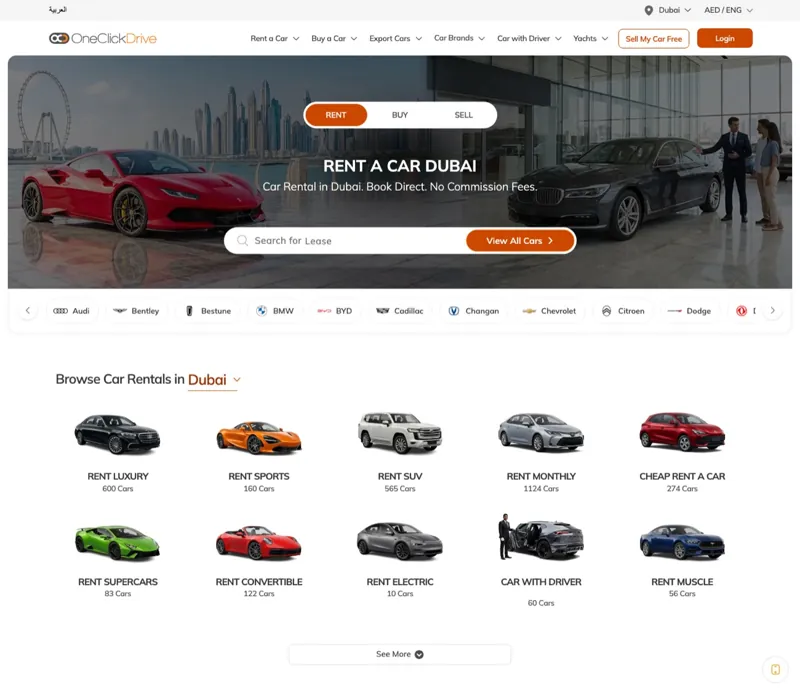
Platform · Car rental · UAE
A car rental marketplace where suppliers list fleets and renters compare and book, under real traffic.
oneclickdrive.com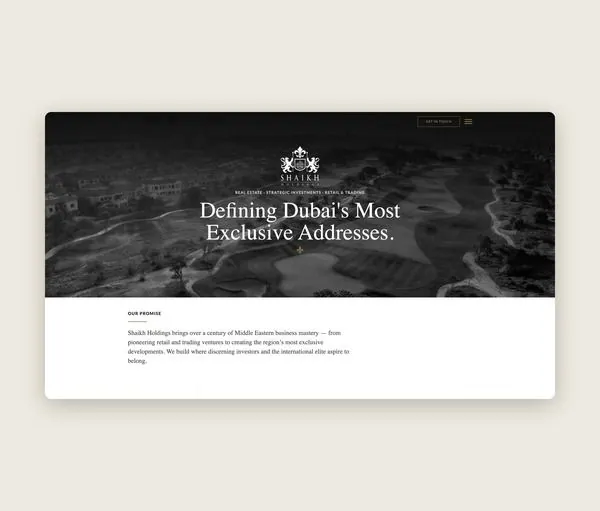
Website · Corporate · Dubai
A Dubai investment house with a century of business behind it. The site speaks to institutional investors, not shoppers.
shaikhholdings.comStraight answers
Most import and export trade runs on negotiated volume pricing, so a request for quote form usually works better than published prices. The site's job is to make it easy for a genuine buyer to send a detailed enquiry.
A focused set of current categories, with clear specification sheets, performs better than an exhaustive historical list. Categories can expand once the core catalogue is proven and maintained.
It depends on which markets you actually trade with. If a meaningful share of enquiries come from a specific region, translating the key product and company pages for that market is usually worth it.
Yes, a document request form works well for this, routed to whoever handles trade compliance on your side. We do not issue or verify these documents ourselves.
Every project gets a fixed written quote scoped to your brief, sent within 45 minutes during business hours with no obligation. Catalogue size, languages and any document request system are the main cost drivers.
Sources
Fixed price, in writing
Got it. Your quote is being written now.
In business hours you will have it within 45 minutes. Check your inbox for the confirmation.