
Specification pages, the base of B2B website design
Technical detail, dimensions, compliance standards and capacity, written for someone who already knows the category, not an introductory paragraph.
Web Design by Industry
A B2B buyer in the UAE rarely decides alone. They forward your site to a colleague, download a spec sheet, and check a tender document library before they ever fill in a contact form. The site has to work for that whole committee, not just the first visitor.
A B2B website design in Dubai is judged by people who will never speak to your sales team before they have already formed an opinion, an engineer checking a spec sheet, a procurement officer comparing suppliers against a tender, a director forwarding the site to a colleague with a single line of comment. Most B2B sites in the UAE are built like a brochure for a single reader. We build them for the committee that actually decides, with the documents, comparisons and request flows each person in that chain is looking for.
This sits inside our wider web design by industry work. For the technical build behind it, see website development.
The rest of this page works through the buyer, the pages the site needs, the rules that touch B2B enquiry forms, and how a B2B website design in Dubai is actually built, sequenced and measured once it is live, so you can see the whole shape of the project before a single page is designed.
What the site has to do
A B2B buyer moves through stages before they contact anyone, and each stage needs its own page.
Technical detail, dimensions, compliance standards and capacity, written for someone who already knows the category, not an introductory paragraph.
Spec sheets, certifications, capability statements and past tender responses, organised so a procurement officer can find what they need without emailing to ask.
What the client’s problem was, what was delivered, and what changed, named wherever the client has agreed to it.
A structured request for quote form that captures volume, specification and timeline, so the first reply is a real proposal, not a request for more information.
Who a buyer would actually be dealing with, useful for a large contract where the buyer is assessing the supplier as much as the product.
If you serve several industries with different specifications, a page per sector so each buyer sees relevant detail rather than a generic overview.
Data protection
A B2B website design in Dubai usually runs on lead generation: enquiry forms, RFQ requests and gated downloads that collect a name, company and contact details. The UAE government states that its Federal Decree Law No. 45 of 2021 on the Protection of Personal Data applies to the processing of personal data inside and outside the country, prohibits processing without the consent of the data owner outside specific exceptions, and gives that person the right to request correction or restriction of their own data.
This is not legal advice, and how the law applies to your specific forms and CRM setup should be checked with your own advisor, but as a practical matter every form we build states what the data will be used for and gets clear consent, rather than collecting details silently under a generic privacy notice link nobody reads.
Content gating
The instinct on many B2B websites in Dubai is to lock every useful document behind a form, on the theory that every download should become a lead. In practice this pushes a cautious buyer away before they have decided you are worth the enquiry. We generally recommend keeping the first layer of proof, general specifications, certifications, a capability overview, open, and reserving the form for detailed pricing structures, full technical drawings or tender specific documents.
Which documents sit where depends on your sales cycle and how competitive your sector is, so this is one of the first decisions we make together before any page is built.
What stops an enquiry
Two problems recur on B2B sites we review in Dubai.
A buyer checking whether you can actually meet a spec needs certifications, numbers and past examples on the page, not a promise to discuss it on a call.
A single form with no fields for volume, specification or deadline forces a slow back and forth before a real quote can start, and many buyers move on before that happens.
How we build it
A B2B site does not need every feature at launch, but the sequence matters for a long sales cycle.
Every spec sheet, certification and past tender response you can share, sorted into open and gated content before any page is written.
Fields built around the actual information your sales team needs to quote quickly, agreed with them directly.
Every page approved by you before development starts, including how case studies and client names are credited.
Form completions and document downloads measured from day one, so you can see which pages actually produce qualified leads.
Ongoing visibility for sector and specification searches sits under SEO services. A dedicated page for a specific tender or trade show is covered under landing page design, and where the build itself needs to plug into a broader software estate, our mobile app development and enterprise integration work sits alongside B2B website design in Dubai rather than replacing it.
The buyer
The person who approves a B2B website in Dubai is rarely the person who will use it most.
Measured on qualified leads and the length of the sales cycle, so they ask whether the site will shorten the gap between a first visit and a real conversation, not whether it looks impressive.
Measured on whether the company reads as credible to a much larger client than itself, since B2B website design in Dubai often has to make a mid sized supplier look ready for an enterprise tender.
Measured on volume and quality of enquiries reaching the CRM, so their first questions are usually about tracking, form fields and how a lead is scored before it reaches sales.
In the first meeting we are usually asked how long it takes for a real proposal to reach a buyer, how a case study gets named client approval, and how much of the site the sales team can update themselves once it is live.
Buying committees
A consumer site is built for one visitor. B2B website design in Dubai is built for several, arriving separately, at different points in a decision that one of them will eventually have to defend internally. A technical evaluator checks whether the specification actually matches the brief. A procurement officer checks whether the supplier can be onboarded and paid through the company’s own systems. A finance or director level sign off checks commercial terms and risk before a contract is signed. Each of them reads the site differently, and a page written only for the first of the three loses the other two.
We map this committee for your specific market before any wireframe is drawn, since a business selling industrial equipment to contractors has a different committee shape from a firm selling software to enterprise IT departments, even though both are B2B.
Long cycles
A B2B enquiry in Dubai can sit for weeks between a first visit and a signed order, moving through internal approval rather than a single decision maker.
A page a buyer can send to a colleague with no further explanation, with the specification, certifications and a clear next step all on the same page rather than split across a call.
A buyer returning weeks later after internal budget approval needs to find the same document, the same pricing structure and the same contact, not a page that has quietly changed underneath them.
A long B2B sales cycle is not a reason to build a thin site. It is the reason the site has to hold up on the third visit as well as the first.
Lead qualification
A generic contact form on a B2B website design in Dubai produces a name, an email and a one line message, which is not enough for a sales team to prepare a proposal without a back and forth first. An RFQ form built around what your team actually needs to quote, volume, specification, intended use and timeline, lets the first reply from your side be a real answer rather than a request for more information.
The fields belong to your sales team, not to a generic template, so we agree them with whoever will actually be quoting from the responses before the form is built.
Trade pricing
Many B2B suppliers in Dubai want to show more detail to an existing trade account than to a first time visitor, without publishing a public rate card. A logged in area for account holders can show trade pricing, order history and reorder shortcuts once we have confirmed with you how accounts are approved and who can see what. The public pages stay focused on specification and proof, since that is what a first visitor is comparing you on before they ever ask for an account.
This is separate from the RFQ flow above. An RFQ is for a new enquiry from someone without an account yet. An account area is for an existing trade customer who already has terms agreed with you.
Channel partners
A B2B website design in Dubai that sells through distributors as well as directly needs a page for each audience, not one page trying to speak to both.
Where a direct buyer can find an approved distributor near them, listed by region rather than left to search generally.
A short application route for a business that wants to become a reseller, asking for trade licence details and the territory or category they want to represent.
Distributor terms, minimum order quantities and territory rules kept off pages a direct buyer would see, so the two audiences never read content meant for the other.
Procurement
Some B2B buyers in Dubai, particularly larger companies and government linked entities, run a formal procurement process before they will engage a new supplier at all. That usually means a vendor registration step, a request to submit a trade licence and basic company documents, and a written quotation format rather than an email exchange. B2B website design in Dubai for a supplier who wins this kind of work needs a page that explains how to register as a vendor and what documents to have ready, so a procurement officer is not left guessing whether you can even be onboarded.
We build this as a straightforward information page with a document checklist, not a portal that tries to replicate your client’s own procurement software, since that system belongs to them, not to your website.
After the form
A form that reaches an inbox nobody checks regularly is worse than no form at all, since the buyer assumes you received it and simply did not respond.
Enquiries and RFQs post into your CRM with the page they came from attached, so a lead about one product category does not land with someone who sells another.
Form fields set up to match the stages and information your sales team already tracks, rather than a generic set that has to be re entered by hand.
An on page confirmation and an automatic email receipt, so a buyer knows their enquiry reached you before anyone from your side has replied.
We confirm what your specific CRM plan supports before promising a particular integration, since capability varies between CRM providers and pricing tiers.
Search behaviour
A research search and a ready to buy search look different, and a B2B site needs an answer for both.
| Search type | What the site needs to show |
|---|---|
| Category or specification research, early stage | A specification page that answers the technical question directly, not a sales pitch |
| Supplier comparison, mid stage | Certifications, capability statements and case studies a buyer can check against a shortlist |
| Supplier name plus location, ready to buy | A fast route to the RFQ form or a direct contact, with no extra steps in the way |
No search volume figures are quoted here, since actual demand depends heavily on your category and should be checked directly for your business rather than assumed from a general pattern.
Content you supply
The single biggest delay on a B2B website build is waiting for content that only your team can produce. Spec sheets exist but are scattered across old proposals. Certifications are real but the current copies are with whoever last renewed them. Client sign off on a named case study takes longer than expected because the actual approver is on leave. None of this is unusual, and it does not need to be perfect before we start, but knowing what is genuinely ready and what is not lets us sequence the build sensibly instead of guessing.
Launch order
A B2B site does not need every feature at launch, and trying to include all of them usually delays the parts that matter most.
Specification pages, a document library for what is ready now, the RFQ form and case studies you already have sign off for.
A trade account area, a distributor locator or partner application page, and sector specific pages once category performance shows which ones are worth building.
Arabic
Arabic matters differently for a B2B buyer than for a consumer shopper.
A procurement contact at a government linked entity may expect a company profile and key documents available in Arabic, even if the working relationship continues in English.
A supplier selling into Saudi Arabia or elsewhere in the Gulf through the same site often needs Arabic specification content, not just a translated homepage.
Internal account areas and RFQ confirmation emails used only by an existing English speaking trade account, where translation adds cost without a real reader.
Mistakes we see
A handful of patterns recur across B2B sites we review in Dubai, beyond the two covered earlier on this page.
A single large catalogue PDF with no way to find one product, which a technical evaluator will usually abandon rather than search through.
A returning trade customer sent through the same first time enquiry form as a brand new visitor, with no faster route for someone who already has an account with you.
A project description that explains what was delivered but never says what changed for the client, which is the part a buying committee actually wants to read.
Measuring success
Traffic on its own tells you little about a B2B site. What matters is what a visitor does once they arrive.
How many visitors who start the request for quote form actually finish it, which points at whether the fields are reasonable for the stage a buyer is at.
Which spec sheets and certifications are actually opened, which tells you where genuine technical interest sits rather than guessing from page views alone.
Whether the leads reaching the CRM from the site are ones your sales team would call qualified, which is the measure that actually matters over time and one only your team can confirm.
We do not quote conversion rate benchmarks here, since a realistic figure depends heavily on your category, price point and sales cycle, and an invented number would be more misleading than useful. The honest starting point for any B2B website design in Dubai is your own current numbers, not a borrowed industry average that may not reflect your buyers at all.
Integrations
A B2B site rarely stands alone. It sits in front of systems your sales, finance and operations teams already rely on, and B2B website design in Dubai has to connect to those rather than duplicate them. A CRM, whether that is Salesforce or another platform, is usually the first integration, since an enquiry that does not reach the CRM is a lead your sales team never sees in their normal workflow. Where you run an ERP for inventory, order status or account balances, a trade account area can pull from it directly rather than showing figures that drift out of date within days.
None of this needs to be built on day one. We agree which integration matters most for your sales process first, and treat the rest as phase two work once the core site is live and proving useful.
Keeping documents current
A certification that expired eight months ago sitting in an open document library is worse for trust than no certification page at all.
One person responsible for checking that certifications, spec sheets and capability statements are current, rather than assuming whoever built the page will notice when something lapses.
A document library built so your team can swap a file themselves once training is complete, rather than raising a request every time a certificate renews.
Why we do not publish a rate card
The instinct to hide all pricing entirely is understandable in a competitive B2B category, since a public rate card lets a competitor benchmark against you instantly. The opposite instinct, publishing full pricing openly the way a retail site would, rarely fits B2B either, since most B2B pricing genuinely depends on volume, specification or contract length rather than a single fixed figure. What tends to work is a public RFQ flow that makes it easy to ask, paired with a private account area for existing trade customers who already have agreed terms.
This is a judgement call specific to your category and your competitors, not a rule we apply the same way to every B2B website design in Dubai we build, so it is one of the first things we discuss with you.
Regional buyers
Many B2B suppliers based in Dubai sell across the wider Gulf and beyond, and the site needs to read clearly to a buyer who has never visited the UAE.
A buyer outside the UAE checking early whether you actually serve their market, rather than assuming from a Dubai address alone.
International or regionally recognised certifications shown alongside any UAE specific ones, since a buyer abroad may not know a local certification by name.
A clear indication of response times across time zones and business hours, without promising round the clock coverage we cannot commit to.
Document security
Not every document belongs at the same access level, and B2B website design in Dubai has to plan for that from the structure of the library, not as an afterthought.
| Document type | Typical access level |
|---|---|
| General capability overview and certifications | Open to any visitor |
| Detailed technical drawings or full pricing structures | Gated behind a short form or account login |
| Tender specific responses and confidential specifications | Shared directly, not published on the site at all |
Genuinely confidential material, a live tender response with commercial terms, should never sit on a public server regardless of how it is gated. We treat that as content to send directly, not to publish.
Before launch
A B2B website design in Dubai is only as useful as the process behind it, so we walk through a short checklist with your sales team before launch rather than after.
Confirmed by product category or region, so an RFQ does not sit unassigned while your team debates who owns it.
Agreed with the person who will send it, so the RFQ form asks for exactly that information and nothing your team does not use.
A named owner and a simple process for swapping an expired certificate or an outdated spec sheet.
Agreed in terms your team can actually check, RFQ completions and document downloads, rather than a number invented before the site has any real traffic.
Nurturing a long cycle
Weeks can pass between a first visit to a B2B website design in Dubai project and a signed order, and the site should give a buyer a reason to come back in that gap rather than relying on memory alone.
A simple way for a buyer to opt in to new specification updates, product news or case studies, kept genuinely useful rather than a generic newsletter nobody reads.
Recently completed projects or case studies shown prominently, so a returning visitor sees the site is active rather than unchanged since their last visit.
Whether a visitor is on a specification page, a case study or the document library, a visible route back to the RFQ form rather than a dead end.
Sector pages
A supplier serving several industries with genuinely different specifications, construction and healthcare for example, usually benefits from a page per sector rather than one generic overview trying to serve both. A buyer in one sector should not have to read past detail meant for another before reaching the specification that applies to them. This is different from the industry pages you are reading now, which are written for our own clients, but the same logic applies to a B2B website design in Dubai for a business that itself sells across multiple sectors.
We only recommend building sector pages once you can show genuinely different content for each one. A sector page that repeats the same paragraph with the industry name swapped is exactly the kind of thin content that hurts search visibility rather than helping it.
Testing before launch
A B2B site is tested the same way any website should be, on real devices and browsers, but with extra attention to the parts unique to a B2B build.
Spec sheets and certifications checked so they open correctly on the devices your buyers actually use, since a procurement officer reviewing on a phone is common.
Tested with the actual fields agreed with your sales team, checking that a completed form arrives in the CRM correctly before launch, not discovered as a gap afterwards.
A note on scope
Being clear about scope avoids a mismatch between what a buyer expects from their own site and what we actually build.
We connect the site to systems you already run or plan to run. Selecting, licensing and configuring the CRM or ERP itself is a separate decision for your business.
Trade pricing, minimum order quantities, distributor territories and contract terms are commercial decisions for you and, where relevant, your legal adviser, not something built into the site design.
A worked example
Consider a procurement officer at a mid sized contractor searching for a specific type of industrial equipment. They land on a specification page from a search, not the homepage, and check whether the capacity and compliance standard match their project before reading anything else. Satisfied, they open the document library, download a spec sheet and a certification, and forward the page to their technical lead with no message beyond the link. Two weeks later, once the technical lead has reviewed it internally, the procurement officer returns and submits an RFQ with the volume and timeline for their specific project. The RFQ reaches the right person in your CRM because the routing was set up to match your product categories, and the first reply is a real quotation rather than a request for the same details again.
Every part of that sequence is a page or a form we would have designed and tested individually. B2B website design in Dubai works when each part holds up on its own, since a buyer rarely experiences the whole site in one sitting.
Working with us
The stages follow our usual way of working, adapted for the longer decision chain a B2B project involves.
We ask about your buying committee, your existing documents and your CRM, not a generic questionnaire about colour preferences.
Specification pages and the RFQ flow built first, reviewed by whoever on your side will actually use the leads it produces.
Launched with lead tracking in place from day one, and revisited once real RFQ data shows which pages and fields are actually working.
See our full website development process, and our UI and UX design work for how specification heavy pages are structured for readability. For handling consent on any marketing list built from RFQ contacts, see our post on email marketing consent under the UAE data protection law.
Nearby industries
For manufacturers with a similar specification driven buying process.
For trading businesses with a comparable document and quote led sales cycle.
For firms selling expertise to the same kind of buying committee.
Selected work
Work across sectors, with the closest to this industry shown first. Every one is a live site, not a mockup.
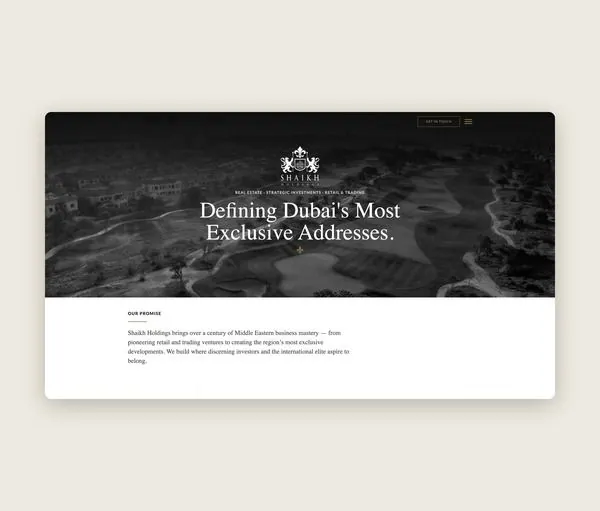
Website · Corporate · Dubai
A Dubai investment house with a century of business behind it. The site speaks to institutional investors, not shoppers.
shaikhholdings.com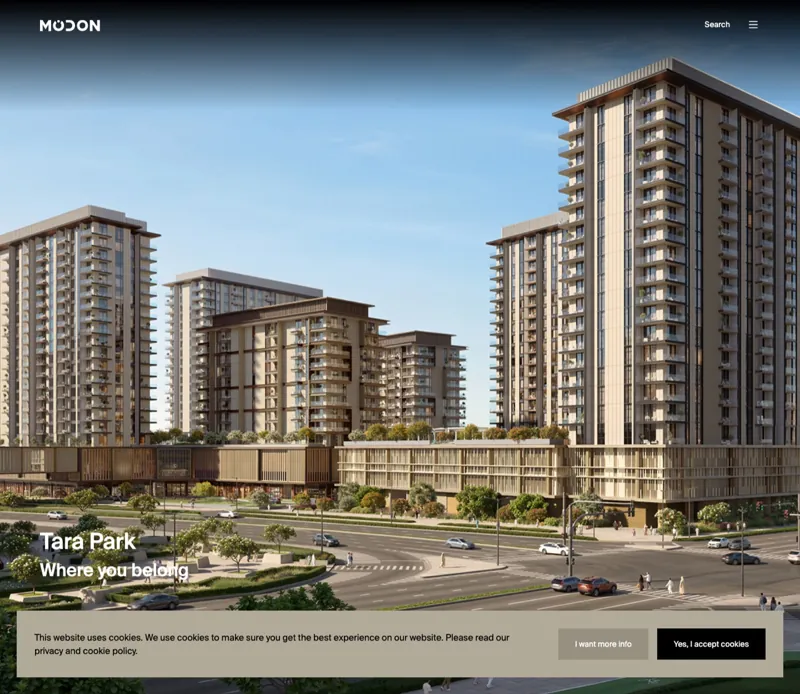
Website · Property development · Abu Dhabi
An ADX listed holding company building master planned communities, with a site that holds investors and residents at once.
modon.com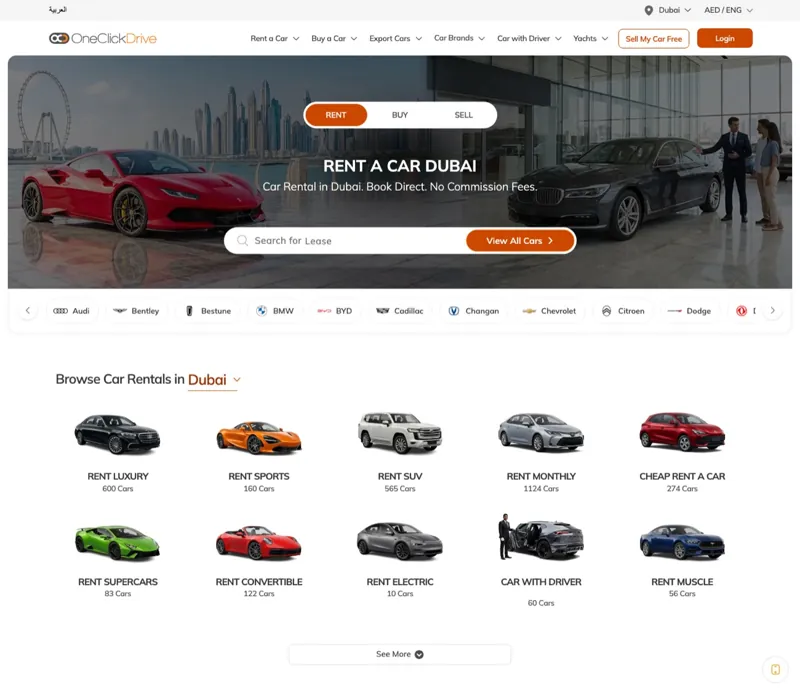
Platform · Car rental · UAE
A car rental marketplace where suppliers list fleets and renters compare and book, under real traffic.
oneclickdrive.comStraight answers
Yes. Downloads can sit openly for general material or behind a short form for detailed technical documents, depending on how much information you are comfortable giving before a conversation starts. We recommend keeping the first useful document open, since a locked site with nothing to show puts many B2B buyers off before they engage.
Every form is built to collect only what is needed for that enquiry, with consent for how the data will be used, in line with the UAE's Personal Data Protection Law. What happens to the data after submission, such as which CRM it flows into and who can access it, is agreed with you before the form goes live.
We do not publish fixed prices on the pages we build, since B2B pricing usually depends on volume, contract length or specification. What we build instead is a clear request for quote flow that captures enough detail for a fast, accurate written proposal.
Named case studies are the strongest form of B2B proof, but only where the client has agreed. Where a client will not be named, an anonymised summary of the problem and outcome is a reasonable alternative, though it carries less weight than a named one.
Usually, yes. Enquiry and RFQ forms can post to most CRMs through an API or a middleware tool, so a lead lands with the right sales owner and the page it came from attached. We confirm what your CRM plan supports before promising a specific integration.
Sources
Fixed price, in writing
Got it. Your quote is being written now.
In business hours you will have it within 45 minutes. Check your inbox for the confirmation.