Licensing detail on the trading website
Licence number, licensing authority and jurisdiction, stated clearly and consistently across the site, so a visitor can check the claim independently rather than take it on trust alone.
Web Design by Industry
A trading website in Dubai is read by someone about to put real money into a platform, and it is watched closely by regulators. We build these sites around clear risk disclosure, verified licensing detail and functional accuracy, never around promises of return.
Nothing on this page is investment advice, and nothing we build for a trading platform promises a return of any kind, whatever the market or instrument being described. Trading website development in Dubai sits at the intersection of two audiences who both read closely: a visitor deciding whether to trust a platform with their money, and a regulator checking whether the marketing around that platform stays inside the rules.
This page is part of our web design by industry work, built through the same website development process as every project, applied here to a sector where regulatory accuracy in Dubai is genuinely not optional.
What the site must do
A trading platform earns trust through clarity, not enthusiasm, and the site has to be built with that in mind from the first page.
Licence number, licensing authority and jurisdiction, stated clearly and consistently across the site, so a visitor can check the claim independently rather than take it on trust alone.
The same clear risk wording repeated across relevant pages, not confined to a footer link nobody opens, covering the possibility of losing some or all invested capital in plain, unambiguous terms.
What instruments are actually offered, what fees apply in general terms, and how the platform itself works day to day, described accurately and without exaggeration.
Identity verification and funding flows built to the standard expected for handling financial account data, not treated as a simple contact form left over from a template.
A visible, working route to human support matters more here than in most industries, since account and funding issues need a fast, real response rather than an automated reply.
Where the site serves Arabic speaking clients, regulatory and risk wording needs the same precision in Arabic as in English, checked by someone fluent rather than a loose machine translation.
A trading platform rarely lets marketing publish a page on its own, and understanding who else is in the room changes how a trading website development project runs. Compliance or legal usually owns every word of the risk statement and any licence claim, and treats a change to that wording as a formal review rather than a copy edit. Whoever runs the trading desk or the platform relationship cares most about instrument pages being technically accurate, since a wrong spread, wrong minimum deposit or wrong list of tradable instruments creates support tickets and complaints the moment the site goes live. And a founder or managing director at a smaller platform is often personally named on the licence, which means they read every regulatory statement on the site with a level of scrutiny a generic business owner would not apply to their own homepage.
What all three ask about early is consistent: how quickly can a risk disclosure or licence detail be updated if the regulator changes something, who has final sign off if compliance and marketing disagree about a headline, and whether the agency understands that a mistake on this kind of site is not just an unhappy customer, it is a regulatory exposure. Being straightforward about what we can and cannot promise on that front, before design starts, is what keeps a Dubai trading website project honest from the brief onward.
A smaller platform often assumes an agency needs to understand trading itself in depth to build the site well, and while a working knowledge of how spreads, margin and order types are usually explained helps, what actually matters more is a working process: draft copy, route it to the named compliance reviewer, log what was approved, and treat any later change to a rate, an instrument or a risk statement the same way, not as a quick edit anyone can make. Platforms that already run a tight internal compliance process tend to find that process transfers naturally onto the website once we understand who owns which decision, which is usually a shorter conversation than clients expect going in.
DIFC and ADGM platforms
A number of trading platforms operating out of Dubai and Abu Dhabi are licensed inside the DIFC or ADGM financial free zones rather than under a mainland UAE licence, and the rules that shape their websites come from a different regulator again.
The DFSA, which regulates financial services conducted through the DIFC, operates a Financial Promotions Prohibition under Article 41A of the DIFC Regulatory Law 2004. In a guide the DFSA has published to explain it, a Financial Promotion covers any communication, oral, written or electronic, that invites or induces someone to enter into a financial service agreement or deal in a financial product, which plainly includes a trading platform’s homepage, its instrument pages and any advertisement driving traffic to them. The guide sets out that where a Financial Promotion is provided to a retail client and contains information or a representation relating to past performance, or a forecast based on past performance or other assumptions, it must present a balanced view of the product or service, explain in an easy to understand way how the performance figure or forecast was derived and what assumptions sit behind it, and carry a prominent warning that past performance is not necessarily a reliable indicator of future performance. That single requirement is close to the heart of what this page means by restrictions on performance claims: a chart or figure showing how an instrument, strategy or account has performed historically is not automatically banned, but it cannot stand alone, unexplained and without that warning, anywhere on a trading website governed by DFSA rules.
The Abu Dhabi Global Market runs a comparable restriction under its own Financial Services and Markets Regulations 2015. Section 18 makes it unlawful, in the course of business, to communicate an invitation or inducement to engage in investment activity, unless the person making the communication is an authorised or exempt person in ADGM, is licensed and supervised by a UAE financial services regulator, has the communication approved by an authorised person, or the communication falls within a listed exemption. For a trading platform, that means every promotional page and, in most interpretations, every piece of paid advertising pointing at the site needs to originate from, or be approved by, the entity actually holding the ADGM licence, not from an unrelated marketing affiliate.
This is a general summary of two guides and one section of a rulebook, not legal advice, and it does not cover every DFSA or FSRA rule that could apply to a specific platform. A DIFC or ADGM licensed trading platform should confirm its current obligations directly with the DFSA or FSRA before publishing anything that touches performance, forecasts or promotional claims.
| Where the platform is licensed | Regulator | What the website should name clearly |
|---|---|---|
| UAE mainland | Capital Market Authority, formerly the Securities and Commodities Authority | Licence number, licensed activity and the CMA as the licensing authority |
| Dubai International Financial Centre | Dubai Financial Services Authority | DFSA authorisation status, and that promotions to retail clients meet the balanced view and past performance warning |
| Abu Dhabi Global Market | Financial Services Regulatory Authority | FSRA authorisation status, and that any promotion is made by, or approved by, the authorised person |
Content to gather
Trading website development in Dubai depends on compliance content being settled before design starts, since risk wording and licensing detail shape the layout, not the other way round. Whoever handles compliance for your platform should sign off this content before it reaches the design stage.
Onboarding
Opening a trading account online moves through a small number of stages, and where each stage sits, on the public website or behind a login, matters for both compliance and conversion.
| Stage | What happens | Where it sits |
|---|---|---|
| Registration | Name, contact details, country of residence and an initial risk or suitability questionnaire | Public website, short enough to complete in a few minutes |
| Identity verification | Document upload, a liveness or selfie check, and screening against sanctions and politically exposed person lists | A verification provider integrated into the flow, not a manual email exchange |
| Source of funds | Where the money funding the account comes from, gathered at a level appropriate to the account size and risk profile | Behind login, reviewed by the platform’s compliance team before full trading access opens |
| Funding and first trade | Payment gateway connection, account activation and access to live instruments | Client area, once verification and any compliance review are complete |
The Central Bank of the UAE’s guidance for licensed financial institutions on customer due diligence and know your customer controls, in force from November 2025, sets out that institutions should understand a customer’s occupation, source of income, source of funds and expected activity in order to detect suspicious activity, and should keep records that can be reconstructed on request by the relevant authorities. That guidance applies to Central Bank licensed institutions specifically, and a trading platform licensed by the Capital Market Authority, the DFSA or the FSRA should confirm its own applicable anti money laundering obligations with its own regulator rather than assume the Central Bank’s guidance applies directly, since this is not legal advice.
Arabic matters on a trading platform site for a reason that goes beyond reaching Arabic speaking clients, though that matters too. Risk disclosure, licence detail and the balanced view requirement around performance figures all need to carry the same weight in Arabic as they do in English, and a loosely translated Arabic risk statement is a genuine gap rather than a cosmetic one, since a regulator assessing the site’s compliance does not treat the Arabic version as secondary, and treating Arabic as equal in weight is a defining feature of careful trading website development in Dubai. In practice, this means the Arabic version of every regulatory statement on the site needs its own review by your compliance function, not an assumption that a competent translation of the English version automatically carries the same legal weight, a review step trading website development in Dubai should schedule alongside the English sign off, not after it.
There is a commercial reason to get this right as well as a regulatory one. A trading platform’s most cautious visitors, the ones reading a risk statement carefully rather than skimming past it, are disproportionately likely to be comparing Arabic and English versions of a site side by side, particularly where a family member or business partner reviews the platform before an account is funded. An Arabic site that reads as thinner or less careful than the English one undermines the platform’s credibility with exactly the audience most inclined to check, and it is a detail that trading website development in Dubai has to plan for from the outset rather than add once the English site is finished.
A testimonial implying a client made money through the platform sits in the same category as a performance figure without context, and it carries the same problem: it invites a visitor to expect a similar outcome, which is exactly what regulators warn against when a platform’s marketing strays into implied investment advice, a line trading website development in Dubai keeps deliberately in view. A genuine review about account opening speed, platform usability or support responsiveness is a different matter and generally sits well outside that concern, since it describes the service rather than the trading outcome. The distinction sounds subtle written down, but it is usually obvious once someone reads the actual wording: a client review that says opening an account was fast and support answered quickly is service feedback, while a review that says a client made a specific return is a performance claim wearing a testimonial’s clothing.
We build trading platform sites to keep that distinction deliberate rather than accidental, which in practice means reviewing any client quote, testimonial or case study against the same standard applied to a performance figure, before it goes anywhere near a page a prospective client will read. Google and Meta star ratings, where a platform already has them, are usually a safer form of social proof to display than a handpicked quote, since they reflect a broader, less curated sample of client sentiment and rarely reference a specific trading outcome, and they are a safer form of social proof for trading website development in Dubai to lean on generally.
Demo content
A demo or simulated trading environment is one of the most persuasive pieces of content a trading website can offer, and one of the easiest to get wrong.
A demo account exists to show how the platform actually works, the order screen, the charting, the account dashboard, not to showcase a curated run of winning trades. Every screen, video or screenshot drawn from a demo or simulated environment needs a clear, visible label saying so, placed on the same screen as the content rather than in a caption easily missed. Results generated in a demo environment, using simulated funds and often without the slippage or execution delay a live account experiences, should not be presented in a way that implies they predict what a live account would achieve, which loops back to the same principle covered in the DIFC and ADGM section above: a performance figure without context and a caveat is a promotional claim, not neutral information.
Functionally, a demo environment embedded in a website is worth building accurately rather than as a simplified mockup, since a prospective client who tries a demo and then finds the live platform behaves differently loses trust immediately, and that loss of trust is far more damaging on a trading site than on almost any other kind of website we build.
Client area
Once an account is verified and funded, a trading platform’s website work is not finished, it moves into a secure client area that has its own design and content requirements.
Balance, open positions and recent activity, presented clearly and without the promotional framing appropriate on a public marketing page.
Trade confirmations and periodic statements a client can download, which often need to match a format the platform or its regulator already requires, another detail that separates trading website development in Dubai from a standard client login area.
Two factor authentication, withdrawal address whitelisting where relevant, and session management, treated as functionality rather than an afterthought, since security is one of the areas trading website development in Dubai is judged on most closely by returning clients.
A clear, logged route to raise an issue from inside the account area, distinct from the general public enquiry form, so an existing client’s issue reaches the right team quickly, a routing detail worth planning early in any trading website development in Dubai project.
A funding flow that states processing expectations honestly, since an unrealistic promise about withdrawal speed is one of the fastest ways to damage trust with an existing client, which is exactly why trading website development in Dubai treats the funding flow as seriously as the marketing pages.
A client area available in the same languages as the public site, so a client who opened an account in Arabic is not dropped into an English only dashboard, a detail trading website development in Dubai has to plan for from the start.
Regulation and the website
This is a general summary, not legal or financial advice, and current requirements should be confirmed directly with the regulator.
The body formerly known as the Securities and Commodities Authority, now operating as the UAE Capital Market Authority, has publicly warned against unlicensed entities offering trading and investment activity, and it asks the public to verify a platform’s licence status directly with the regulator before sending money or personal data. A trading website in Dubai should make that verification easy rather than discourage it, since a platform confident in its own licence has nothing to lose by being checked.
None of this page constitutes financial advice, and nothing here should be read as encouragement to promise a client any specific outcome. A trading website development project in Dubai treats return figures, testimonials implying assured profit, and pressure tactics such as counting down a limited offer as out of scope entirely, because these are exactly the practices regulators flag when warning the public about unlicensed or predatory platforms.
The Capital Market Authority also keeps a public, English language list of warnings against entities it has found publishing advertisements or offering regulated activity without a licence, authorisation or approval. Reading through that list is instructive for anyone building or briefing a trading website in Dubai: recent entries name platforms advertised under names that sound entirely plausible, describe cloned websites and forged documents carrying the CMA’s own logo alongside logos of genuine financial institutions, and repeat the same advice each time, that investors should verify a firm’s licensing status on the regulator’s own website before entering an agreement or transferring funds. That pattern is exactly why a licensed platform’s website should make its own licence number, licensing authority and jurisdiction easy to find and, where the regulator provides a public register, easy to cross check, rather than leaving a visitor to take the claim on trust in an environment where cloned and fraudulent sites are demonstrably common. A genuinely licensed platform has nothing to lose from making that verification easy, and a website that hides or vaguely gestures at its regulatory status, when the same regulator is actively publishing warnings about entities doing exactly that, invites the comparison rather than avoiding it.
Risk warnings
A risk statement that exists only on a dedicated legal page satisfies almost nobody, not the regulator reviewing the site and not the visitor deciding whether to trust it.
The homepage, the instrument pages and the account opening flow are where a visitor is actually deciding, so the risk statement belongs close to those pages, not only in a footer link.
Wherever a historical return, a backtest or a demo result appears, the past performance warning covered under DIFC and ADGM rules above belongs on the same screen, not one click away.
A risk statement rendered as tiny grey text at the bottom of a mobile page is functionally invisible, and most trading platform traffic in Dubai arrives on a phone.
The same approved wording repeated across the site, rather than a slightly different version on each page, which avoids a subtle drift where one page ends up softer than the version compliance actually signed off.
An Arabic risk statement placed less prominently than its English equivalent, or translated more loosely, undermines the entire purpose of having one in the first place.
A visitor should see the risk statement before starting account opening, not for the first time buried in a terms document they scroll past while signing up.
Search behaviour around trading splits into a research phase and a ready to open phase, and the two need different pages entirely. A research search reads like a question someone is still forming an opinion about: how does margin trading work, what is the difference between a broker and a platform, is a specific instrument type regulated in the UAE. Someone typing that is comparing options and is not ready for an account opening form, and sending them straight to one usually loses them. A ready to open search names the action directly: open a trading account Dubai, regulated forex broker UAE, trading platform sign up. Someone typing that already has a shortlist and wants a fast, clear route to start, with the licence and risk information visible along the way rather than hidden behind marketing copy.
A site structured only around account opening pages answers the second intent and ignores the first, which is a common gap we see on trading platform sites. Educational and explainer pages, written honestly and without performance promises, serve the research intent and tend to be what a cautious, first time trader reads several times before ever filling in a form. No search volumes are quoted here, since we have not measured them for a specific platform, but the pattern of research search against ready to open search is consistent across the trading sites we have built.
Phasing
A trading platform rarely needs every instrument, every account type and every language live on day one, and forcing that usually delays the whole launch.
| Stage | What it usually includes |
|---|---|
| Phase one | Homepage, licence and risk disclosure, core instrument pages, account registration and identity verification, a working demo |
| Phase two | The full instrument range, a second language built out in full, deeper educational content and any client portal features beyond basic account management |
A handful of habits show up repeatedly on trading platform sites we are asked to review or rebuild. Performance figures shown without the assumptions behind them or a past performance warning are the most common, usually copied from a marketing deck without anyone checking whether the same wording works on a public website read by a retail visitor rather than a room of professionals. Risk statements confined to a single legal page, disconnected from the instrument pages and the account opening flow they should sit beside, are nearly as common. A licence number stated without a working way to verify it, at a time when the regulator itself is actively warning about cloned websites carrying forged logos, undermines exactly the credibility the number is meant to establish. And a demo environment that behaves noticeably differently from the live platform, in execution speed or available instruments, damages trust the moment a new client notices the gap.
None of these are difficult to fix individually. What they have in common is that they are usually the result of marketing content being built and published without a compliance review step built into the process from the start, rather than any single page being poorly designed.
A generic business website template treats persuasion as the whole job: a strong headline, a confident claim, a clear call to action. A trading website has to do all of that while working inside a narrower set of boundaries than almost any other industry on this site, because the visitor reading it is deciding whether to send money to a platform, and the regulator watching it is specifically alert to the kind of enthusiastic, promise heavy language that a generic template rewards. Borrowing a homepage structure built for, say, a retail store or a consulting firm and swapping in trading language usually produces exactly the kind of page that reads well to a marketing team and badly to a compliance officer or a cautious client.
Trading website development in Dubai, done properly, covers platforms across a wide range: a small, newly licensed broker operating out of a single Dubai office and a larger platform with an established compliance department and an existing brand across several markets both need the same underlying discipline. What stays constant across that range is the same discipline covered throughout this page: performance figures carry the required context and warning, risk disclosure sits where a visitor will actually see it, licence detail is verifiable rather than merely claimed, and the site is built expecting instruments, rates and regulatory guidance to change, not treated as a one time project finished at launch. That discipline, more than any particular layout or feature, is what separates trading website development in Dubai from a general business site with a risk warning bolted on at the end.
Build order
Every project runs through the six stages under web services, with compliance review built into each stage rather than added at the end.
Licensing detail, platform integration and compliance content shape a fixed written quote for your Dubai site, sent within 45 minutes during business hours.
Homepage and account opening flow are designed first, built around clarity and required disclosure rather than promotional imagery, before you approve everything else that follows.
Instrument pages, account opening, identity verification and funding connections are built, with risk wording placed exactly where your compliance team specifies and reviewed once more before it goes live.
Every regulatory statement, licence detail and risk disclosure is checked line by line against your latest approved wording before the site goes anywhere near live.
Domain, hosting and CMS logins sit under your company’s name, with training for whoever on your team updates licensing detail and disclosure content going forward.
Search visibility and account opening completion rate are the two signals worth watching closely first, available through an optional SEO retainer.
Data behind the site
A trading site is unusual among the industries on this section of our site because part of its content changes constantly, on a schedule the website itself has no control over.
Where a site shows live or delayed prices, the feed’s source, its update frequency and a clear label showing whether a price is live or delayed all need to be accurate, since an outdated price presented as current is misleading regardless of intent.
Published spread ranges, minimum margin and maximum permitted margin ratios are exactly the kind of figures a prospective client compares across platforms, and they change with market conditions and regulatory limits, not on a fixed schedule.
The list of tradable instruments, and any that have been suspended or delisted, needs an owner who updates the website the same day the platform itself changes, not weeks later, a discipline trading website development in Dubai depends on as much as the initial build itself.
Market hours, and the UAE public holidays or market specific closures that affect them, are a small detail that causes a disproportionate number of support enquiries when the website gets them wrong.
A licence number, its expiry or renewal status and the jurisdictions the platform is actually permitted to serve, kept current rather than left as a launch day snapshot, which is exactly the kind of ongoing maintenance trading website development in Dubai has to budget for beyond the initial build.
A visible, working route to a human, since an account or funding issue on a trading platform is rarely something a visitor is willing to wait days to hear back about, and responsiveness is one of the clearest signals trading website development in Dubai has actually served the client well.
Getting started
A trading website development project depends more heavily than most on content that has to come from compliance and the trading desk rather than from marketing, and the earlier that content is settled, the faster the build moves, which is the single biggest lever a client has over how quickly trading website development in Dubai actually reaches a launch date.
Raw traffic or even raw registration numbers are weak signals on a trading site, since a registration is not an account, and an account is not a funded, active trader. The more useful funnel to watch runs from registration through identity verification completion, through to a funded account and, eventually, a first trade, and the stage where the largest share of people drop out usually points directly at a specific page or form field worth fixing. Identity verification is a common drop off point, often because the process asks for more than the visitor expected at that stage, and testing whether that expectation is set clearly before verification begins tends to matter more than any visual redesign of the form itself, a lesson repeated across most trading website development in Dubai projects we have run. Funding is a second common drop off point, particularly where a payment method a visitor expected to use is not actually supported, so listing accepted funding methods clearly before someone reaches that step avoids a frustrating dead end late in the process, exactly the kind of small planning decision trading website development in Dubai benefits from.
We do not publish invented conversion benchmarks here, since a realistic figure depends heavily on the platform’s instrument range, its minimum deposit and its target market, and quoting a number without that context would not be honest, since two platforms with very different minimum deposits and target audiences will naturally see very different completion rates at every stage of the funnel, which is why trading website development in Dubai resists a single universal benchmark. What we can say is that the funnel from registration to funded account is the one worth instrumenting properly from day one, since it is the single clearest signal of whether trading website development in Dubai has actually produced a working site rather than an attractive one.
Related industries
Shares the same emphasis on licensing accuracy and disclosure.
Another sector where unverifiable claims damage trust immediately.
A neighbouring professional service with similar credibility requirements.
Selected work
Work across sectors, with the closest to this industry shown first. Every one is a live site, not a mockup.

Mobile app · Fintech · United States
A fintech platform connecting merchants, customers and charities in a single payment flow.
purposepayment.com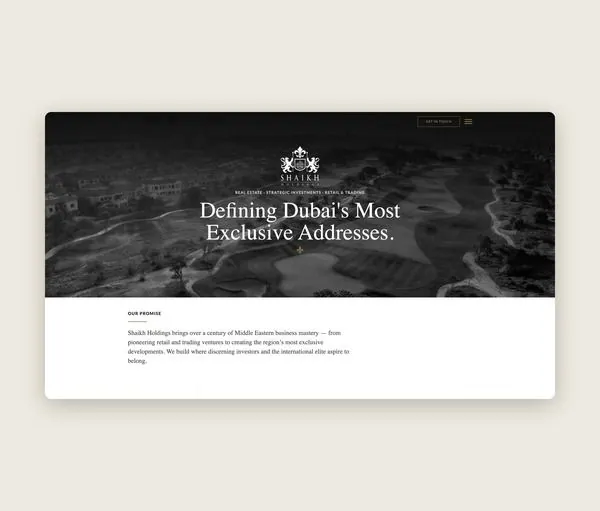
Website · Corporate · Dubai
A Dubai investment house with a century of business behind it. The site speaks to institutional investors, not shoppers.
shaikhholdings.com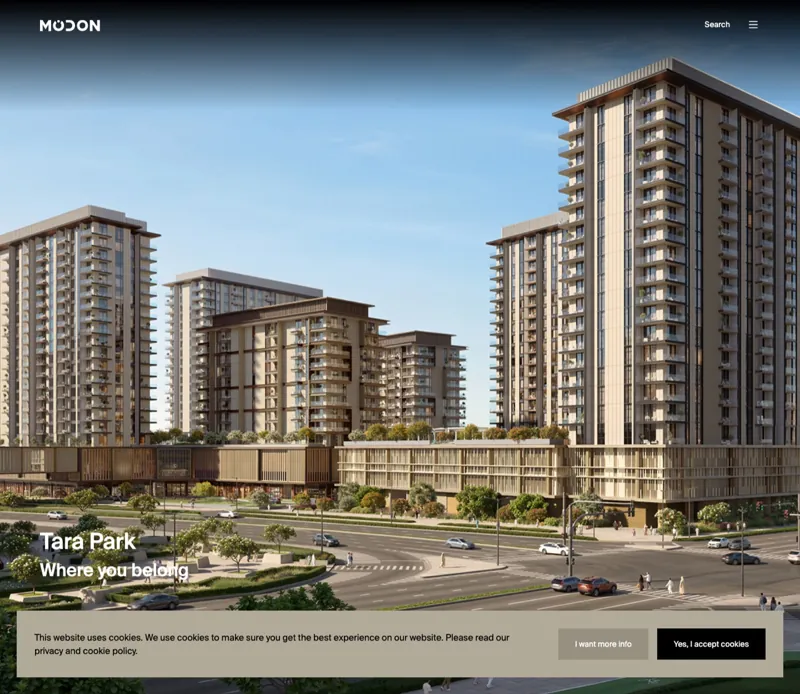
Website · Property development · Abu Dhabi
An ADX listed holding company building master planned communities, with a site that holds investors and residents at once.
modon.comStraight answers
We do not build pages that state or imply assured, likely or typical returns, since that crosses into investment advice and is one of the specific practices UAE regulators warn against. Past performance, where shown at all, needs the standard caveat that it does not predict future results.
Clearly, usually in the footer and on an about or regulatory page, along with the name of the licensing authority. A visitor should be able to find and verify it without searching.
Often yes, through account opening and funding flows that connect directly to your trading platform or broker infrastructure. The website itself typically handles onboarding and disclosure, with the platform provider handling execution.
A standard, clearly worded risk statement placed consistently across the site, rather than hidden in small print on one page, is what regulators expect and what a serious visitor expects to see from a credible platform.
Every project gets a fixed written quote scoped to your platform integration, languages and compliance content, sent within 45 minutes during business hours with no obligation.
Sources
Fixed price, in writing
Got it. Your quote is being written now.
In business hours you will have it within 45 minutes. Check your inbox for the confirmation.