
A job board with real filters
Sector, role type and location filters matter once a vacancy list passes a handful of roles, so a jobseeker can find a relevant listing without scrolling everything.
Web Design by Industry
Recruitment website design in Dubai for agencies working both sides of the desk, built around a job board, CV upload, sector pages and a MOHRE licensed agency shown clearly to employers and jobseekers.
A recruitment website serves two visitors with opposite needs on the same domain. An employer wants to know the sectors you cover and how quickly you can put candidates in front of them. A jobseeker wants to see current vacancies and get a CV in front of someone quickly. Recruitment website design in Dubai has to serve both without either one feeling like an afterthought, since a site built only for employers reads as a corporate brochure, and one built only for jobseekers reads as a job board with no agency behind it.
Recruitment website design in Dubai is also unusually sector driven. Construction staffing, healthcare staffing, finance and hospitality all attract different search terms and different kinds of employer, so a single generic staffing page tends to rank for none of them. This sits alongside our wider B2B website design work and follows the same website development process behind every build.
This page goes through who actually signs off a recruitment website in Dubai, the two journeys the site has to run at once without one interrupting the other, the job board and applicant tracking integrations that usually come up, how candidate data should be handled under the UAE’s personal data protection law, and what a sensible first launch and phase two look like for an agency of this kind. It also covers where Arabic content actually pays off, what content we need from you before a build starts, and the concrete mistakes we see repeated across recruitment sites in Dubai.
What the site has to do
These are the pages and features that decide whether a Dubai recruitment website actually generates placements.
Sector, role type and location filters matter once a vacancy list passes a handful of roles, so a jobseeker can find a relevant listing without scrolling everything.
A generic contact form loses CVs. A dedicated upload flow that tags the sector and role a candidate is interested in routes faster to the right consultant.
Construction, healthcare, finance and hospitality staffing each need their own page, since an employer searching for one rarely wants to read about the others first.
Employers want a fast way to describe a vacancy and get a response, separate from the jobseeker facing parts of the site, not buried in the same form.
A recruitment agency operating in Dubai holds a MOHRE licence, and showing that status plainly builds trust with employers who are wary of unlicensed intermediaries.
Sectors that hire across a wide nationality mix, such as construction and hospitality, often benefit from Arabic content alongside English, not only for the employer side.
The buyer
On the employer side, the person who commissions or approves a recruitment website is rarely the same person who fills in a vacancy request. It is usually the agency owner or the operations manager, and what they are measured on is placements made per month, the ratio of CVs sent to interviews arranged, and how quickly a role gets filled once it lands with a consultant. In the first meeting they will ask what the site does for their existing consultants, not what it looks like, because a recruitment website that does not reduce the manual work of matching a CV to a vacancy is not solving the problem they actually have.
A second, quieter decision maker sits behind that: whoever holds the MOHRE licence and carries personal liability for how the agency represents itself publicly. That person cares less about design and more about whether every sector page and every claim on the site matches what the licence actually permits, and whether candidate data is being handled in a way that will not come back as a complaint. A recruitment website design brief in Dubai that only talks to the operations side and skips this second reader tends to need rework later, once the licence holder sees the site live. Good recruitment website design in Dubai plans for all three readers from the first meeting, not just the one who happens to book the call.
There is often a third voice in the room too, whoever manages the agency’s relationship with its largest employer clients. That person tends to focus on how the site reflects on existing relationships: whether a case example or a named sector claim could embarrass a client who reads it, and whether the site looks like it belongs to an agency their own business would be comfortable being associated with publicly.
Agency types
Not every recruitment business in Dubai works the same way, and the website has to reflect that rather than assume one model fits all.
Volume driven, working several sectors at once, usually construction, hospitality, retail or logistics. The website needs a job board that can carry a large number of live vacancies without becoming unreadable, and sector pages that let each specialism stand on its own.
Lower volume, higher value placements, often finance, legal or senior management roles. These sites tend to carry fewer live vacancies and more content built around discretion: confidential search, a request to be contacted rather than a public job board, and consultant profiles that carry real weight with a candidate deciding whether to trust the agency with their career.
Often supplying labour in bulk to a small number of large employers rather than running a public facing job board at all. The website’s job here is closer to a capability statement and an employer enquiry route than a jobseeker facing product, though a simple CV registration page still matters for building a candidate pool.
A recruitment website design brief in Dubai should say early which of these models the business actually is, since the difference changes almost everything downstream: how the job board is structured, how prominent the CV upload is against the employer enquiry form, and how much of the site is public versus built for a small number of repeat employer clients who already know the agency.
Some agencies also run a hybrid of these models, for example a general staffing business that has built a smaller, higher value executive search line alongside its volume work. Where that is genuinely the case, the website usually works better as two clearly separated sections under one brand, each with its own tone and its own call to action, rather than blending the two into a single homepage that undersells the executive search side or overwhelms the volume side with search focused content it does not need.
Two journeys, one site
A jobseeker arrives with a narrow goal: find a role that matches their sector and experience, and get a CV in front of someone before the listing goes stale. The point where a recruitment website loses that visitor is almost always the same: a job board with no filters, forcing them to scroll a long undifferentiated list, or a CV form that asks for a full account registration before it will accept an upload. Neither delay is necessary, and both push a candidate toward a competing agency’s site instead.
An employer arrives with a different goal and a shorter attention span for anything that looks like a jobseeker facing page. They want proof the agency understands their sector, and a fast way to describe a vacancy without wading through candidate content that is not relevant to them. The two journeys have to be built as genuinely separate paths from the homepage onward, sharing the same brand and the same sector pages where useful, but never forcing one audience to sit through content meant for the other.
Two audiences
Recruitment website design in Dubai works only when neither audience has to dig for what they came for.
| Visitor | What they want first | Where it should live |
|---|---|---|
| An employer with a vacancy | Sector experience and a way to describe the role fast | Sector page with a direct enquiry route |
| A jobseeker browsing | Current, relevant vacancies by filter | The job board |
| A jobseeker with a CV ready | A quick, direct upload, not a long form | A dedicated CV upload page |
| Either, checking legitimacy | Proof the agency is properly licensed | An about or licensing page linked from the footer |
A recruitment website that serves both audiences equally rarely looks the same to each of them, and that is the point.
Sector pages in practice
A sector page that lists a headline and a stock description does little for either audience. A sector page worth building carries specific, sector level content.
Named job titles, not a vague category. A construction sector page naming site engineer, quantity surveyor and project manager roles reads as credible to an employer in a way a generic “construction staffing” heading does not.
Whether the sector typically needs visa sponsorship support, specific certifications checked before shortlisting, or particular documentation, stated plainly so a candidate knows what to prepare before they apply.
An employer enquiry form that asks sector relevant questions, such as certification requirements for construction or shift patterns for hospitality, gets your consultants a workable brief faster than a generic form.
The sectors worth a dedicated page are the ones you actively staff at volume, not every sector you have ever touched. A recruitment website design in Dubai with fifteen thin sector pages usually performs worse in search results than one with five detailed ones, since a search engine and a reader both treat a thin page as evidence the agency does not really specialise in it. Good recruitment website design in Dubai treats each sector page as its own small website, briefed and written on its own merits.
Integrations
Most Dubai agencies already run on some combination of a job board presence and an applicant tracking system before the website exists, and the site has to sit alongside both rather than replace them.
Vacancies posted on general boards such as Bayt or LinkedIn, and Gulf specific boards such as Naukrigulf, usually need to be entered a second time unless the website’s job board can push or pull the same listing. This does not remove the manual work of writing the listing well, it only avoids retyping it in three places.
Where an agency already runs an applicant tracking system to manage candidates through a pipeline, a website CV upload can be built to post into it directly, so a new candidate lands in the same place your consultants already work, rather than a separate inbox someone has to check.
Connecting a job board and an applicant tracking system to the website removes retyping, it does not replace a consultant deciding which candidates are actually worth shortlisting. Agencies that expect an integration to automate matching usually end up disappointed by what it can and cannot do.
We confirm which job boards and which applicant tracking system, if any, your agency already uses before proposing an integration, since the available connection method varies by platform and plan, and some platforms support this more readily than others. Good recruitment website design in Dubai treats these integrations as a convenience layered on top of a solid job board, not a substitute for one.
Licensing
Any agency placing workers with employers in the UAE needs a private employment agency licence from the Ministry of Human Resources and Emiratisation, separate from the ordinary trade licence a company holds. MOHRE’s own service page sets out that this licence covers mediation between employers and jobseekers, temporary employment, or outsourcing, and that each activity carries its own conditions, including a bank backed financial deposit that runs for the life of the licence and is one of several eligibility checks applied to the applicant, alongside conditions on the applicant’s own record.
For the website, the practical point is that an agency’s licensing status is something employers and jobseekers increasingly check before trusting a recruiter with a role or a CV. This is not legal advice, and specific licence terms should be confirmed with MOHRE directly rather than assumed from general guidance. A common risk we see instead of a specific regulatory breach is agencies advertising sectors or services their current licence does not cover, which is worth checking before new sector pages go live.
Candidate data
A recruitment website exists to collect personal data at scale: names, contact details, salary history, passport and visa status, work history and, often, references. The UAE’s Federal Decree Law No. 45 of 2021 on the Protection of Personal Data applies to processing this kind of data, whether the processing happens inside or outside the country, and the government’s own summary states that processing without the consent of the data owner is prohibited outside specific exceptions, and that a data subject can request correction or restriction of how their data is used.
For a recruitment agency this touches the website in several concrete ways: a CV upload form should state what the CV will be used for and who can see it, a candidate should be able to ask for their CV to be removed from an active pipeline, and a CV kept on file for future roles after an application has closed is a retention decision, not a default. This is not legal advice, and an agency’s exact obligations, including how long a CV can be retained and what a valid consent statement should say, should be confirmed with a qualified adviser or directly with the relevant authority rather than assumed from this page.
Data in practice
Data protection is not only a form design question. It is also a question of who in the agency is responsible for the CV database once it starts filling up.
A CV database that nobody owns tends to drift: candidates who found a role months ago stay listed as available, contact details go stale, and a consultant searching the database wastes time on people who are no longer looking. We recommend naming one person, not a shared inbox, as the owner of the candidate database, responsible for periodic review and for acting on removal requests promptly rather than letting them queue.
The same applies to employer data collected through the enquiry form: which consultant a vacancy is assigned to, and how long that record is kept once a role is filled, are decisions worth setting explicitly rather than leaving to whatever a CRM or spreadsheet happens to do by default. None of this is legal advice, and an agency’s own data retention policy should be confirmed with a qualified adviser, but recruitment website design in Dubai should be built so that whatever policy you agree on can actually be applied through the site itself. This is one of the less visible parts of recruitment website design in Dubai, and one of the most consequential once the CV database starts to grow.
Search behaviour
Jobseekers and employers use different language, and a recruitment website that only answers one kind of search misses the other entirely.
A jobseeker’s search is almost always ready to act: a role, a sector and often a location typed together, and the intent is to find and apply, not to research the agency itself. This is the search a sector page and a well filtered job board answer directly, and it is also where a stale, out of date listing does the most damage, since a jobseeker who lands on a page with nothing current has no reason to check back.
An employer’s search leans research first far more often. They are comparing agencies before they commit a vacancy to any of them, which means sector pages, case examples and clear proof of licensing do more work than the job board does for this audience. A recruitment website design that only builds for the ready to apply jobseeker, and treats the employer page as an afterthought, is optimising for the easier half of its traffic and ignoring the half that actually pays.
Getting this right is one of the less glamorous parts of recruitment website design in Dubai, but it is the part that decides whether the site converts. The structure of the site has to answer both without forcing either visitor down the wrong path. A jobseeker typing a role and a sector should land, in as few clicks as possible, on a filtered view of current vacancies in that sector, not a generic homepage they then have to navigate manually. An employer researching agencies should be able to find the sector page relevant to them from a search result directly, with the enquiry route visible on that same page, rather than being routed through a general contact page that does not mention their sector at all. Getting this structure right is largely a question of how sector pages are titled and organised, which is a job board and information architecture decision made early in a recruitment website design in Dubai, not something patched in after launch.
Arabic content
Arabic is not equally important across every sector a recruitment agency serves. A finance or corporate staffing agency working mainly with multinational employers and English speaking candidates may need little beyond a professionally translated about page. A construction, hospitality or blue collar workforce supply agency, hiring and placing candidates across a much wider nationality and language mix, usually needs the CV upload form, key vacancy information and the employer enquiry route genuinely usable in Arabic, not only the marketing pages.
The practical decision is not whether to add Arabic, it is where. A short, accurately translated CV upload flow that a candidate can actually complete unassisted is worth more than a fully translated site with a form that still only makes sense in English. Bilingual work follows proper right to left layout rather than a mirrored English template with swapped text. Sector led recruitment website design in Dubai should decide the Arabic scope sector by sector, not as a single yes or no answer for the whole site.
What we gather before we build
A recruitment website build moves at the speed of the content it receives, and certain items are the ones that most often go missing. None of this content writes itself, and gathering it properly is as much a part of recruitment website design in Dubai as anything that happens on screen.
A short description of how you work each sector differently is more useful than a title alone, and it is the content most often missing at the brief stage.
An exported list from wherever vacancies currently live, so the job board launches with real listings rather than sample content that has to be replaced later.
The licence type and what it covers, confirmed against every sector the site will advertise, which usually delays a launch by a day or two if it is left until review.
Login details or an export from any existing system, and a decision on whether new CVs should post into it directly or arrive separately for now.
What your consultants actually need to know before they can act on a new vacancy request, which shapes the fields on the employer enquiry form.
Translated sector pages and forms for sectors that hire across a wide nationality mix, supplied rather than machine translated at launch.
Launch and phase two
Not every feature belongs in the first release, and a recruitment website design in Dubai that tries to launch everything at once usually launches late.
| Launch first | Sensible phase two |
|---|---|
| Job board with sector and role filters | Self serve employer job posting, once volume justifies it |
| CV upload routed to the right consultant | Direct posting into an applicant tracking system |
| Core sector pages for your busiest specialisms | Additional sector pages as new specialisms grow |
| Employer enquiry form and licensing shown clearly | A candidate account area for saved searches and alerts |
| English content, Arabic where the sector needs it now | Arabic coverage extended across every sector page |
A phased launch also gives your team time to keep the job board current, which matters more to a visitor’s trust than any feature added later, and it gives whoever holds the MOHRE licence a chance to review each new sector or feature before it goes live rather than after.
What stops a placement
The most common problems on a recruitment site are ordinary and avoidable once you know to look for them.
The most common problem on a recruitment site is a job board that looks abandoned: a handful of stale listings with no dates, which makes both a jobseeker and an employer assume the agency is not actively placing people. Keeping listings current, or clearly marking a sector page as ongoing intake rather than tied to specific vacancies, avoids that impression.
Recruitment website design in Dubai has a second common gap: trust on the employer side. An employer choosing between several agencies is comparing sector experience and how quickly a consultant responds, not design polish, so sector pages that name real specialisms outperform a single page claiming to cover everything. A third mistake we see often is a CV upload form with no confirmation and no stated next step, which leaves a candidate unsure whether their application even arrived.
Employer enquiries
The employer enquiry form is the single most undervalued page on most recruitment websites, treated as an afterthought next to the job board.
A bare contact form, name, email, message, tells a consultant almost nothing about a new vacancy before they pick up the phone. A recruitment website design in Dubai that instead asks for sector, role, seniority, number of positions and rough timeline gives the consultant a workable brief before the first call even happens, which shortens the time between an enquiry landing and a candidate being shortlisted.
This matters more for high volume agencies than it might first appear. An agency receiving several enquiries a day across different sectors benefits from structured data far more than an agency receiving a handful a week, since structured fields let enquiries be routed automatically to the consultant who owns that sector, rather than sitting in a shared inbox until someone has time to triage them. This is a small piece of recruitment website design in Dubai that rarely gets discussed, yet it is often what separates a site that generates placements from one that only generates traffic.
Measuring success
The numbers a recruitment agency should watch after launch are the same ones that mattered before the website existed, just easier to see clearly.
On the jobseeker side, the figures worth tracking are how many applications a listing gets before it is filled or closed, how many CV uploads convert into a genuine consultant conversation rather than sitting unread, and whether a candidate abandons the upload form partway through, which usually points at a form asking for too much too early.
On the employer side, the figure that matters most is how many enquiry form submissions turn into a qualified vacancy your consultants actually work, rather than raw form volume. A recruitment website design in Dubai that generates a lot of enquiries but few workable vacancies usually has a form that is either too vague or attracting the wrong sector of employer, and that is a website problem worth fixing rather than a sign the site is not working at all. We do not publish invented benchmark figures for these numbers, since a realistic target depends on your sectors and your current consultant capacity, and is worth agreeing with your team directly.
It is also worth watching which sector pages actually bring in enquiries and which sit quiet, since that tells you where search demand and your own visibility currently overlap, and where it does not. A sector page with strong search visibility but few enquiries usually has a weak or unclear call to action rather than a traffic problem, while a sector page with almost no visitors at all is more likely a content or search problem worth addressing through SEO services before anything else on the page is changed. Reviewing these numbers every quarter, rather than once at launch, is the difference between recruitment website design in Dubai that keeps improving and one that quietly goes stale.
A busy job board and a quiet inbox both tell you something. Neither is a full picture on its own.
Build process
Recruitment website design in Dubai follows the same six stage process behind every build, with sector structure and licensing content built in from the brief.
We map every sector you staff, how vacancies currently reach you, and what system, if any, already holds your CV database.
A fixed written quote covering the job board, CV upload flow, sector pages and any employer self posting, sent within 45 minutes during business hours.
Sector pages, the job board and both enquiry routes are built, with licensing content placed where it is easy to find.
You approve the full site, including a check that every sector and service claim matches what your current licence covers, before development is signed off.
Handover of domain, hosting and CMS logins, training for whoever posts vacancies, and a support window.
New sectors and updated vacancy content over time, alongside SEO services and UI UX design work.
Concrete mistakes
These are specific, not generic, and each one is fixable without a full rebuild. Most of them are not a design failure so much as a maintenance one, which is a useful distinction when planning ongoing recruitment website design work in Dubai rather than a one off launch.
A listing with no posted date reads as equally likely to be a week old or a year old, and most jobseekers assume the worst. Adding a visible date, even an approximate one, is a small change with a real effect on trust.
A form that submits silently, with no thank you message or next step stated, leaves a candidate unsure whether it worked at all, and a meaningful share simply try again or give up.
Licensing information placed only in small print in a footer, or left off the site altogether, misses a genuine trust signal that costs nothing to show clearly.
A single staffing page listing ten industries in one paragraph tells a specific employer nothing about whether the agency actually understands their sector.
A name and a message field is not enough to act on. See the enquiry form fields above for what a workable brief actually needs.
Old, unmanaged CV records left in a database with no review process create both a poor candidate experience and a data handling risk, covered in more detail above.
Related industries
A recruitment agency’s website sometimes belongs on a neighbouring page instead, depending on how the business is actually structured.
A better fit for a boutique agency run by one or two people, without a dedicated job board or applicant tracking system yet.
Shares a similar workforce supply model, useful if your agency staffs the security sector specifically alongside general recruitment.
The right starting point if your agency sells recruitment as a service to other businesses through a longer, more formal sales process.
Worth a look if you also run upskilling or certification courses alongside placement, since the two audiences overlap.
A closer fit if your agency specialises in technology staffing specifically, where the buyer and the search terms differ from general recruitment.
See the full range under web design by industry. For the online store side of a growing agency’s offer, see ecommerce solutions.
Selected work
Work across sectors, with the closest to this industry shown first. Every one is a live site, not a mockup.
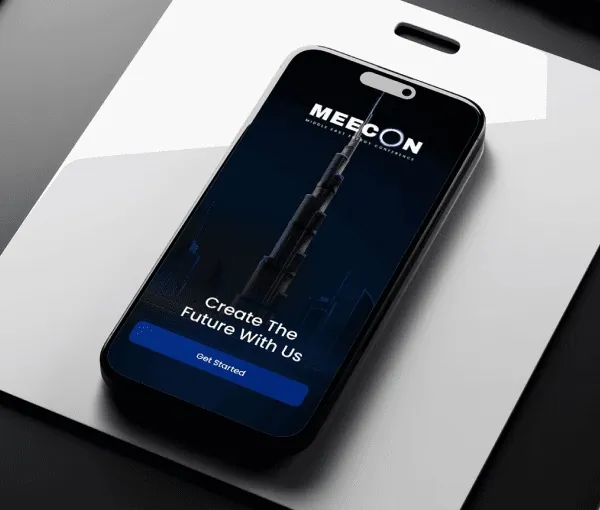
Mobile app · Events · UAE
A UAE conference platform replacing printed programmes and email chains for delegates and organisers.
meecon.ae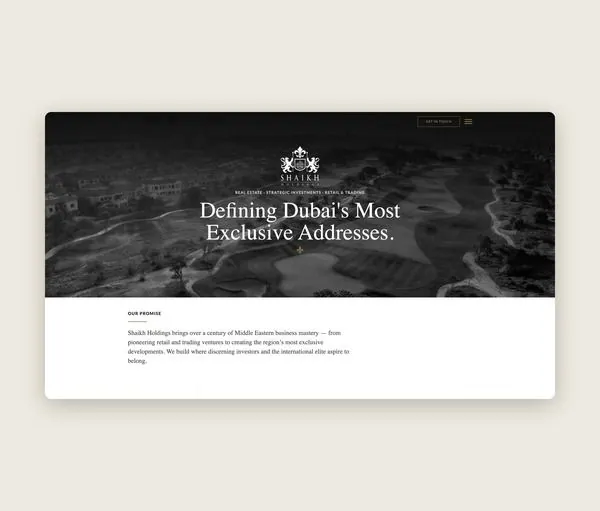
Website · Corporate · Dubai
A Dubai investment house with a century of business behind it. The site speaks to institutional investors, not shoppers.
shaikhholdings.com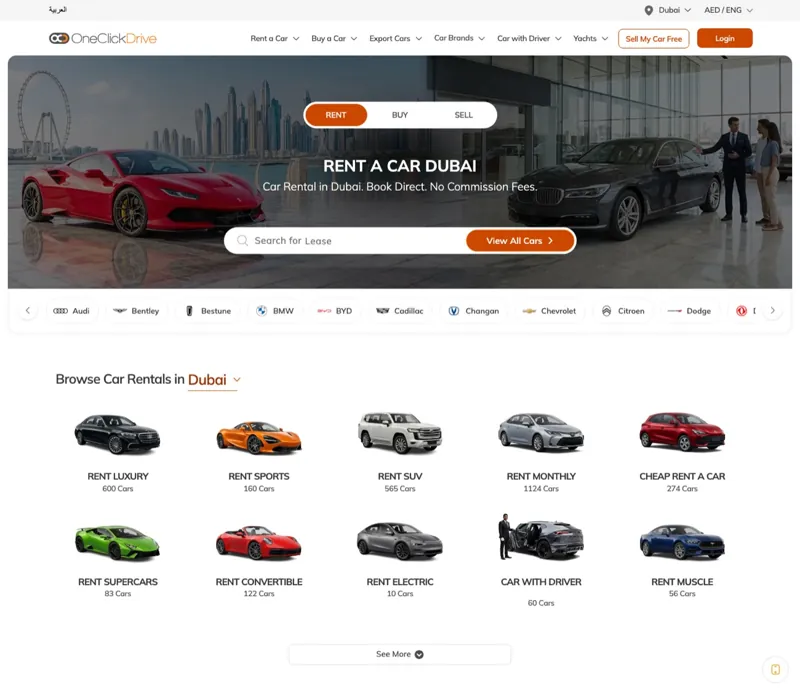
Platform · Car rental · UAE
A car rental marketplace where suppliers list fleets and renters compare and book, under real traffic.
oneclickdrive.comStraight answers
Yes. A job board with filters by sector and role, and a CV upload form that reaches your team directly, are the two features most recruitment sites need from day one.
Showing your agency's licensing status clearly is common practice, since it reassures both employers and jobseekers that they are dealing with a properly licensed agency. Confirm exactly what to display with MOHRE.
Usually through a request form that reaches your consultants, rather than a fully self serve posting tool, since most agencies want to qualify a role before it goes live. A self serve option can be built if your process supports it.
Yes, and it usually should. Separate sector pages let each one target the right search terms and speak to a different kind of employer, rather than one general staffing page trying to cover everything.
Our pages never publish prices or fixed figures, and salary ranges work the same way: general market guidance can be described in words, but a role's actual salary is a conversation with your consultant, not a published number.
Every project gets a fixed written quote scoped to your brief, sent within 45 minutes during business hours with no obligation. The number of sectors, whether employers self post, and any CV database work are the main cost drivers.
Sources
Fixed price, in writing
Got it. Your quote is being written now.
In business hours you will have it within 45 minutes. Check your inbox for the confirmation.