
Oil and gas website equipment categories
A structured catalogue of what the company actually supplies or delivers, organised the way a procurement officer searches, not marketing language.
Web Design by Industry
An oil and gas website in Dubai gets checked during supplier prequalification, not just browsed by chance. We build these sites around capability, HSE documentation and honest certification claims.
Oil and gas website design in Dubai serves a narrower, more sceptical audience than most industry sites. A procurement officer running a supplier check reads the site looking for reasons to trust or reject a company before a tender is ever opened, and they are usually comparing it against internal registration systems rather than taking claims at face value. The site’s job is to support that check with clear, honest information, not to persuade with generic promotional language.
This industry spans operators, suppliers, equipment providers and technical services contractors, and each of these groups is judged on slightly different evidence. What stays constant across all of them is that overstated claims, whether about certification, HSE record or project experience, are the fastest way to lose credibility with a buyer who checks. Careful oil and gas website design in Dubai treats verifiable content as the main deliverable, not the visual design, and it sits alongside our wider website development work rather than replacing it.
Whether a company is an equipment manufacturer, a specialist technical contractor or a logistics provider serving the sector, the underlying discipline is the same: write what can be shown, structure it so a procurement officer finds the right page quickly, and keep it current enough that it never contradicts the paperwork already sitting with an operator. Oil and gas website design in Dubai is built around that discipline from the first page of the brief.
What the site has to do
A capability heavy audience wants documentation, not a mission statement.
A structured catalogue of what the company actually supplies or delivers, organised the way a procurement officer searches, not marketing language.
A clear summary of the company’s health, safety and environment approach, with a request route for the full documentation.
Only certifications the company genuinely holds appear, each shown accurately with its scope, never listed alongside ones still in progress as if complete.
Describing the kinds of projects delivered, without fabricated figures or client names that have not been agreed for public use, keeps the site credible.
A short approval step before sharing HSE and compliance documents protects sensitive material while still giving a genuine buyer access.
Specialist recruitment for engineers and technicians benefits from its own page rather than a generic careers form.
The buyer
The person approving an oil and gas website in Dubai is almost never a marketer working alone. On a supplier or equipment provider it is typically a commercial manager or the managing director, working alongside whoever owns HSE and quality documentation internally, since that person has to confirm every safety and certification claim before it goes live. On a larger technical services contractor, a business development lead usually drives the brief, but sign off still runs through HSE and technical management, because a claim that does not match the company’s own prequalification submissions creates a real problem the next time an operator’s procurement team checks both.
In the first meeting, this buyer is an engineer as often as a marketer, and the questions reflect that: can equipment and service categories be organised the way their own procurement system classifies suppliers, can HSE documents be shared without sitting openly on the public internet, and does the site avoid the kind of inflated claim that would embarrass the company during an actual audit. An oil and gas website in Dubai earns approval by treating those questions as the brief, not as an afterthought once the design is finished.
Three visitors, one site
Oil and gas website design in Dubai rarely has a single audience, and the three visitors below read the site for different reasons.
Already has the company on a shortlist or tender list and is confirming that the public site matches what the supplier’s own paperwork says, more than discovering the company for the first time.
Researching the sector before committing time to a registration and prequalification process, and wants a clear, honest sense of what a company actually does before reaching out.
Already registered with one or more operators and uses the public site mainly to keep partners and candidates informed, rather than as a discovery channel.
Content care
Every claim on the site should be one the company can back up if a buyer asks for evidence.
A certification or capability should be described with its exact scope, since an overstated claim is easy for a technical buyer to spot and expensive to be caught out on.
Safety statistics and policy summaries should reflect the current period, not a figure carried over from years earlier without review.
Describing project types by scale and sector, without naming figures that have not been confirmed, still gives a buyer a useful sense of experience.
A dead phone number or an unanswered enquiry form on an oil and gas website is one of the fastest ways to lose a serious buyer’s confidence.
Prequalification, verified
We opened ADNOC’s supplier hub registration page directly to check what it actually describes. Registration is free, centralised across the ADNOC Group, and estimated at 14 days: a supplier creates an Ariba account, submits a registration request through a profile questionnaire, completes an Integrity Due Diligence submission, and waits for the ADNOC team to review the application before it either proceeds to prequalification or is declined. To register at all, a company needs a licence issued by an Abu Dhabi authority covering the right business activities, described on the page as onshore and offshore oil and gas field and facility services where relevant.
Once registration is approved, the prequalification page we also opened describes a separate, longer process, estimated at 90 days and free of charge, that applies to contractors, associates and manufacturers, local and overseas. ADNOC’s team evaluates the application against vendor agreements, supplier experience, HSE and quality documents and classification criteria, then decides whether a facility audit is required or a desktop assessment is enough, before issuing a final outcome. None of this process happens on the company’s own website, but the same HSE, experience and classification information a supplier submits to ADNOC is exactly what a serious buyer’s own team tends to check the public site for consistency against.
Not legal advice
What we opened describes ADNOC’s own process at the time we checked it. It is not a substitute for confirming your position directly.
This is not legal advice, and prequalification requirements vary by operator and change over time. Other operators in the region run their own registration and prequalification systems that differ in detail from ADNOC’s, and a company working across several operators typically has to maintain more than one supplier profile in parallel. Current criteria, timelines and required documents should always be confirmed directly with the specific operator’s procurement or supplier registration team rather than assumed from any general description, including this one.
The visitor journey
A visitor running a supplier check moves through the site in a fairly consistent order, and each step is where a badly built site raises doubt instead of confidence.
Working contact details, a current copyright year and no obviously broken pages are the first, most basic check, and failing it ends the visit immediately.
The visitor is matching what the site describes against what the tender or shortlist requires, so vague or missing categories are noticed fast.
Safety record and current certification are usually checked before pricing or capability, since a weak HSE position rules a supplier out regardless of anything else on the site.
A working, monitored document request route at this point either keeps the check moving or stalls it, depending on how quickly a real person responds.
Integrations
Accuracy and document control matter more here than any marketing integration.
Where a company already keeps HSE and quality documents in a system such as SharePoint or a dedicated document management platform, connecting the request form to that system avoids maintaining a second, separate copy that can drift out of date.
Enquiries and document requests reaching the correct commercial or HSE contact automatically, rather than one shared inbox, keeps a time sensitive procurement check moving.
Where hiring volume justifies it, connecting careers applications to an applicant tracking system keeps field and engineering recruitment organised separately from general enquiries.
Ongoing data
Very little on this kind of site should ever go stale, because the cost of an outdated claim is higher here than on most business websites. Certification expiry dates need an owner who checks them against renewal, since a certificate shown as current after it lapses is exactly the inconsistency a procurement audit is designed to catch. HSE statistics, where a summary is published, should be reviewed on a set schedule rather than left from whenever the page was first written. Project descriptions need periodic review too, both to add genuinely completed work and to remove anything a client no longer wants publicly associated with their name.
Assigning each of these to a named owner inside the company, rather than leaving them to whoever built the site originally, is what keeps an oil and gas website in Dubai trustworthy a year or two after launch rather than just at the moment it went live.
Mobile use
A meaningful share of visits to a capability heavy site like this happen away from a desk.
A procurement officer or technical contact may open the site from a project site or vehicle rather than an office desktop, so the capability, HSE and contact pages need to load and read clearly on a phone, not only look complete on a wide screen.
A document request form that is awkward to complete on a phone loses exactly the kind of time sensitive enquiry this site exists to capture, so it gets the same attention as the desktop version rather than being treated as an afterthought.
Mistakes we see
Beyond the vague services list and missing HSE content already covered, a few more issues come up repeatedly.
A badge or logo with no description of what it actually certifies reads as decoration rather than evidence, and a technical buyer tends to discount it entirely rather than take it on trust.
Round numbers, suspiciously perfect outcomes or client names used without confirmed permission damage credibility more than having no case studies at all, since a sceptical reader assumes the whole page is exaggerated.
Old branding, a stale copyright year or projects that clearly stopped updating long ago all read as a company that may no longer be active, regardless of how the business is actually performing.
Hosting and access
Ownership and access control questions come up early, usually from whoever manages compliance rather than marketing.
Every oil and gas website design in Dubai project we build hands over the domain, hosting account and content management system logins to you directly, so the site is never locked to a supplier relationship.
A compliance contact updating certification pages needs different access to a recruiter updating careers content, and setting that up at launch avoids the wrong person editing sensitive pages.
What stops an enquiry
A vague services list is the most common cause, since a buyer wants to know precisely what a company can deliver, not a broad description of the sector it works in. Missing HSE information is another, since safety record is often checked before price. And a site that reads as clearly outdated, with old branding or contact details that no longer work, raises doubt about whether the company is still active in the sector.
Partners and subcontractors
An oil and gas website in Dubai frequently serves a second audience alongside the operator facing procurement officer: other suppliers looking to subcontract part of a scope, or a potential joint venture partner assessing whether to team up on a bid. Treating these enquiries through the same public form as a general sales question loses useful detail, since a subcontracting enquiry usually needs to state the specific discipline or work package, the relevant certifications the subcontractor already holds, and which projects or regions they can support.
A short, separate enquiry path for partners and subcontractors, even a simple form with the right fields rather than a full portal, signals that the company takes these relationships seriously and gives its own business development team a clearer, more useful enquiry to respond to than a generic message would.
Documents, not downloads
This is one of the clearest differences between oil and gas website design in Dubai and a general business site.
HSE policies, insurance certificates and quality manuals typically sit behind a short request form rather than a public download link, so the company knows who has seen sensitive material.
Someone on the HSE or compliance team, not the general enquiries inbox, should own approving document requests so a genuine buyer gets a fast response.
A document library only stays useful if someone checks it against renewal dates, since sharing an expired certificate is worse for credibility than not sharing one at all.
Search behaviour
Search behaviour in this sector is almost entirely business to business, and the split between a research search and a ready to act search is sharper here than in most industries. A research search looks like a service or equipment category combined with the sector and Dubai or the UAE, the kind of term a procurement officer types while building a shortlist of possible suppliers to register with. A ready to act search is usually the company’s own name, since by the time a buyer is checking a specific supplier’s site they generally already have that name from a tender list, a referral or an existing registration.
That second pattern matters more here than the volume of general keyword traffic, because the site’s job in that moment is not to persuade a stranger but to confirm, quickly and accurately, that the company is exactly who its paperwork says it is. Oil and gas website design in Dubai is built around that confirmation moment as much as around attracting new visitors in the first place.
Capability statement
This is usually the single most read page on an oil and gas website in Dubai, and the one most often left too vague to be useful.
“Engineering services” tells a procurement officer nothing. Naming the specific disciplines, such as mechanical, electrical, instrumentation or a defined equipment category, lets a reader match the company against a tender’s actual requirement in seconds.
Stating onshore, offshore or specific emirate and regional coverage honestly avoids a wasted enquiry from a buyer whose project sits outside where the company can realistically operate.
Describing the scale of projects typically undertaken, by sector and rough size band rather than a specific unverified figure, still gives a reader a useful sense of fit.
Content you supply
This build moves at the pace of internal sign off, not design.
A current HSE policy summary written for public use, distinct from the internal version, is frequently the single item that holds up launch while it goes through internal review.
Certificates alone are not enough. What is missing as often is a plain description of what each certificate actually covers, which someone technical has to write, not just scan and upload.
Where a client has not confirmed permission to be named, project descriptions have to be reworded to describe scope and sector without identifying details, which takes longer than simply publishing what was drafted.
Careers
Field and engineering recruitment behaves differently to office hiring, and the website should reflect that.
A field engineer or technician applicant wants to see the discipline, base location and whether the role is rotational before they apply, not a single generic “careers” page with one form for every role.
Technical applications routed to a general HR inbox alongside every other role in the company tend to move slowly, so a separate route to whoever actually hires for field and engineering positions keeps strong candidates from going elsewhere.
Not the same thing
This distinction is worth stating plainly, since visitors sometimes conflate the two.
The public website and an operator’s own registration system, such as the Ariba based process ADNOC’s supplier hub describes, serve different purposes and are never the same platform. The public site presents the company’s capability, HSE position and contact route to anyone researching it, including a procurement officer building a shortlist before registration even begins. The operator’s own portal is where the formal registration, integrity due diligence, prequalification and later tendering actually happen, entirely separate from the company’s own website and governed by that operator’s own process and timelines. A company should never suggest on its site that registering or prequalifying can happen through its own pages, since that overstates what the website does and could mislead a visitor about how the actual process works.
| Content type | Who signs it off | Shared how |
|---|---|---|
| Equipment or service categories | Commercial or technical management | Published openly, organised by category |
| HSE policy summary | HSE or compliance lead | Public summary, full document by request |
| Certifications | Quality or compliance lead | Published with exact scope, only if current |
| Project descriptions | Business development, client permission confirmed | Published by scope and sector, named only with agreement |
| Registration | Prequalification | |
|---|---|---|
| What ADNOC’s pages say it costs | Free of charge | Free of charge |
| Estimated timeline stated | 14 days | 90 days |
| What it requires | Ariba account, profile questionnaire, integrity due diligence | Vendor agreements, HSE and quality documents, classification |
| What decides the outcome | ADNOC team review of the application | Desktop assessment or facility audit, then evaluation |
A buyer running a supplier check is not reading an oil and gas website to be persuaded. They are reading it to see whether it matches what your own paperwork already says.
Build
Content accuracy matters more here than visual design, so verification happens before any page is written.
We collect the equipment and service categories, current certifications, and HSE summary directly from your technical and compliance team.
Capability pages, the document request flow and careers are built inside our wider website development process.
Document requests and careers submissions route to the right internal team, with a short approval step before sensitive files are shared.
Core capability and HSE pages go live first, since these are what a procurement check reads first. Careers and case examples follow once verified.
Search visibility for equipment and service category searches is covered under SEO services.
Phasing
The first version of an oil and gas website in Dubai should carry accurate equipment and service categories, the HSE policy summary, current certifications shown with their real scope, and a working document request route. That is what a procurement check reads first, so none of it should be compromised to launch on an earlier date with a careers section or expanded project gallery only half finished.
A sensible phase two adds the content that depends on more internal sign off or is simply less urgent for a first review: expanded project categories once more client permissions are confirmed, dedicated careers pages for each technical discipline, and, where genuinely useful, a bilingual Arabic version of the core capability and company pages for government adjacent or Arabic speaking procurement contacts.
Language
Bilingual work here is targeted rather than blanket, since much of the audience corresponds in English regardless of first language.
A company overview and HSE summary in Arabic can matter for government adjacent or Arabic speaking procurement contacts, and it signals the business operates properly in both languages of the market it works in.
Detailed equipment specifications and technical documentation are typically produced and exchanged in English across this sector regardless of the reader’s first language, so translating every technical page by default is rarely the priority.
How we work
The stages stay the same as any project, but verification carries more weight at each one.
You tell us what you need, who it is for and what it has to achieve. A short call or a WhatsApp message is enough to start.
A written scope and a fixed price within 45 minutes during business hours. No obligation.
Design, writing, production or build, done by the people who specialise in that exact work.
You see the work before it goes anywhere, comment in one place, and approve it.
Final files, live campaigns or a launched site, handed over with everything you need to use them.
Where the work is ongoing, we measure what happened and decide the next step with you.
Design
A capability and compliance led site rewards clarity over decoration.
A procurement officer scanning for a specific equipment or service category benefits far more from a clear, consistent menu structure than from an elaborate homepage animation.
These sections should read as a genuine part of the site, not a small badge tucked into a footer, since they are frequently what a visitor came to check first.
Clear language around what happens after a request is submitted, and who reviews it, reassures a company sharing sensitive compliance material that the process is being taken seriously.
Measuring it
The commercial or business development lead judges the site on the quality of what it supports, not on visitor counts.
A steady, traceable flow of HSE and compliance document requests reaching the correct internal approver, rather than getting lost in a general inbox, is a fair sign the request route is working.
Whether the public site still matches what the company states in current prequalification and tender documents is a practical, ongoing check worth running periodically.
Where a careers section exists, whether applications for field and engineering roles arrive with the right qualifications attached is a more useful measure than the raw number of applications.
A small but steady number of well qualified subcontracting or joint venture enquiries, carrying the discipline and certification detail requested, is a better signal than a large volume of vague general messages.
A generic industry page swaps in the sector name and leaves the substance untouched, and on a site read by a supplier prequalification team that gap is easy to spot. Oil and gas website design in Dubai only does its job when equipment and service categories, HSE summaries, certification scope and project descriptions are all written to match what the company can actually document, not adapted from a template built for a different kind of buyer. Everything above, including the registration and prequalification detail from ADNOC’s own supplier hub, was written for this specific brief because a capability heavy, verification led audience notices the difference immediately.
We treat oil and gas website design in Dubai as content work as much as design work, because the credibility of the site rests on whether its HSE, certification and project claims survive the same scrutiny a company’s own tender submissions already go through. A confident, honest capability statement, written in plain language and matched to current documentation, does more for a supplier’s credibility here than any amount of visual polish.
This is also a long buying cycle by nature. A company rarely registers with an operator, gets prequalified and wins its first tender inside a few weeks, so the website has to stay accurate and useful across months of a relationship developing in parallel through Ariba accounts, integrity due diligence and facility audits that have nothing to do with the site itself. Oil and gas website design in Dubai supports that cycle by staying current and consistent for as long as it takes, rather than being optimised for a single fast enquiry the way a retail site would be.
Related
Sites for equipment and component manufacturers supplying this sector.
Sites for freight and heavy transport providers serving oil and gas projects.
Sites for contractors and developers who also tender through document heavy procurement systems.
Oil and gas sites share ground with other capability driven, procurement facing sectors. See the wider pattern on our B2B website design page, or start from the web design by industry hub. For an equipment or spare parts catalogue that needs to be searchable, see ecommerce solutions, and for the document request and careers flows described above, UI UX design covers how we design forms that capture the right detail. Search visibility for equipment and service category searches is covered under SEO services, and a mobile facing document request or careers form is covered under mobile app development where a native app genuinely adds value over a mobile site.
Selected work
Work across sectors, with the closest to this industry shown first. Every one is a live site, not a mockup.

Website · Property development · Abu Dhabi
An ADX listed holding company building master planned communities, with a site that holds investors and residents at once.
modon.com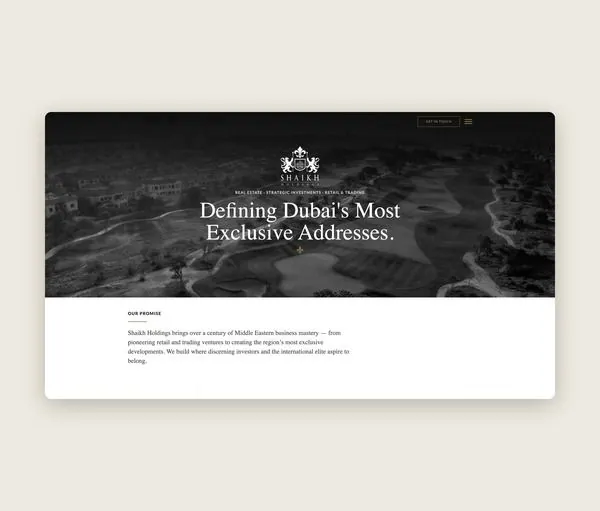
Website · Corporate · Dubai
A Dubai investment house with a century of business behind it. The site speaks to institutional investors, not shoppers.
shaikhholdings.com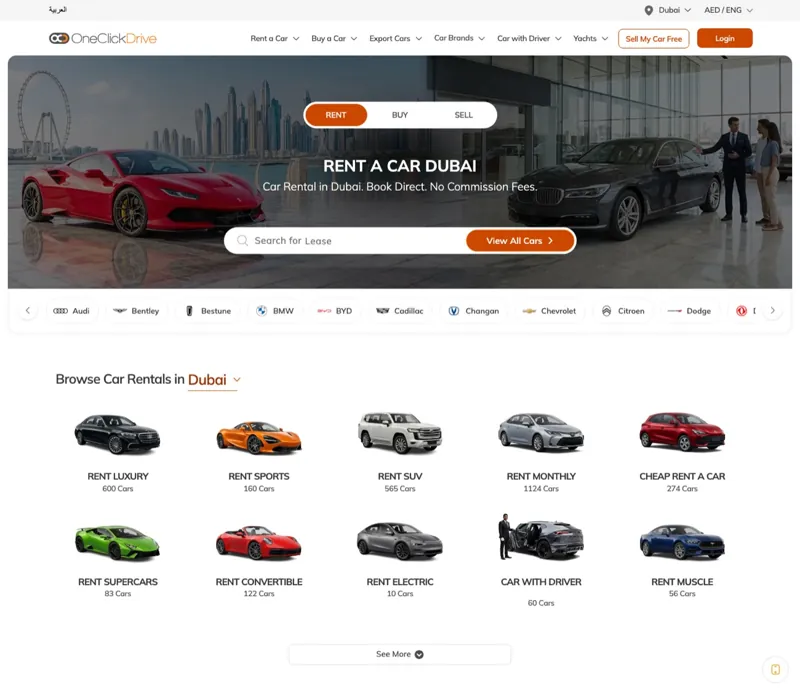
Platform · Car rental · UAE
A car rental marketplace where suppliers list fleets and renters compare and book, under real traffic.
oneclickdrive.comStraight answers
Only certifications you currently hold should appear as held. A certification in progress can be mentioned as in progress, but presenting it as complete risks being caught out during a buyer's own verification checks.
Both are useful, and many oil and gas sites use categories for the main navigation with project type filters layered on top, so a buyer can search however they think about the work.
A document request form that emails or shares a document after a short approval step works well, rather than leaving compliance documents openly downloadable to anyone.
The site supports prequalification by presenting HSE, certification and project information clearly, but the actual registration and assessment happens directly with the operator's own procurement system, and criteria should be confirmed there.
Every project gets a fixed written quote scoped to your brief, sent within 45 minutes during business hours with no obligation. The number of service categories and whether a document request area is needed are the main cost drivers.
Sources
Fixed price, in writing
Got it. Your quote is being written now.
In business hours you will have it within 45 minutes. Check your inbox for the confirmation.