
Hospital website department directory that scales
Cardiology, orthopaedics, paediatrics and every other department needs its own page, grouped so a visitor can browse by specialty rather than scroll one long list.
Web Design by Industry
Hospital website design in Dubai for multi department facilities, built around a doctor finder, department directory, insurance panel lists and advertising content that follows Dubai Health Authority rules.
A hospital website carries a different kind of weight to a single clinic site. The visitor might be looking for an emergency number, a specific department, a named doctor, a bill payment page or a job vacancy, often under pressure and on a phone. Hospital website design in Dubai has to organise a lot of content, sometimes hundreds of pages across dozens of departments, so that each of those visitors reaches the right page in a couple of taps rather than a long menu search.
Where a single clinic site can lead with one booking form, a hospital site has to route different visitors to different destinations at once: patients, referring doctors, corporate insurance contacts, jobseekers and international visitors researching treatment abroad. This work sits alongside our wider healthcare website design and follows the same website development process, scaled for a larger content structure.
What the site has to do
A hospital website design in Dubai needs structure that a single clinic site never has to solve.
Cardiology, orthopaedics, paediatrics and every other department needs its own page, grouped so a visitor can browse by specialty rather than scroll one long list.
Search by department, specialty and language, not a single alphabetical list, matters once a roster passes twenty or thirty doctors.
The emergency department number and location need to be visible on every page, not just the homepage, for a visitor who is not browsing calmly.
Hospitals typically work with far more insurers and third party administrators than a small clinic, so this list needs its own searchable page, not a paragraph.
Patients travelling for treatment need practical information gathered in one place: how to send records ahead, accommodation nearby and who to contact before arrival.
A hospital hires continuously, so a careers page linking to the applicant system in use keeps hiring visible without collecting applications on the website itself.
Advertising and content rules
Every page on a hospital website that describes a treatment or a specialist’s results falls under the same DHA Guidelines for Medical Advertisement Content on Social Media that apply to a single clinic, multiplied across many more pages and authors. The guidance places responsibility on health facility management to oversee what gets published, and lists content that must never appear on any page, including claims that a treatment promises a full recovery and comparisons against other facilities that are not backed by credible, peer reviewed evidence.
At hospital scale, the practical risk is usually not one bad page, it is inconsistency across dozens of department and doctor pages maintained by different teams over time. This is not legal advice. A content owner responsible for reviewing new and existing pages against current DHA guidance is worth naming before launch, not after a page has been live for a year.
Content ownership
Unlike a small clinic where one person edits the site, hospital website design in Dubai has to plan for several departments publishing at once: marketing, HR for careers, a patient experience team for the international section, and clinical leads reviewing their own department pages. Hospital website design in Dubai without user roles and an approval step is where a Dubai site drifts out of date fastest, particularly doctor rosters and insurance panels.
The other common gap is search. A hospital site with hundreds of pages needs internal search that actually finds a department or a doctor by name, not just a sitemap a visitor has to scroll through.
Different audiences
Hospital website design in Dubai has to serve each of these visitors without making the others harder to find, since one Dubai site now carries all of them.
| Visitor | What they need first | Where it should live |
|---|---|---|
| A patient in an emergency | The emergency number and location | Header and footer on every page |
| A patient booking a consultation | The right department and an available doctor | Department directory and doctor finder |
| A referring doctor | Specialist contact details and referral process | A dedicated referrals page |
| An international patient | How to send records and plan a visit | An international patients section |
| A jobseeker | Open clinical and support roles | A careers page |
Build process
Hospital website design in Dubai follows the same six stage process behind every build, scaled to a much larger site.
We map every department, the current doctor roster, and who inside the hospital will own which section of the new site.
A fixed written quote covering the department structure, doctor finder, insurance pages and any patient portal or booking integration, sent within 45 minutes during business hours.
Templates are built once and reused across every department, so new department pages can be added later without a full redesign.
You approve the full site, including a check of medical advertising claims across department and doctor pages, before development is signed off.
Handover of domain, hosting and CMS logins, role based training for the different teams who will publish, and a support window.
Ongoing work usually covers new department pages, updated doctor rosters and search improvements, continued under SEO services and UI UX design.
Related industries: dental website design, plastic surgeon website design and healthcare website design cover smaller clinical sites. See the full range under web design by industry.
Emergency department
The emergency department page is the one page on a hospital website that a visitor reads under real pressure, sometimes from the back of a taxi, and it needs to do exactly one job well: tell them where to go and what to expect on arrival. Hospital website design in Dubai treats this page differently from every other department page on the site. It states the emergency entrance location separately from the main hospital entrance where the two differ, gives the direct emergency line in large type, and avoids anything that reads like marketing, since a person deciding between two nearby emergency departments is not comparing brochures.
The page also has to set expectations honestly. It should describe how triage works in plain terms, patients are seen in order of medical urgency rather than arrival time, without promising a wait time, since no hospital can commit to one in advance and a promised figure that turns out wrong does real harm to trust at the worst possible moment. What to bring, an Emirates ID or passport, insurance card, and a list of current medication, is worth stating plainly, because it is exactly the kind of detail a stressed visitor forgets to check before leaving the house.
Department structure
A hospital’s clinical structure and a patient’s mental map of it rarely match, and hospital website design in Dubai has to bridge that gap rather than mirror the org chart.
A patient rarely knows they need “gastroenterology”. A short symptom or condition list that routes into the right department gets them there faster than a department name alone.
Cardiology at hospital scale usually covers several sub specialties, interventional, electrophysiology, paediatric cardiology, and each needs its own short page rather than one department page trying to cover all of them.
A patient seen in one department is often referred to another inside the same hospital, and the site can support that with clear pages a doctor can point a patient to, rather than assuming referrals only ever happen by phone.
Where a hospital has built a named centre around a condition, a cancer centre or a heart centre for example, that centre usually deserves its own section rather than being folded into a single department page.
Radiology, laboratory and diagnostic imaging serve every department at once, so they need a shared page describing what a patient needs to prepare, rather than being duplicated across every department that refers to them.
Whether a procedure is typically same day or requires admission changes what a patient needs to prepare, and department pages that are silent on this leave a real gap in planning.
Consultant directories at scale
A doctor finder that works well for thirty names starts to fail once a hospital lists two hundred consultants across dozens of specialties, and hospital website design in Dubai has to plan for that scale from the structure, not patch it in later. The directory needs layered filtering, specialty first, then sub specialty, then language and gender if the hospital wants to offer that choice, rather than one search box returning a long unsorted list. A consultant profile itself carries more than a doctor page at a small clinic: qualifications, DHA licence specialty as registered, clinical interests, publications where the hospital wants to include them, and which department and, where relevant, which centre of excellence they sit under.
“On call” status is a detail specific to hospital scale that a single clinic site never needs. Where a hospital wants to show which consultants are currently on call for a given specialty, that has to pull from a real roster system rather than a manually updated page, since a stale on call listing is worse than none at all for a patient or a referring doctor relying on it.
Insurance at hospital scale
A hospital’s relationship with insurers goes deeper than the accepted or not accepted list a small clinic publishes, and hospital website design in Dubai has to reflect that depth rather than reuse a clinic sized insurance page.
| What the site needs to show | Why a hospital needs more than a logo list |
|---|---|
| Direct billing versus reimbursement, per insurer | A patient needs to know whether the hospital settles with their insurer directly or whether they pay and claim back |
| Pre-authorisation guidance for planned procedures | Many inpatient and surgical treatments need insurer approval before admission, and a patient who does not know this arrives unprepared |
| A TPA list alongside the insurer list | Hospitals often work through third party administrators as well as insurers directly, and the two lists are not interchangeable |
| A corporate and government scheme section | Hospitals frequently hold separate panel arrangements for corporate clients and government health schemes that a general insurance page should not bury |
Keeping this list accurate matters more at hospital scale than anywhere else on the site, since an out of date insurance page generates a support call for every patient who relied on it, not a handful.
The international patient journey
A Dubai hospital treating international patients is answering a longer, slower question than a local patient booking a consultation. The journey usually runs from an initial enquiry, often by email or a dedicated form describing the condition and any existing medical reports, through a cost estimate once those reports have been reviewed by a clinician, to practical planning: a medical visa letter, travel and accommodation guidance, and confirmation of what documentation to bring. Hospital website design in Dubai for this audience builds a dedicated section around that sequence rather than assuming a general contact form covers it, because the questions an international patient asks first, cost, timeline, visa support, are different from the questions a local patient asks.
A secure way to send medical records ahead of a visit is the single most requested feature in this section, since an international patient wants a clinician to review their case before committing to travel, not after. This usually means a simple upload form routed to an international patient coordinator rather than email attachments, both for the patient’s convenience and to avoid medical records travelling as unencrypted email attachments. Dedicated international patient coordination is a service some Dubai hospitals offer under different names, and where a hospital already runs one, the website should route enquiries to that team directly rather than through the same request form used for local outpatient bookings. Dubai Health’s own published patient FAQ page is a useful reference for how a Dubai health network describes appointment booking, insurance and emergency access to the public, and is worth reading before drafting equivalent content for a hospital’s own site.
What this section should not do is promise an outcome or a fixed cost before a clinician has actually reviewed a case, since every treatment estimate depends on the individual patient and the same DHA guidance on medical advertisement content applies to this page as much as to a department page. A cost estimate is exactly that, an estimate given after review, not a published price, and the site should say so plainly rather than implying a fixed figure applies to every case.
Wayfinding
A hospital campus is often several buildings, towers or floors, and hospital website design in Dubai has to plan for that from the start, since a site that only gives one address leaves a patient or a visitor lost in the car park.
Where a hospital has more than one building or a named tower system, the site needs to say which building each department sits in, not just one shared address for the whole campus.
Visiting hours in a maternity ward, an ICU and a general ward are rarely the same, and a single set of hours published for the whole hospital misleads a visitor to the ward with stricter rules.
Intensive care, isolation wards and paediatric wards often carry specific visitor limits, sometimes one visitor at a time or age restrictions on child visitors, and stating this before arrival avoids a difficult conversation at the door.
Parking capacity, whether valet is available, and where the closest drop off point sits for someone who cannot walk far matter more here than at almost any other kind of site.
Wheelchair access, accessible parking bays and lift access should be described accurately for the actual building, rather than a generic accessibility statement copied from elsewhere.
A short, practical checklist for someone being admitted, identification, insurance documents, personal medication, saves a phone call to the ward on the day of admission.
Accreditation, handled carefully
Accreditation is a genuine point of trust for a hospital, and it is also an area where overclaiming causes real reputational and regulatory risk.
Where a hospital holds an accreditation, whether from an international body or a DHA led quality programme, hospital website design in Dubai states it precisely: the accrediting body’s name, the scope of what was accredited, and, where the accreditor publishes one, a link to that body’s own public verification of the certificate rather than a badge alone on the page. A badge without a way to verify it is the single most common accreditation mistake we see, since a badge image can be copied by anyone, and a patient or a referring doctor has no way to check it is current.
This is not legal advice, and accreditation status changes on its own renewal cycle rather than the hospital’s website update schedule. A named person responsible for confirming accreditation claims are still current, checked against the accrediting body directly rather than assumed from the last time the page was written, is worth having before launch, and the DHA guidance on medical advertisement content that governs the rest of the site applies here too: a claim has to be accurate and substantiated, not just a badge that looks reassuring.
Behind the public pages
A hospital runs far more patient data internally than any website should ever surface, and hospital website design in Dubai has to draw that line clearly rather than by accident. Bed occupancy, individual patient status and ward level detail belong inside clinical systems and, where relevant, a logged in patient portal, never on a public page, even in aggregate form that seems harmless. The same applies to operating theatre schedules: useful internally for planning, not something a public site should show even in summary, since a schedule can reveal patient volume and specialty activity that a hospital has no reason to publish.
Where a hospital does want to show something close to real time, such as current emergency department wait conditions in general terms, that content should be reviewed specifically for what it reveals, and kept to a broad, honest signal rather than exact figures the hospital cannot keep accurate from one minute to the next.
Beyond the website
Some hospitals in Dubai eventually want a dedicated patient app once hospital website design in Dubai has already given them a booking flow, a portal and an international patient section that work well on their own. The two answer different needs: the website is where a new or prospective patient researches a department, checks a consultant’s specialty or starts an international patient enquiry, while an app tends to suit an existing patient who already knows the hospital and wants appointment reminders, lab results or a repeat prescription request without opening a browser each time. We treat mobile app development as a conversation worth having once the website’s core patient journeys are proven, not a parallel build from day one, since duplicating a half working website feature into an app rarely fixes the underlying problem.
Where a hospital does build an app, it should share the same consultant, booking and patient record logic as the website rather than being built as a separate system that quietly drifts out of sync, which is the same principle that applies to a single independent doctor’s own site scaled up to hospital size: one source of truth for consultant and appointment data, read by both the website and the app.
Integrations
A hospital website usually needs to connect to more systems than any other kind of site we build, and mapping what each one actually solves before the build starts is a core part of hospital website design in Dubai that avoids expensive surprises later.
| Integration | What it solves | What it does not solve |
|---|---|---|
| Hospital information system | Real consultant availability and appointment booking | Insurance eligibility, which needs a separate check |
| Insurance and TPA eligibility service | Lets a patient check their own cover before booking | Final approval, which the insurer or TPA still confirms directly |
| Lab and radiology results portal | Secure access to a patient’s own results once ready | Clinical interpretation, which stays with the treating doctor |
| Ambulance and emergency dispatch link | A fast route to requesting emergency transport | Real time ambulance tracking, a separate and larger system |
| Pharmacy repeat prescription request | A simple request routed to pharmacy for processing | Home delivery logistics, usually a separate service arrangement |
Confirming these systems accurately is a necessary early step in hospital website design in Dubai. None of these are assumed at the start of a project. We confirm what a hospital already runs and connect the website to it, since replacing a working clinical system with something new built for the website is rarely the right call.
Search behaviour at hospital scale splits the same way it does across healthcare generally, but the volume and variety of terms is wider because a hospital covers so many specialties at once. A research stage search, a condition or symptom paired with words like “causes” or “treatment”, is answered by a specialty page written for a worried reader. A ready to act search looks different depending on who is searching: a local patient searches a specialty plus “hospital Dubai” or a named consultant, while an international patient more often searches a procedure name plus “Dubai” or “UAE” while researching medical travel generally. Hospital website design in Dubai has to serve both without the international patient section competing for the same page as the local outpatient booking journey, which is exactly why the two get separate structures rather than one shared page trying to answer both audiences.
No search volumes are claimed here, since none have been measured for this site. The structural point stands regardless: a hospital with dozens of departments generates a wide spread of search intent, and building one page per intent, rather than one long page per department, is what keeps each of those searches landing somewhere useful.
Content that goes missing
Department, sub specialty and language tags per consultant rarely exist in one place before a build starts, and assembling them is usually the single biggest source of delay in hospital website design in Dubai.
A hospital often knows it holds an accreditation but has to track down the exact certificate, its scope and its expiry date before the website can state it accurately.
Wayfinding content depends on knowing exactly which department sits where, information that usually lives with facilities management rather than marketing, and pulling the two teams together takes time.
Phasing
| Stage | What launches | What waits |
|---|---|---|
| Phase one | Department directory, consultant finder, emergency information, insurance panel, a booking request form | Live patient portal, direct hospital information system booking, international patient upload |
| Phase two | Secure international patient document upload, real time consultant availability, lab result access | Centres of excellence content still being finalised clinically |
| Ongoing | New consultant profiles, updated accreditation status, refreshed department content | A full patient app, usually scoped once the website’s booking flow is proven |
A hospital rarely needs everything finished before launch, and hospital website design in Dubai works better as a sequence, the departments and information patients need most going live first, than as one large launch date that keeps slipping while every integration is finished at once.
Arabic and other languages
Arabic content across department, consultant and admission pages matters for the same reasons it does across every healthcare site in Dubai, and hospital website design in Dubai tests it right to left on the pages a patient actually books from, not only the homepage. What is specific to a hospital, particularly one that treats international patients, is that Arabic and English alone sometimes do not cover the audience a hospital actually sees. Where a hospital genuinely serves patients travelling from a specific region for treatment, a short section in a third language for that international patient journey can be worth building, rather than assuming translation software on the international patient’s side will bridge the gap for a decision this significant.
The mistakes we see most often on existing Dubai hospital sites tend to be structural rather than cosmetic. A department directory that mirrors the hospital’s internal org chart rather than how a patient actually searches, so a visitor cannot find “heart” because the department is only listed as “cardiovascular medicine”. A consultant list that has not removed someone who left months ago, because whoever manages the roster at that department was never given access to the website. An emergency page buried three clicks deep behind a general “contact us” menu, when it is one of the pages most likely to be opened under real pressure. None of these need a redesign to fix, but they need someone at the hospital with regular access to the site and a habit of treating department and consultant changes as website updates, not just internal memos.
Measuring it
Overall site traffic tells a hospital communications team very little, and measuring hospital website design in Dubai properly means looking at department level and journey level numbers instead.
What matters more is booking or enquiry conversion by department, since a hospital site that performs well overall but poorly for one specialty usually means that department’s page needs attention, not the homepage. International patient enquiries, tracked separately from local outpatient bookings, is a second useful signal for a hospital investing in that section specifically. Whether the emergency page is actually being found quickly, measured by how fast a visitor reaches it rather than how many people view it, is a third. None of this is a promised outcome, and no specific result is promised by hospital website design in Dubai on its own. It is what we recommend a hospital track using its own analytics and booking data, not a figure we would publish here.
The buyer
A single clinic owner approves their own site directly, which is a very different sign off path to hospital website design in Dubai. A hospital involves several people before a page goes live: a hospital or communications director usually owns the project, a medical director or clinical governance lead signs off anything describing treatment or outcomes, and IT is in the room early because so much of the site depends on connecting to systems that already exist. What this buyer is measured on rarely maps to how the homepage looks. It is closer to whether the emergency department is easy to find under pressure, whether referral pathways between departments actually get used, and whether the accreditation and consultant information on the site matches what compliance can stand behind if a regulator or a journalist ever checks it.
The questions this buyer asks first are usually about control and accuracy rather than design: who can update a consultant’s profile the same day they join or leave, what happens to the site if the hospital information system is down, and whether the international patient section can be handed to a named coordinator rather than sitting with general marketing.
The content a hospital has to supply before a build can really start is usually larger and more scattered than the design work itself, and it is worth naming plainly rather than discovering it mid project. A consolidated, current consultant list with department, sub specialty and language tags rarely exists as one file, since it is often held by HR, by each department separately, and by whoever manages medical staff credentialing, and reconciling those into one accurate source is real work before a single page can be built. Accreditation certificates, their scope and their expiry dates need tracking down from whichever team holds the original documentation, not assumed from a badge already on the old website. Building floor plans and department locations, needed for the wayfinding content above, usually sit with facilities management rather than marketing, and pulling that team into a website project this early is not always the obvious first step, but it saves rework later.
Gathering this content properly is one of the least visible but most important parts of hospital website design in Dubai. None of this is a criticism of how a hospital operates day to day. A hospital’s internal systems are built to run patient care, not to feed a website, and the gap between the two is exactly what a proper content gathering phase in hospital website design in Dubai is meant to close before development starts.
The emergency page is the one page on a hospital site that gets read under real pressure, and it has to earn that trust with clarity, not design.
Related industries
Our wider page on multi facility healthcare groups, insurance networks and advertising rules across more than one address.
For a single outpatient premises rather than a full hospital, with a simpler booking and walk in journey.
Relevant where a hospital runs a named bariatric or weight loss programme that needs its own patient journey.
Relevant where a hospital pharmacy or wellness store sells online alongside clinical care.
Selected work
Work across sectors, with the closest to this industry shown first. Every one is a live site, not a mockup.

Website · Healthcare · Dubai
A Dubai rehabilitation and physiotherapy practice with one properly bilingual site in English and Arabic.
hmsfmce.com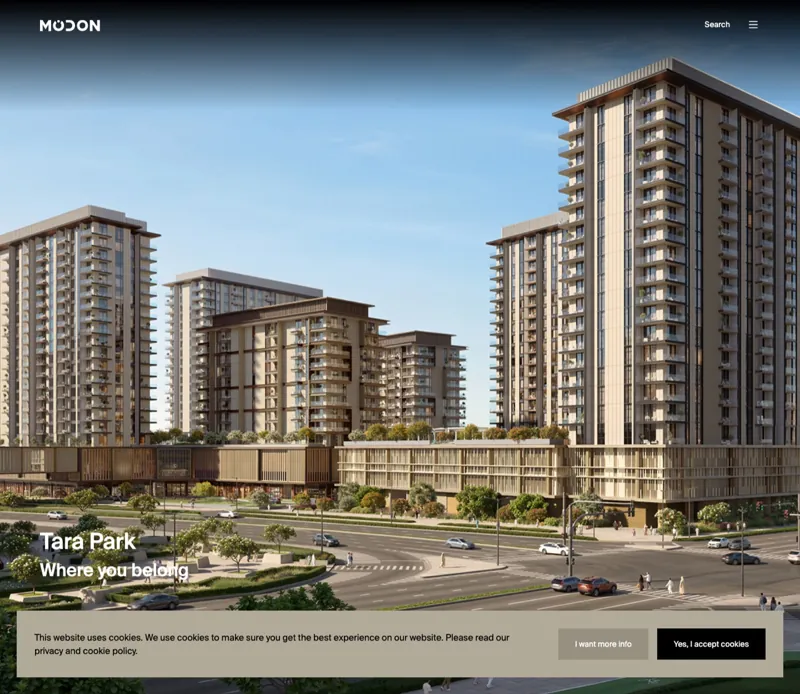
Website · Property development · Abu Dhabi
An ADX listed holding company building master planned communities, with a site that holds investors and residents at once.
modon.com
Website · Education · Dubai
One of Dubai's most diverse schools, 2,400+ students and 40+ nationalities, connected across campuses.
aldiyafah.comStraight answers
Yes. A hospital site needs a searchable doctor finder filtered by department, specialty and sometimes language, rather than one long list, and the structure is built to stay usable as the roster grows.
Usually through a request form naming the department and preferred doctor, which your call centre or booking team confirms, or a widget connected to your hospital information system where one exists. We confirm which fits before quoting.
Dubai Health Authority guidance sets conditions for medical advertisement content, including a ban on claims that a treatment promises a fixed result and rules on patient photography and testimonials. This is not legal advice, and content should be checked against current DHA guidance before publishing.
A dedicated section for international or medical tourism patients, covering practical information such as visa guidance links, accommodation partners and how to send medical records ahead of a visit, is common and can be built in.
Yes, a careers page listing open clinical and non clinical roles is a common addition, usually linking to your existing applicant tracking system rather than collecting applications directly.
Every project gets a fixed written quote scoped to your brief, sent within 45 minutes during business hours with no obligation. The number of departments, doctors, languages and any patient portal work are the main cost drivers.
Sources
Fixed price, in writing
Got it. Your quote is being written now.
In business hours you will have it within 45 minutes. Check your inbox for the confirmation.