
A hotel spa director
Judged on treatment room occupancy and revenue per guest, and needs the website to feed the same booking system the hotel’s front desk and concierge already use, not a separate calendar.
Web Design by Industry
A spa website in Dubai has to fill the appointment book, list every treatment with a clear duration, and show which of your therapists and treatments actually hold DHA licences. Most spa sites only manage the first of those three.
A spa website design brief in Dubai almost always starts with photographs and a colour palette, and stops there. What actually fills a treatment room is a menu that states duration and what a client should expect, a booking flow that only offers slots your therapists can genuinely deliver, and honest information about who is licensed to perform which treatment. We design and build spa and massage websites for Dubai and the wider UAE around that booking reality, not around a gallery of candles.
Dubai’s spa market splits into two quite different businesses that often get treated as the same brief: a spa inside a hotel, and a standalone day spa. A hotel spa website has to work alongside the hotel’s own booking system and brand guidelines, serve both hotel guests and outside walk in clients differently, and often show couples and group packages built around a stay. A standalone spa runs its own calendar, its own therapist roster and its own membership programme with nobody else’s brand to defer to. Spa website design in Dubai has to know which of the two it is building for before the first wireframe, because the booking logic, not just the colour scheme, is different.
This sits inside our wider web design by industry work. For the underlying build, our website development page covers speed, hosting and CMS choice in more depth.
Who signs off
The person who briefs and approves a spa website is measured on very different things depending on whether the spa sits inside a hotel or stands on its own.
Judged on treatment room occupancy and revenue per guest, and needs the website to feed the same booking system the hotel’s front desk and concierge already use, not a separate calendar.
Judged on the appointment book filling up and on membership renewals, and usually wants to see the booking flow working end to end before anything else on the site.
Judged on consistency across several branches, and asks early how therapist rosters and pricing are kept accurate across locations without a developer touching each page.
What the site has to do
A spa or massage website design has a short list of jobs that matter more than the rest of the site combined. A booking widget that checks real therapist and room availability against treatment duration, so a client sees only the slots that can actually be honoured. A treatment menu that states duration, what it involves, and any preparation the client needs to know, grouped by category rather than one long list. Short profiles for senior therapists, useful for returning clients who book a specific person and for building trust with new ones. Multi visit packages, couples treatments and membership tiers, with redemption rules stated plainly rather than buried in a confirmation email. What a first time client should know before arriving: arrival time, what to wear, and any health conditions that mean a treatment should be rescheduled. And a mobile first spa website design, since most spa bookings in Dubai happen from a phone between meetings, so the calendar, time picker and payment step are built and tested for mobile first.
Hotel or standalone
A hotel spa website usually needs to sit visually inside the hotel’s own brand while still functioning as a genuine booking tool, not a page of treatment names with a phone number. It typically serves two different visitors: a hotel guest booking during their stay, who often wants same day availability, and an outside client booking a visit days or weeks ahead, who wants to see the full calendar. The website’s booking widget needs to reflect real room and therapist capacity shared with the hotel’s own reservations system, since a treatment room double booked between the hotel’s internal system and a separate website calendar is a fast way to damage a guest’s stay.
A standalone day spa has more freedom to build its own booking logic and its own brand voice, but carries the full weight of driving its own traffic rather than benefiting from hotel footfall. Membership and loyalty programmes matter more here, since a standalone spa depends on repeat visits from local clients rather than a changing pool of hotel guests. Spa website design in Dubai for a standalone business usually puts more emphasis on local search visibility and a membership page than a hotel spa site needs to.
Licensing
The Dubai Health Authority runs a New Facility License service through its Sheryan portal, and the service description lists the categories that fall under it.
Traditional, complementary and alternative medicine facilities appear in that list, alongside clinics, diagnostic centres and other medical premises, and every facility on that list needs engineering layouts and a completed facility proposal before a licence is issued, along with, for the professionals working inside it, an individual DHA licence. A plain relaxation spa offering wellness massage without medical claims is not automatically the same category, but the boundary between the two depends on what the treatment is and how it is described, so we always ask a spa client to confirm their own facility category with the DHA rather than assume from the treatment name alone.
This matters for the website because it decides what you can honestly say on it. A treatment cannot be described as therapeutic or medical if the facility and the therapist performing it are not licensed for that category, and a page making a claim beyond what the licence covers is a risk for the business, not just an SEO problem. This is not legal advice, and the exact category a given treatment falls under should always be confirmed directly with the Dubai Health Authority’s own facility licensing service before the menu copy is written, not after the site is live.
Wellness or medical aesthetics
Spa and massage brands in Dubai increasingly add treatments that sit closer to medical aesthetics: body contouring devices, certain facial technologies, or treatments marketed with a specific physical outcome rather than relaxation. The moment a treatment description promises a measurable result on the body, the website is no longer describing a wellness service, and the advertising standards, facility licensing and staff qualifications that apply are stricter than a relaxation spa’s. Our aesthetic clinic website design page covers the gallery, consent and claims work that a genuine aesthetics business needs, and it is a different build to a wellness spa site, not a heavier version of the same one.
The practical test we use with spa clients is simple to state and useful to apply: if a treatment is described by how it will change the body rather than how it will make the client feel, or if it uses a device that penetrates or alters skin tissue, it likely belongs in that stricter category, and the facility and staff licensing behind it needs checking before the page is written, not assumed from how a competitor describes a similar treatment. This is not legal advice, and the boundary should be confirmed with the Dubai Health Authority for the specific treatment in question.
Therapist and room availability
The hardest technical problem in spa website design in Dubai is not the visual booking calendar, it is making sure that calendar reflects two constrained resources at once: which therapist is free, and which treatment room is free, for the exact duration a treatment needs.
Not every therapist performs every treatment, so the booking widget needs to know which therapists are qualified for which service before it ever shows a time slot.
A couples suite, a wet treatment room and a standard massage room are not interchangeable, and a booking flow that ignores this will offer slots the spa cannot actually deliver.
Cleaning and setup time between bookings needs to be built into the calendar logic, not left to therapists to manage manually by refusing back to back bookings.
Durations and packages
A single massage or facial is the easy part of a spa menu to show online: name, duration, short description. The harder part is packages, where several treatments are bundled with a combined duration and a different flow through the day, and multi visit passes, where a client buys a set number of sessions to redeem over weeks or months. Spa website design in Dubai needs to show a package’s total time commitment honestly, not just its component treatments, since a client booking a ninety minute journey needs to plan their afternoon differently to a forty five minute single treatment.
Multi visit passes and memberships add a second layer: an expiry period, a redemption process, and usually terms about whether unused sessions carry over or are lost. These terms belong on the same page as the purchase, in plain language, not discovered later when a client tries to redeem a session past an expiry date they never saw clearly stated.
Couples and groups
Couples treatments and small group bookings are a genuine revenue driver for spas in Dubai, particularly around anniversaries, hen parties and corporate wellness days, and they need booking logic that a standard single person calendar does not naturally support. A couples booking needs two therapists and one shared room booked as a single unit, not two separate bookings that happen to land at the same time by coincidence. A group booking, for four or more guests, usually needs a named organiser, a way to collect individual treatment choices from each guest, and a single payment or a split payment option depending on how the spa handles it.
Getting this wrong shows up as a specific, recognisable failure: a couple books two treatments that turn out to be in different rooms at different times, discovered only when they arrive. A spa website design in Dubai built for couples and group bookings from the start avoids this by treating a shared booking as one unit in the system, not as two coincidentally aligned individual ones.
Membership and loyalty
A standalone spa’s repeat business often runs on a membership or loyalty structure, and the website needs to explain it clearly enough that a client understands what they are committing to before they sign up.
| Membership model | What the website needs to show |
|---|---|
| A recurring monthly membership with included treatments | What is included each cycle, what happens to an unused month, and how to pause or cancel |
| A prepaid credit balance spent on any treatment | How credit is calculated against different treatment prices and how long it remains valid |
| A tiered loyalty programme earning points or status | How points are earned and redeemed, and what each tier actually includes |
A recurring membership is a standing agreement with the client, and the UAE’s consumer protection guidance on the UAE Government Portal states that a contract clause exempting a supplier from its obligations to the consumer is void. A membership page that makes cancellation deliberately hard to find, or auto renews without a clear notice, sits close to the kind of one sided term that guidance is aimed at. This is not legal advice, and the exact wording of a membership agreement should be reviewed with your own advisor, but showing the cancellation process on the same page as the sign up is a sound starting point for a spa website design in Dubai.
Deposits and cancellations
Spa websites in Dubai routinely take a card hold or deposit to reduce no shows, then bury the cancellation terms in a confirmation email nobody reads before booking. The same consumer protection guidance applies here as it does to memberships: a policy that simply keeps every deposit regardless of the reason for cancellation is the kind of term the law is aimed at, even though a deposit itself is not banned.
Our approach is to put the deposit and cancellation terms on the same screen as the booking step, in plain sentences, not a linked policy page a client has to find separately. This is not legal advice, and the exact wording should be checked with your own advisor, but a policy a client has actually seen before paying is a better starting point than one shown for the first time in a dispute.
Data the site handles
A spa website design is not a static brochure. Several streams of information behind it change daily, and each one needs a clear owner in the business.
Shift patterns, leave and which room each therapist is assigned to, changing daily and feeding directly into what a client sees as an available slot.
Which treatments and staff currently hold valid licences, reviewed regularly rather than set once at launch and forgotten.
What has been sold, redeemed or expired for each client, so nobody is told a pass is valid when the balance has already run out.
Seasonal treatments and package changes that need one clear owner in the business rather than being edited inconsistently.
Genuine client feedback pulled from a review platform, kept current rather than frozen at the point the site launched.
For a multi branch spa group, hours, facilities and staff lists that differ by location and need independent updating.
Integrations
A spa website rarely runs alone, and naming the systems it needs to talk to at the brief stage avoids a rebuild once the site is live.
A spa or salon management system holds the therapist calendar, room availability and client treatment history, and the website’s booking widget needs to read and write against that same calendar. For a hotel spa, that often means connecting to the hotel’s property management system rather than a standalone booking tool, so a treatment room does not appear free on the website while the hotel’s own system has already allocated it elsewhere. A payment gateway processes deposits, packages and membership payments, and needs to support the currencies and card types your actual clients use. WhatsApp is where a large share of Dubai spa clients expect booking confirmations and appointment reminders to land, which is why appointment reminders are often built through our WhatsApp Business API integration work where it suits the client base. An email or SMS platform handles membership renewal notices and pass expiry reminders, and needs proper consent behind it rather than an imported contact list.
Each integration solves one specific problem and nothing more. A shared calendar stops a double booking, not a no show. A payment gateway processes a deposit, not the cancellation policy around it. Naming these systems honestly at the brief stage, rather than assuming everything will connect to everything, is what keeps a spa website design in Dubai realistic about what launch actually looks like.
What visitors come to do
Most lost bookings happen for the same two reasons, and both are fixable in the design.
Clients drop off when they are unsure how early to arrive, whether to bring anything, or what a treatment room looks like. A short, specific first visit page answers this once instead of leaving it to a phone call.
Asking for full payment details before a client has chosen a therapist and time slows the flow down. We order the steps so a client picks treatment and time first, then confirms with a deposit.
Search behaviour
Two different kinds of search bring visitors to a spa website design in Dubai, and the site needs to answer both.
| Research search | Ready to book search |
|---|---|
| Broad terms comparing treatments, areas or spa type, often days ahead of an actual visit | A specific treatment plus a location or a date in mind, usually close to when they want to book |
| Answered by a clear treatment menu, honest duration, and content explaining what a treatment involves | Answered by a booking button visible within one screen, with no detour through a general enquiry form |
| Often lands on a treatment category page or a comparison of packages | Often lands directly on a specific treatment or branch page from a search result |
We do not publish invented search volume figures for a specific spa. The point is structural: a spa website design in Dubai needs both a comparison friendly menu for the researching visitor and a fast booking path for the visitor who already knows what they want.
Common mistakes
A handful of problems recur across spa sites we review, and most are fixable without starting again.
A booking widget showing slots that do not account for room type or therapist skill, so a client books something the spa cannot actually deliver.
Menu wording that describes a wellness massage in therapeutic or medical language, when the facility and staff are not licensed for that category.
A deposit policy buried in a confirmation email rather than shown before payment, which is exactly the kind of term consumer protection guidance is aimed at.
No logic linking two therapists and one room as a single unit, so a couple’s treatments end up misaligned by time or location.
Images that could belong to any spa anywhere, doing nothing to show a first time client what your own rooms and staff actually look like.
Sign up made easy, cancellation made hard to find, which damages trust with exactly the repeat clients a membership programme depends on.
Arabic and English
A meaningful share of spa clients in Dubai search and book in Arabic, and the areas that need genuine attention are specific to this industry.
Treatment names on a spa menu are often kept in their recognised international form even on the Arabic page, while the description of what the treatment involves is properly translated rather than machine generated. Health related wording needs particular care in translation, since a phrase that reads as a mild claim in English can read as a stronger medical claim once translated, which matters directly for the DHA licensing point covered above. The booking calendar and time picker need to mirror correctly right to left, and membership or package terms need to be translated in full, not summarised, since a client signing up for a recurring payment in Arabic deserves the same clarity as one signing up in English.
Content to supply
A spa website design in Dubai moves quickest once the details below are ready.
Every treatment, its duration and which licence category, if any, it falls under, confirmed with your own DHA and DET paperwork before we write a word of menu copy.
Which therapists perform which treatments, and which rooms are needed for which services, so the booking logic reflects your actual floor plan.
Duration, validity, redemption and cancellation rules written in plain language, ready to publish rather than drafted after launch.
Matched to how many rooms and therapists you run and whether you already use a salon, spa, or hotel management system with its own calendar.
Your own photography of your own rooms and staff, since generic stock imagery is one of the fastest ways a spa website blends into every competitor’s site.
The detail that goes missing most often is which room type each treatment needs. Without it, a booking widget can only assume every room is interchangeable, which is precisely the mismatch that causes a couples or group booking to go wrong, and its absence delays the booking build until it is confirmed directly with the spa manager.
The second most common gap is membership and pass terms. Spas often supply a treatment list and pricing but leave renewal, pause and cancellation rules undefined until a client asks, at which point the answer is improvised rather than consistent. Writing these terms down before the site is built, even in draft form, saves the awkward task of retrofitting a policy after members have already signed up under an unclear one.
What goes live first
A spa website in Dubai does not need every feature on day one, but the sequence in which they are added matters.
Every treatment, its duration and which licence category, if any, it falls under, confirmed with your own DHA and DET paperwork before we write a word of menu copy.
Matched to how many rooms and therapists you run and whether you already use a salon or spa management system with its own calendar.
Your own photography, real therapist profiles and menu descriptions, approved by you in full before development starts.
Booking completions and enquiry taps measured from day one, so you can see which treatments and time slots actually convert.
A sensible second phase adds couples and group booking logic, membership and pass sales, and multi branch pages once the core calendar is proven reliable. Selling packages or gift vouchers with online payment sits close to our ecommerce solutions work, and ongoing visibility for treatment searches is covered under SEO services.
Measuring success
Beyond visits and page views, a small set of practical numbers tell a spa owner whether the site is doing its job.
How many booking flows actually finish, since a widget that is frequently started but abandoned partway is pointing at a specific point of friction.
Whether online bookings show up at a comparable rate to phone bookings, a sign of whether the deposit and reminder steps are working.
Whether members actually renew, rather than signing up once and lapsing quietly, which points to whether value and terms are communicated clearly.
Whether the site is successfully guiding clients toward higher value packages, or whether packages are being ignored in favour of single treatments only.
We do not publish invented benchmark figures for these numbers, since they vary by treatment mix, branch count and whether the spa is hotel based or standalone. Tracking your own site consistently against its own baseline, rather than a single quiet week, gives an honest read on whether a spa website design in Dubai is genuinely performing.
It is also worth separating what the website controls from what it does not. A quiet week can come from seasonal travel patterns, a therapist on leave, or a competitor’s opening rather than a fault in the site itself, and treating every dip in bookings as a website problem leads to constant, unnecessary redesign rather than a genuine fix to whatever is actually causing it.
Design and marketing that follow
A spa website in Dubai rarely stands still once it launches, and a few adjacent services tend to matter quickly.
The booking flow and membership pages are designed as real interfaces under our UI UX design work before development starts, not sketched as an afterthought.
Renewal notices, pass expiry reminders and appointment confirmations sit under our email marketing work, built on proper consent from the start.
Where a standalone spa depends on repeat local clients, our local SEO work helps the spa stay visible for nearby, ready to book searches over time.
If a hotel or wellness group plans a dedicated booking app rather than a mobile optimised website, that is a separate conversation covered under mobile app development. Most standalone spas do not need one at launch, since a well built mobile booking flow inside the website covers the same job for most clients, and the ongoing cost of maintaining an app is only worth it once booking volume genuinely justifies it.
Retail and gift vouchers
Many spas in Dubai sell the oils, skincare or wellness products used in treatments, and a gift voucher is one of the strongest performing add ons a spa can offer, particularly around gifting occasions and corporate wellness budgets. Retail products work best as their own small shop section, linked back to the treatments that use them, rather than mixed into the treatment menu itself where they slow down someone trying to book. A gift voucher page should state plainly what it covers, whether it applies to packages as well as single treatments, its validity period, and what happens if only part of the value is used in one visit.
The same consumer protection principle covered above for memberships applies to vouchers: a term that quietly voids any unused balance with no fair route to resolve a problem is the kind of one sided clause the law is aimed at. A voucher policy written in plain language on the purchase page itself, rather than only in a follow up email, is the safer approach for a spa website design in Dubai.
Multiple branches
A wellness or spa group operating more than one branch in Dubai needs a site structure that keeps the brand consistent while letting each branch manage what is genuinely local to it.
| What differs by branch | What stays shared |
|---|---|
| Address, hours, facilities and therapist roster | Brand story, treatment descriptions and package structure |
| Branch specific offers or newly added treatments | Booking flow, membership terms and site navigation |
A branch selector placed early in the booking flow, before a client picks a treatment and time, avoids the common failure of a client booking against the wrong location’s calendar entirely, a mistake that is far harder to unwind once a deposit has been taken.
Nearby industries
For salons and lifestyle brands with a wider retail and booking mix.
For clinics offering aesthetic treatments with stricter advertising and consent requirements.
For clinics and medical facilities operating fully under DHA licensing.
For a hotel website where the spa is one department among many, not the whole site.
Selected work
Work across sectors, with the closest to this industry shown first. Every one is a live site, not a mockup.
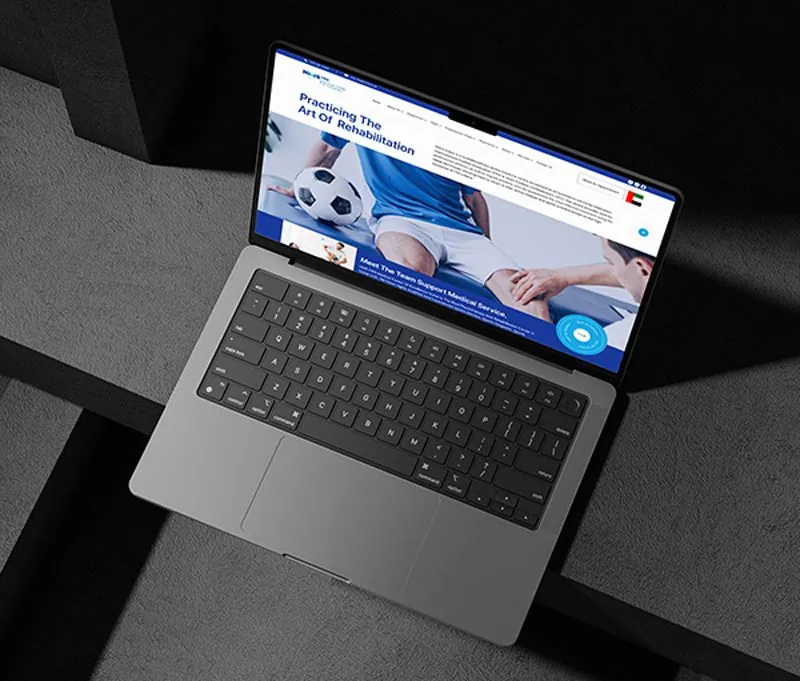
Website · Healthcare · Dubai
A Dubai rehabilitation and physiotherapy practice with one properly bilingual site in English and Arabic.
hmsfmce.com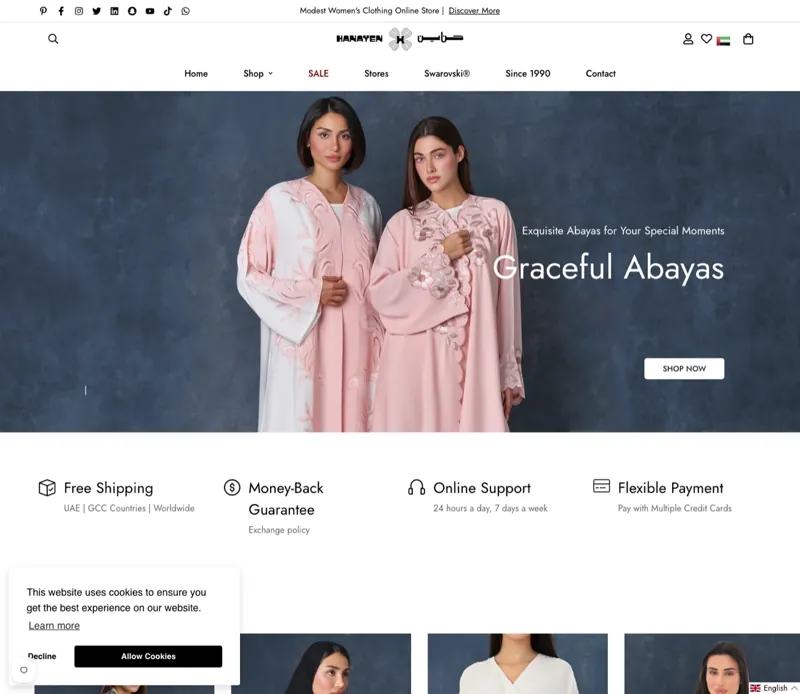
E-commerce · Fashion · Dubai
A Dubai luxury abaya house trading since 1990, carrying its craftsmanship into a quick mobile checkout.
hanayen.com
E-commerce · Retail · Dubai
A Dubai floral boutique on WooCommerce, built around a fast checkout for a gift driven market.
thegorgeousflower.comStraight answers
If any treatment on the menu is a medical or therapeutic service under a Dubai Health Authority facility licence, we display the facility licence detail the DHA expects near that treatment, and list which staff hold an individual DHA practitioner permit. A relaxation only spa without medical claims does not carry this requirement, but check your own facility category with the DHA before publishing, since categories change.
Yes, a deposit or prepayment field can sit inside the booking flow. Your deposit and cancellation policy needs to be written out in plain language next to that field, since UAE consumer protection law voids contract terms that unfairly deny a consumer a refund.
We connect the site to a booking system that holds real therapist calendars, room availability and treatment duration, so a client cannot book a ninety minute massage into a forty five minute slot. Which booking system fits depends on how many rooms and therapists you run.
Yes. Packages, memberships and gift vouchers can be built as products with their own expiry and redemption rules, though the payment and voucher logic itself sits with the booking or ecommerce platform, not the page design.
Only your own photographs of your own rooms and staff, taken with consent. Stock photography of generic spa scenes is common on spa sites in Dubai and tends to look identical from one competitor to the next, which is a poor way to earn trust before a first visit.
Sources
Fixed price, in writing
Got it. Your quote is being written now.
In business hours you will have it within 45 minutes. Check your inbox for the confirmation.